Jugend Magazine

jugend.jpg

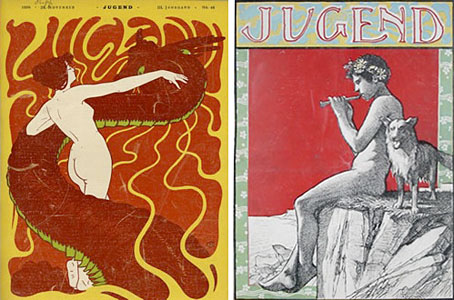
Two of several cover illustrations by Hans Christiansen (1866–1945) for 1898 issues of Jugend magazine. I waited a long time for someone to put together a site devoted to Jugend and good as this one is I can’t help but wish it was as thorough as the Simplicissimus site. Jugend is a regular fixture in histories of Art Nouveau since it was the magazine’s promotion of the new graphic style which gave the movement a name in Germany, Jugendstil. The covers look strikingly advanced today in the way they vary their style and the presentation of the magazine title from one week to the next. The monotonous branding of contemporary magazines seems staid in comparison. Christiansen’s swirling title design shows why these covers had such an influence on the psychedelic poster art of the 1960s. You can see a larger copy of that cover here and a further 299 drawings and paintings by the artist here.

Elsewhere on { feuilleton }
The illustrators archive

Previously on { feuilleton }
Meggendorfer’s Blatter
Simplicissimus

The art of Ryan Martin

martin1.jpg

To Live and Die in LA.

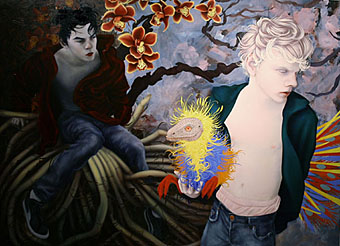
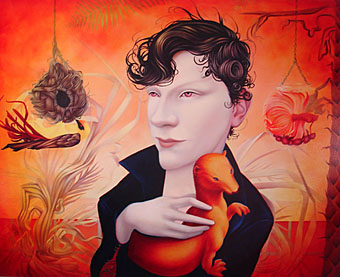
I really like Ryan Martin’s beautiful paintings of fey youths in vibrant, vaguely surreal scenarios. Those familiar with the work of Leonardo da Vinci may recognise Please, Please, Please Let Me Get What I Want as being based on The Lady with an Ermine (1490). There isn’t a great deal of Martin’s work around since he’s only just starting out but you can see more of it at Mark Wolfe Contemporary Art.

martin3.jpg

Please, Please, Please Let Me Get What I Want.

martin2.jpg

Cupid de Locke.

The art of Maxwell Armfield, 1881–1972

armfield1.jpg

De Profundis.

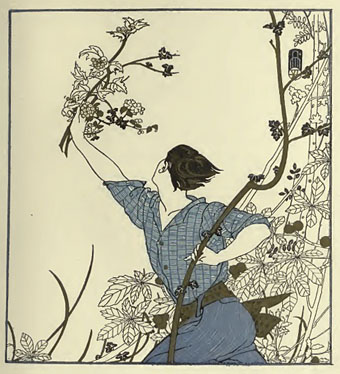
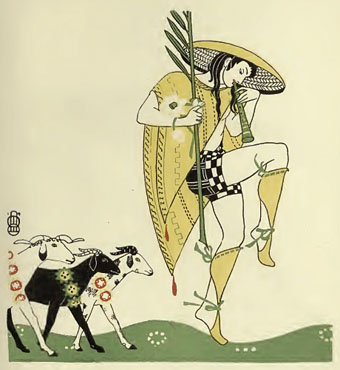
I’ve known Maxwell Armfield’s work in the past mainly for the appearance of his paintings in books of late Victorian or even Pre-Raphaelite art. His depiction of Faustine (1904), which illustrates a Swinburne poem, is probably the most popular of these, with a subject resembling Rossetti’s portraits of Jane Morris. So it’s a surprise to find his illustration work using a very different, more open style based on Ancient Greek art and (possibly) Classical enthusiasts such as John Flaxman. Among the online examples, the redoubtable Internet Archive has a few book downloads available including a volume of Armfield’s rather tepid poetry, The Hanging Garden, and other verse (1914), which nonetheless includes the fine illustrations shown here. In addition there’s a curious fable by Vernon Lee, The Ballet of the Nations; a Present-day Morality (1915) in which Death stages a ballet (aka another war) to decimate humanity, and a short book Rhythmic Shape; A Text-book of Design (1920), Armfield’s guide to art and design theory.

armfield2,jpg

“Out of the East he came.”

Elsewhere on { feuilleton }
The illustrators archive