Prince Iskandar’s horoscope

iskandar.jpg

The horoscope of Prince Iskandar, grandson of Tamerlane, the Turkman Mongol conqueror, by Imad al-Din Mahmud al-Kashi, showing the positions of the heavens at the moment of Iskandar’s birth on 25th April 1384.

From the Wellcome Trust image collection. Considering the Wellcome Trust’s medical background, there’s a surprising amount of non-scientific material in its image library, not least a collection devoted to Witchcraft. This perhaps reflects the wide-ranging interests of the Trust’s founder, Henry Wellcome. Jay Babcock and I visited the exhibition of artefacts from Wellcome’s vast collection at the British Museum in 2003 and that proved to be a similarly surprising cabinet of curiosities, including sheets of tattooed human skin and Charles Darwin’s skull-headed walking stick. I was sure I had a photograph of the latter but don’t seem able to find it if it’s still around. Never mind, the BBC has a picture, together with other items from the exhibition. Also on display there was a specially-commissioned film from the Brothers Quay which can now be seen in their DVD collection.

Via Boing Boing.

Previously on { feuilleton }
Calligraphy by Mouneer Al-Shaárani
The Brothers Quay on DVD
The Journal of Ottoman Calligraphy
Word into Art: Artists of the Modern Middle East
The Atlas Coelestis of Johann Gabriel Doppelmayr

Architectural renderings by HW Brewer

brewer1.jpg

Birds-eye view of Birmingham in 1886.

brewer3.jpg

Rome in 1890.

There’s little information online about HW Brewer, a Victorian illustrator who specialised in depictions of cities viewed from the air for magazines such as The Builder. He also imagined how cities might have looked in times past, as with these views of London in the sixteenth century. Always fascinating to see the lack of development south of the river in the days when there was only one bridge available for traffic over the Thames.

Update: bigger copy of the Birmingham picture here.

Elsewhere on { feuilleton }
The etching and engraving archive
The illustrators archive

Boys Own Books

boys_own1.jpg

boys_own2.jpg

boys_own3.jpg

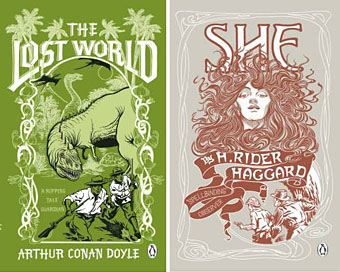
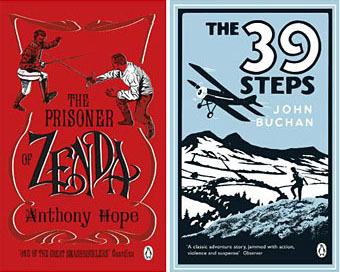
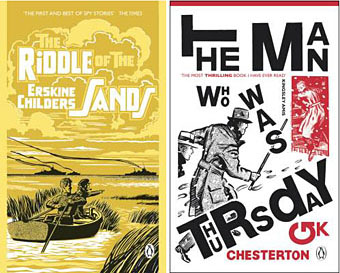
More pulp revenants come blinking back into the light. The runaway success of The Dangerous Book for Boys among fathers as well as sons has set British publishers casting about for new ways to exploit masculine nostalgia. Repackaging a few old warhorses is Penguin’s solution and a cheap one since most (all?) of these titles are out of copyright. I like these covers (and can’t find a design credit unfortunately), they’re well done, capture the right tone and look great as a set.

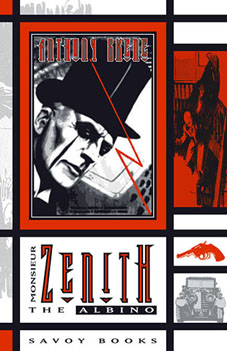
zenith.jpgThe Man Who Was Thursday seems to be the odd man out (as it were) story-wise. All the other books are typical adventure fare but in Chesterton’s novel what appears at first to be a pot-boiler turns out to be a metaphysical allegory closer to Charles Williams than John Buchan. One of Sax Rohmer‘s Fu Manchu volumes would have been more suited to this series but I suspect their “Yellow Peril” racism makes that less easy today. The Chesterton cover is curiously out-of-synch too, a pastiche of El Lissitzky/Bauhaus styles rather than the Edwardian designs the others are imitating. This isn’t a mistake, however, the fractured lettering suits a tale of anarchists with a plot full of twists and surprises. I tried a similar Modernist approach in 2001 with my jacket for Savoy’s edition of Zenith the Albino. In that instance the style was derived from Mondrian, with the colours coming from the initial description of the albino’s black clothes, white skin and red eyes. I’d venture to suggest that Anthony Skene’s thriller is a far better book than all of the above, Chesterton included, but then I am rather biased.

Update: Coralie from Penguin has the credits in the comments.

Elsewhere on { feuilleton }
The book covers archive

The art of NoBeast

nobeast1.jpg

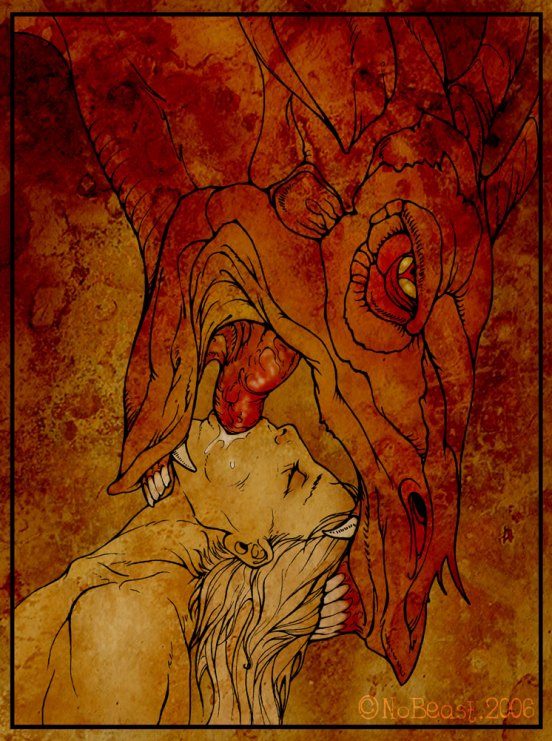
It’s not every day you get to post graphic demon porn but this is such a day so consider yourself duly warned about the content. I’ve no idea who NoBeast is since no one seems to know. Given what’s being depicted here—among other things, a rare gay take on the unique Japanese tentacle rape fetish—the anonymity might be understandable but the quality of the drawing is certainly good enough for the artist to reveal his or herself publicly. This may be the work of a moonlighting commercial artist unwilling to compromise their day job. Who knows?

Continue reading “The art of NoBeast”

The art of Andrey Avinoff, 1884–1949

avinoff1.jpg

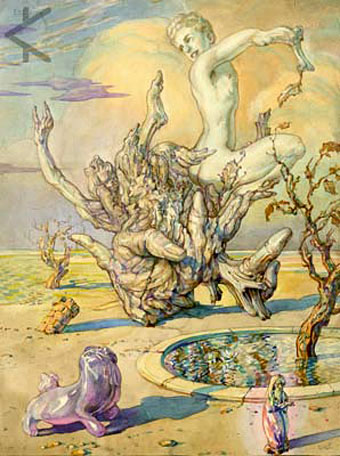
Man Emerging from a Tree Stump (no date).

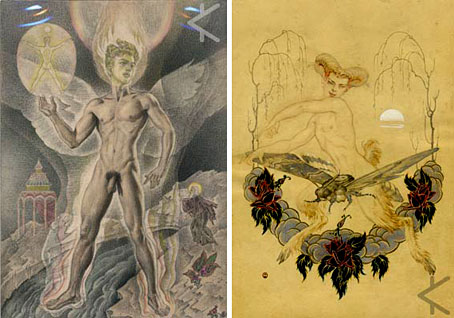
Yet another artist I’d be unlikely to have come across had it not been for the web. Andrey Avinoff’s art manages to be both mystical and homoerotic in equal measure and there’s a good selection of his paintings and drawings to be found in a collection at the Kinsey Institute. Avinoff was an entomologist and worked as director of the Carnegie Museum along with that other famous butterfly enthusiast, Vladimir Nabokov. He was also a friend of Alfred Kinsey’s for many years and the art which Kinsey collected seems (perhaps inevitably) more sexual than the artist’s mystical work or his butterfly pictures. As with other artists discussed here, we learn that “he may have been homosexual”, an equivocation which seems particularly silly when looking at his study of a (naked) young man entitled My Special Longing. He was also a Nijinsky enthusiast and one of his portraits has the dancer as a naked faun bestride an overgrown butterfly.

avinoff2.jpg

left: Standing Nude Man with Figure of Saint (no date); right: Nijinsky (1918).

Continue reading “The art of Andrey Avinoff, 1884–1949”