Butterfly women

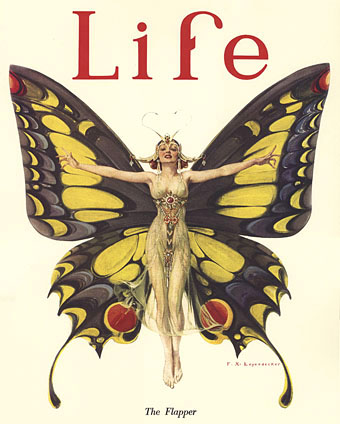
The Flapper by Frank X Leyendecker, Life magazine (1922).

When I posted this splendid cover last July I said that I ought to make a post of Butterfly Women, so here is one. Don’t expect this to be at all comprehensive, women with butterfly wings are as legion as mermaids, these are merely a couple of favourites.

moser_fuller.jpg

Loïe Fuller by Koloman Moser (1901).

The ultimate butterfly woman must be Loïe Fuller (1862–1928) whose Serpentine Dance inspired a host of fin de siècle paintings and sculptures and was also filmed by the Lumière brothers in 1896. The Internet Archive has a tinted copy of the latter while Europa Film Treasures has an Italian short from 1907, Farfale (Butterflies) with a troupe of dancers (also hand-tinted) imitating the Fuller style.

life_benda.jpg

Life magazine cover by Wladyslaw Benda (1923).

These two pictures were discovered via the wonderful Golden Age Comic Book Stories who always has the best scans of vintage art. The Life covers are from the humour periodical which expired in 1936, not the later photojournalism magazine. For more Life covers, look here.

vargas_dragonfly.jpg

Dragonfly by Alberto Vargas (1922).

Okay, so it’s called Dragonfly but those look more like butterfly wings to me. A delicate piece of Vargas cheesecake which echoes the flapper theme of the Leyendecker picture. This Flickr user has a whole set of butterfly girl cigarette cards but we don’t get to see them properly without paying. If anyone has seen them elsewhere, please leave a comment.

Elsewhere on { feuilleton }
The illustrators archive

Previously on { feuilleton }
Mermaids
Wladyslaw Benda
Vintage magazine art II
Vintage magazine art

Darwin at 200

darwin.jpg

Man is But a Worm by Edward Linley Sambourne (1882).

Happy birthday Charles Darwin. The reaction to Darwin’s work from Punch and other journals was typical. While his studies remain controversial among those who believe there were dinosaurs on Noah’s Ark, his life and work are now celebrated on the Bank of England’s Ten Pound Note (but with the wrong kind of bird, it seems). Dogmatists take note: the Vatican is no longer on your side:

Father Giuseppe Tanzella-Nitti, Professor of Theology at the Pontifical Santa Croce University in Rome, said that Darwin had been anticipated by St Augustine of Hippo. The 4th-century theologian had “never heard the term evolution, but knew that big fish eat smaller fish” and that forms of life had been transformed “slowly over time”. Aquinas had made similar observations in the Middle Ages, he added.

He said it was time that theologians as well as scientists grappled with the mysteries of genetic codes and “whether the diversification of life forms is the result of competition or cooperation between species”. As for the origins of Man, although we shared 97 per cent of our “genetic inheritance” with apes, the remaining 3 per cent “is what makes us unique”, including religion.

“I maintain that the idea of evolution has a place in Christian theology,” Professor Tanzella-Nitti added.

Edward Linley Sambourne provided Punch with many caricatures of Victorian notables including the famous one of Oscar Wilde undergoing his own process of evolution by turning into a sunflower.

Dawkins on Darwin

Previously on { feuilleton }
“Weirdsley Daubery”: Beardsley and Punch
The Poet and the Pope

Art Nouveau illustration

stolba.jpg

The cover picture of yesterday’s book purchase complements the month, being a woodcut by Leopold Stolba entitled February from a Ver Sacrum calendar for 1903. The book is Art Nouveau: Posters and Designs (1971), a collection edited by Andrew Melvin for the Academy Art Editions series and the book includes some covers for Jugend magazine which coincidentally was the subject of Monday’s post.

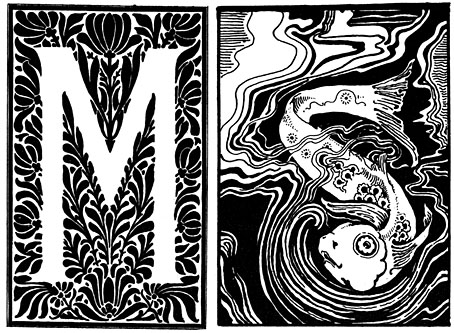
letters.jpg

Ornamental letters from The Studio magazine, 1894; no artists credited.

I wrote about another of the books in the Academy series, The Illustrators of Alice, a couple of years ago and while I don’t really need yet another Art Nouveau book, the presence of a few illustrations I hadn’t seen before made the purchase worthwhile. Further examples follow.

Continue reading “Art Nouveau illustration”

Jugend Magazine

jugend.jpg

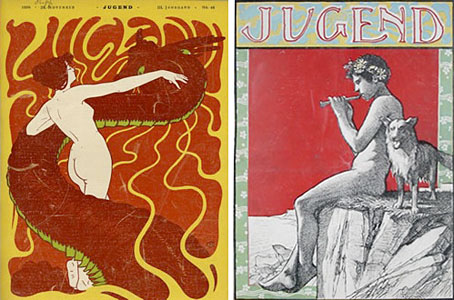
Two of several cover illustrations by Hans Christiansen (1866–1945) for 1898 issues of Jugend magazine. I waited a long time for someone to put together a site devoted to Jugend and good as this one is I can’t help but wish it was as thorough as the Simplicissimus site. Jugend is a regular fixture in histories of Art Nouveau since it was the magazine’s promotion of the new graphic style which gave the movement a name in Germany, Jugendstil. The covers look strikingly advanced today in the way they vary their style and the presentation of the magazine title from one week to the next. The monotonous branding of contemporary magazines seems staid in comparison. Christiansen’s swirling title design shows why these covers had such an influence on the psychedelic poster art of the 1960s. You can see a larger copy of that cover here and a further 299 drawings and paintings by the artist here.

Elsewhere on { feuilleton }
The illustrators archive

Previously on { feuilleton }
Meggendorfer’s Blatter
Simplicissimus

The art of Maxwell Armfield, 1881–1972

armfield1.jpg

De Profundis.

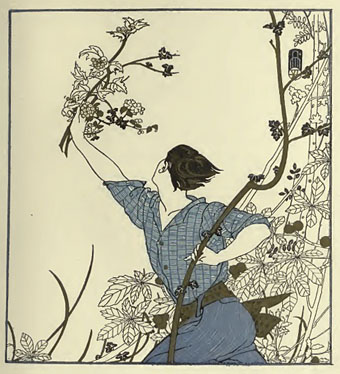
I’ve known Maxwell Armfield’s work in the past mainly for the appearance of his paintings in books of late Victorian or even Pre-Raphaelite art. His depiction of Faustine (1904), which illustrates a Swinburne poem, is probably the most popular of these, with a subject resembling Rossetti’s portraits of Jane Morris. So it’s a surprise to find his illustration work using a very different, more open style based on Ancient Greek art and (possibly) Classical enthusiasts such as John Flaxman. Among the online examples, the redoubtable Internet Archive has a few book downloads available including a volume of Armfield’s rather tepid poetry, The Hanging Garden, and other verse (1914), which nonetheless includes the fine illustrations shown here. In addition there’s a curious fable by Vernon Lee, The Ballet of the Nations; a Present-day Morality (1915) in which Death stages a ballet (aka another war) to decimate humanity, and a short book Rhythmic Shape; A Text-book of Design (1920), Armfield’s guide to art and design theory.

armfield2,jpg

“Out of the East he came.”

Elsewhere on { feuilleton }
The illustrators archive