Antonio Gaudí by Hiroshi Teshigahara

gaudi.jpg

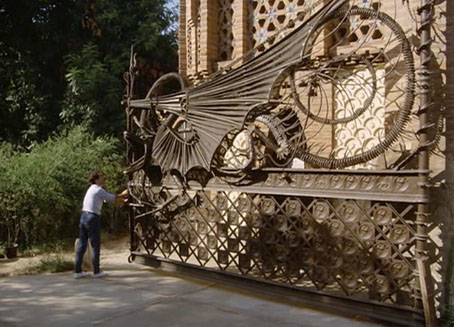
A largely-wordless tour of Gaudí’s architecture by the director of Woman in the Dunes (1964). Like that earlier film this also features a score by the composer Toru Takemitsu. I hadn’t realised before that the famous dragon gate (above) at the entrance to the Parc Güell, Barcelona, was as large as it is.

Teshigahara’s documentary is another film available at Ubuweb.

Previously on { feuilleton }
Atelier Elvira

The slow death of modernism

stpeters1.jpg

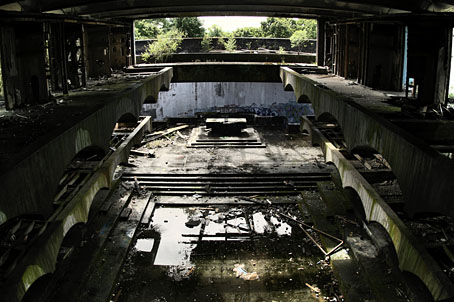
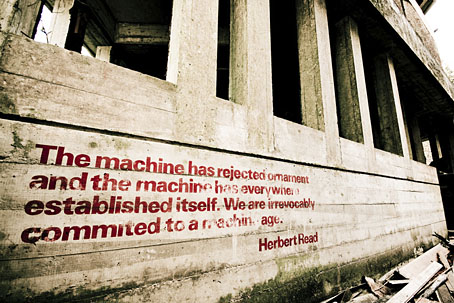
“Soon to be picturesque ruins” was a slogan the Situationists used to enjoy posting on Parisian buildings but their rebuke to architectural hubris can be applied anywhere. St Peter’s College seminary building at Cardross near Glasgow was an example of post-Le Corbusier concrete construction which drew praise for its clean modernity in the 1960s. Today it brings only photographers and graffiti kids to its dereliction. Brian Dillon notes that the seminary

resembles nothing so much as the desolate and sentient “zone” in Andrei Tarkovsky’s 1979 film Stalker: a place where snow falls slowly upon vacant altars, where stagnant pools are so full of rot that they look horribly alive even at the edge of winter, where a startlingly tame robin will perch on your head as you step delicately over the rubble. (More.)

Yes indeed, and Flickr is full of striking examples like these. Someone ought to take advantage of what Dillon calls the seminary’s “futuristic rot” and use the place as a film set before the decay becomes too hazardous or the building is demolished altogether.

stpeters2.jpg

Previously on { feuilleton }
The ruins of Detroit
Ephemeral architecture
The temples of Angkor
St Pancras in Spheroview
• The Stalker meme

Passage des Panoramas

passage.jpg

I thought I might have exhausted this line of pursuit until I decided to search for the Passage des Panoramas, one of the first of the Parisian arcades which so entranced Walter Benjamin. This particular arcade dates from 1799 and was named after the painted panoramas which used to be one of the attractions on an upper floor. The appropriately panoramic view comes from a page of 360º panoramas of some of the more attractive passages couverts of Paris and, as with previous examples here, these are best viewed using the full screen option. On my last trip to Paris I intended to visit some of the arcades but apart from one small place on the Champs-Élysées the ones I tracked down were all closed. Consequently, these photos are the next best thing to being there.

Elsewhere on { feuilleton }
The panoramas archive

Previously on { feuilleton }
Passages 2
Passages

Bruges panoramas

bruges1.jpg

Do you detect a theme here? The 360º Cities site which I linked to yesterday won’t be news to some since its panorama views are now incorporated into Google Earth. I hadn’t fully investigated it before, however, so I wasted some time today wandering the streets of Bruges almost as you would in a computer game thanks to the way the different panoramas are linked. Clicking the arrows or the thumbnail views means you’re immediately transported to the next location. (Needless to say this works best using the full screen option on a large monitor.) The photographs in this instance are by Robin de Baere.

bruges2.jpg

Bruges is another of those waterlogged places with cobbled streets which so beguile me, hence the choice of a Belgian town over more obvious European locations. The light skies in the night shots—a result of long exposures—lend the empty streets some of the same mysterious atmosphere captured by René Magritte in his Empire of Light series. Magritte was Belgian, of course, so it’s rather fitting, as was Paul Delvaux, another painter of noctural mystery.

empire.jpg

Empire of Light by René Magritte (1953–54).

Elsewhere on { feuilleton }
The panoramas archive

Previously on { feuilleton }
Bruges-la-Morte
Taxandria, or Raoul Servais meets Paul Delvaux