
Booklife by Jeff VanderMeer

booklife.jpg

Yet another of the titles I’ve been working on this year—yes, it’s been a very busy time—Booklife took several months of back and forth on the part of author, editor and designer before we had something that everyone was happy with.

Offering timely advice in an era when the burden of production and publicity frequently falls on authors, this essential reference reflects on methods for being focused, productive, and savvy in the craft of writing. Discussing a wide range of essential topics for self-promoting authors, this important guide explores questions such as How can authors use social media and the internet? How does the new online paradigm affect authors, readers, and the book industry? How can authors find the time to both create and promote their work? and What should never be done? Through good-humored encouragement, practical tips of the trade culled from 25 years of experience as a writer, reviewer, editor, publisher, agent, and blogger are shared. Including topics such as personal space versus public space, deadlines, and networking, the benefits of interacting with readers through new technologies is revealed.

After all the work it’s been good to see the book receiving such a positive reception this week, with a feature spot on Boing Boing and a high placing in Amazon’s book listing. Back in February I wrote a lengthy post about the evolution of the cover design, and that post has been reproduced at the Booklifenow site which serves as an online extension of the book itself. Web designer Luís Rodrigues did a great job of matching the site design to the cover.

Update: The cover at unaccountably large size on Wired.com

Previously on { feuilleton }
Designing Booklife

Eyecandy

eyecandy.jpg

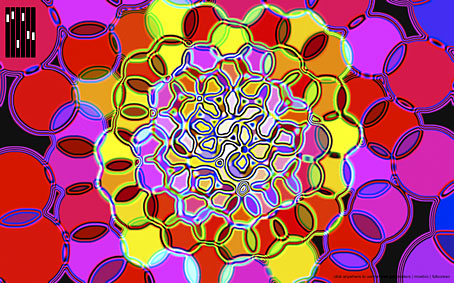
Continuing a rather psychedelic week, Eyecandy is another of those groovy web toys, this time putting you inside a kaleidoscopic sphere of coloured circles whose parameters you can change with sliding controls. Fun to mess with when the right music is playing.

And while we’re on the subject, my new calendar has been selling very well thanks to some generous linkage from Arthur Magazine, Jeff VanderMeer, Boing Boing, Trendhunter, and others. Thanks to everyone who’s bought one, I’ll definitely be following this with something similar, not least a set of illustrations for Through the Looking-Glass. And Jabberwocky, yes, have to do something special for that…

Previously on { feuilleton }
The Kaleidoplex
Colorscreen

The art of Robert Sherer

sherer1.jpg

American Martyr.

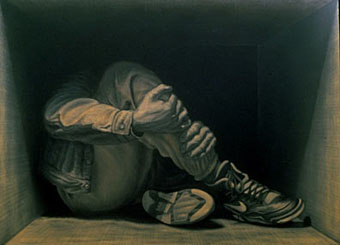
The Sebastian-esque piece above is a pyrograph by American artist Robert Sherer. Pyrographs—pictures burned onto wood—aren’t very common here but are a fixture of craft classes at US summer camps. Sherer adopts the medium to subvert the wholesome orthodoxies of American life, that side of America which persistently stigmatises minorities as “other”, and to resurrect and explore his memories of youthful feelings for other boys.

sherer2.jpg

Newborn.

“Stigma” is an apt word when discussing Sherer’s work. His paintings in the Male Nudes series, of which Newborn (above) is a part, have suffered censorship at the hands of those who found their representations of men in the postures of traditional female nudes to be bizarrely unacceptable. (The tribulations are detailed here.) Then there’s his Blood Works series of symbolic botanical illustrations—some of which are entitled Stigmata—which use HIV+ blood as a medium to explore “the complexities of romantic life and sexual attraction in the HIV era.” The challenge of these works to the viewer makes a considerable change from the usual parade of undressed men which comprise the majority of work by male artists dealing with gay themes.

sherer3.jpg

Condo.

Robert Sherer slideshow at GLBTQ
Robert Sherer at Lyman-Eyer

Elsewhere on { feuilleton }
The gay artists archive

Haeckel fractals

haeckel.jpg

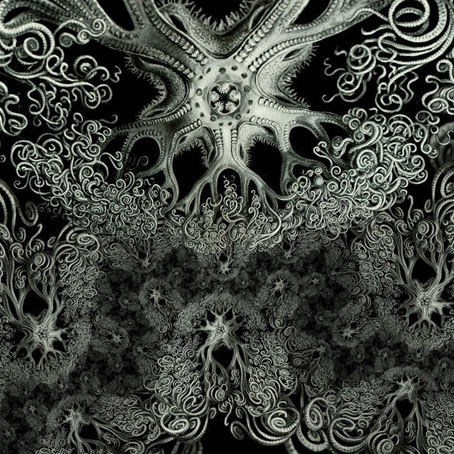
In which Ernst Haeckel’s Art Forms in Nature are given the Mandelbrot treatment. The example above is one of a number of variations created using the splendid Gorgon-headed Starfish, a creature I’ve messed with myself a couple of times.

These fractal images have been created by the Subblue people using their Fractal Explorer plug-in for Adobe’s Pixel Bender Toolkit, both of which are free downloads. I’ve not had chance to play around properly with Pixel Bender but the results here make it seem worth spending time getting to grips with its rather primitive interface.

Previously on { feuilleton }
Ernst Haeckel, Christmas card artist