The best films never made | David Lean’s Nostromo? Michael Powell’s The Tempest?
Author: John
Lumiere at Durham
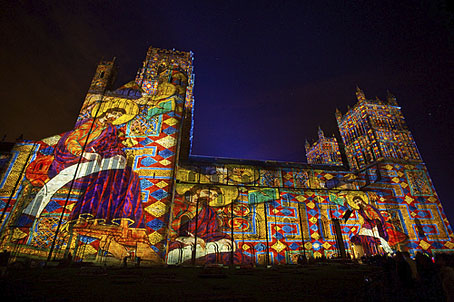
Durham Cathedral as it appeared this weekend as a part of the four-day Lumiere art event which illuminated the cathedral’s already spectacular location with projections and light installations. Flickr has a wide selection of photos documenting the various stages of the event.
The fluorescent bulbs on the banks of the Wear would have dazzled even Dan Flavin, the American founding father of light art. Durham’s river was a riot of neon and sci-fi lasers. What Flavin would make of this display is another matter. Light art has come a long way since the industrial minimalism that saw syncopations of strip bulbs arranged in white gallery spaces. Contemporary artists are using low-emission technology to produce site-specific work on a grand scale. Unlike the postwar modernists, their work has a social function: to transform cities. They are engineers of public space and sculptors of civic identity.
Durham’s Lumiere is part of a growing international movement. The organisers, Helen Marriage and Nicky Webb from the London-based events company Artichoke, loosely modelled the event on an annual Fête des Lumières in Lyon (5–8 December), a festival that hosts 80 light installations and attracts over 4 million tourists every year. (More.)
Previously on { feuilleton }
• Tetragram for Enlargement
• Eno’s Luminous Opera House panorama
• The art of Rune Guneriussen
• Lightmark
• Giant Lantern Festival
• Maximum Silence by Giancarlo Neri
• Volume at the V&A
Nabokov book covers
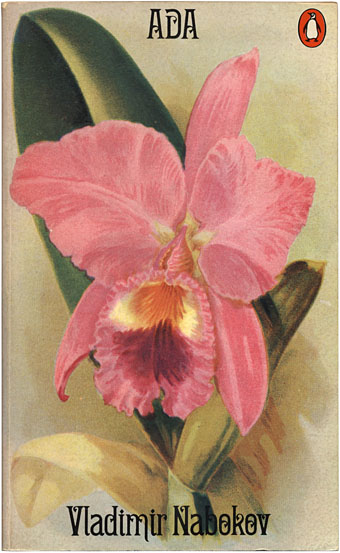
Flowers are the sexual organs of plants, which may have been what designer David Pelham had in mind when he created this cover for the Penguin debut of Nabokov’s densely-written and erotic novel, Ada in 1970. (Butterfly orchids also feature in the text, of course.) The Russian maestro has been unavoidable lately on account of the publication this week of his final, unfinished work, The Original of Laura. The design of the new book by Chip Kidd is slightly more daring than I’d have expected from something which the publisher will be hoping to sell in large quantities, and I’d love to know how much argument was required to push the cover through the marketing department. The contrast between boards and dust jacket is very satisfying and adds value to the book as artefact, a feature impossible to replicate in ebook terms even if this was an ordinary novel rather than sketches on index cards. If people want books to stay physical then smart design needs to be applied a lot more often.
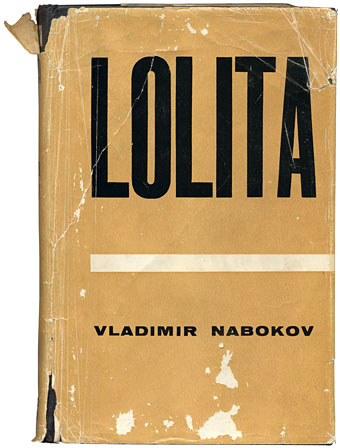
The ragged item above is my battered second edition of the original UK (Weidenfeld & Nicolson) printing of Lolita, now fifty years old and with a cover designed by Eric Ayers. There’s a more pristine copy on display at this comprehensive gallery of Lolita covers, fascinating viewing if you’re interested in seeing how the same book can be presented over 150 editions. From a drab beginning things quickly degenerate into outright salaciousness, a development which would no doubt have dismayed the author. That gallery link comes via Venus febriculosa who recently held a competition to redesign the cover; you can see the results here, many of which are a lot more inventive than the published editions.
Meanwhile, the advent of Nabokov’s final novel has meant that all of his works are being reissued by Vintage. Ace cover designer and art director John Gall was tasked with redesigning the corpus for which he assembled a team of designers and requested that they each fill a butterfly specimen box with material to suit their allotted title. You can see the gorgeous results here. And if that’s not enough Nabokov, you can read Martin Amis taking his favourite author to task over The Original of Laura here.
• The inside story of Nabokov’s last work
Elsewhere on { feuilleton }
• The book covers archive
American inferno
American inferno | David Vann on the malign magnificence of Blood Meridian.
Luke Smalley memorial exhibition
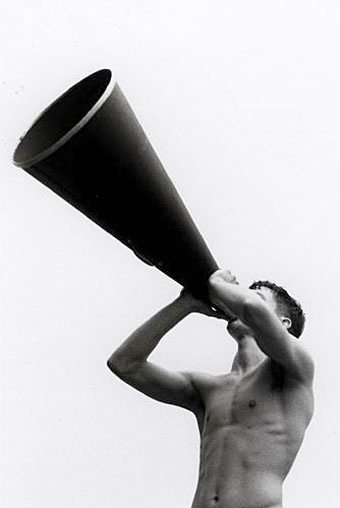
Megaphone from Gymnasium.
I wasn’t aware that photographer Luke Smalley had died prematurely this year until a brief post I’d made about his work started getting hits from an obituary piece at the NYT. Bill O’Connor of Wessel + O’Connor emailed this weekend with news of a showing of Smalley’s final photo series, Sunday Drive, at Clampart, NYC. As with earlier series such as Gymnasium (2000), there’s also a monograph available from Twin Palms Publishers.
Luke Smalley: Sunday Drive—A Memorial Exhibition runs until December 19, 2009.

Medicine Ball from Gymnasium.
Previously on { feuilleton }
• Luke Smalley