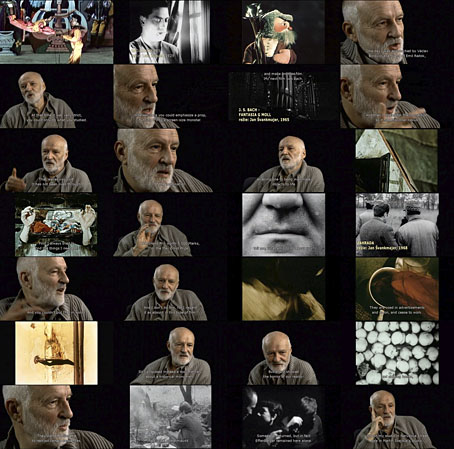
Don Juan, a film by Jan Švankmajer

svankmajer.jpg

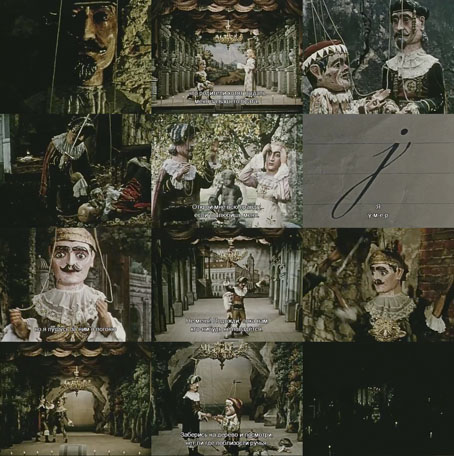
I’ve been reading Thomas Ligotti for the past week so here’s something Ligottian: a short film performed by life-size wooden puppets. Švankmajer’s production from 1969 conveys the Don Juan legend with actors masquerading as traditional Czech marionettes, the proceedings being scored by music from the great Zdeněk Liška. No English subtitles on this one so if you don’t speak Czech or Russian you can either relish the mystery or take it as a prompt to buy a DVD. While we’re on the subject of Ligotti, the new Penguin edition of Songs of a Dead Dreamer/Grimscribe is published next week. I recommend it.

Previously on { feuilleton }
The Pendulum, the Pit and Hope
Two sides of Liška
The Torchbearer by Václav Švankmajer
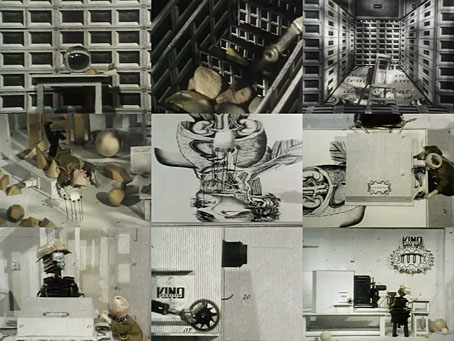
The Cabinet of Jan Švankmajer, a film by the Brothers Quay

quays1.jpg

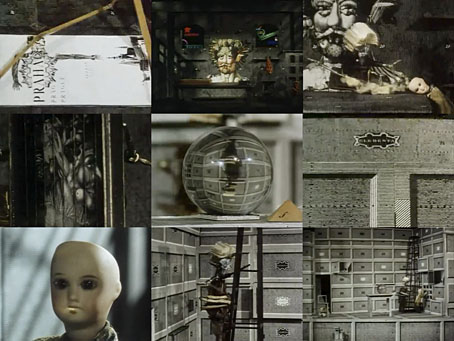
A busy week here (for a change) so this is a bit of a lazy choice but there is a Wunderkammer present. The Quays made this in 1984 for a Švankmajer documentary, and it’s still one of my favourites: Švankmajer as subject, lots of Prague references, and wonderful music (borrowed from Švankmajer’s own films) by Zdeněk Liška. This is also one of the few films you’ll see with animated characters demonstrating some film animation of their own. Watch it here.

quays2.jpg

Elsewhere on { feuilleton }
The Quay Brothers archive

Animated Self-Portraits

portraits.jpg

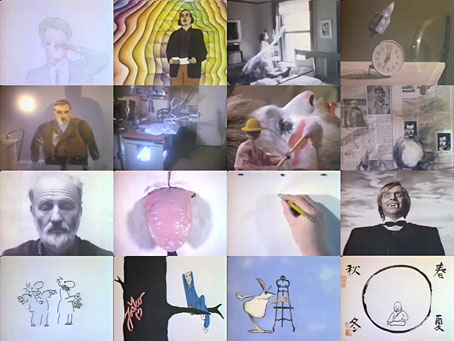
Another animated anthology, this one being a brief collection of self-portraits of around 10 to 20 seconds each. Like yesterday’s short film, Animated Self-Portraits (1989) was produced by David Ehrlich who contributes a portrait of his own. I’m not enough of an aficionado to recognise all the names involved but the contingent from Czechoslovakia (as it was then) includes Jan Švankmajer and Jiří Barta. More of an entertaining piece than Academy Leader Variations even if you aren’t familiar with the animators.

Previously on { feuilleton }
Academy Leader Variations
42 One Dream Rush

Dunsany’s highwaymen

pledge.jpg

The Pledge.

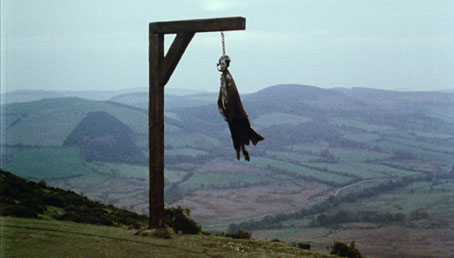
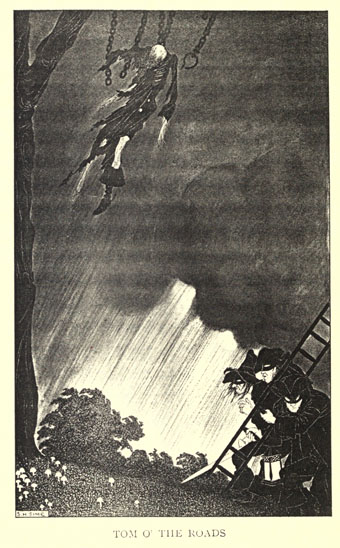
As mentioned last week, the BFI’s DVD of Schalcken the Painter includes as extras two short films by other directors. Edward Abraham’s The Pit (1962) is an adaptation of Poe’s The Pit and the Pendulum which is creditable but lacks the sustained malevolence of Jan Švankmajer’s version. The second film is The Pledge (1981), a 21-minute adaptation by Digby Rumsey of The Highwaymen, a short story by Lord Dunsany. This is unusual for being one of the very few film adaptations of Dunsany, Rumsey being responsible for two others: Nature and Time (1976), and In the Twilight (1978). Since this is a low-budget work it’s no surprise that the story is a historical piece rather than one of the florid fantasies so beloved of HP Lovecraft. A trio of highwaymen decide to rescue the hanging body of their former comrade and inter it in a bishop’s tomb. (The bishop’s bones, they decide, can go in the earth.) The story is so slight it’s more of a curio than anything, and would probably be better seen along with with the other Dunsany adaptations. Of note is a typically jaunty score by Michael Nyman, while Nyman’s later collaborator, Peter Greenaway, assisted with the editing. If nothing else, Greenaway would have appreciated the film’s macabre nature.

sime.jpg

Illustration for The Highwaymen by Sidney Sime.

The original story appeared in Dunsany’s 1908 collection The Sword of Welleran and Other Stories. The Internet Archive has a scan of the entire book with illustrations from Sidney Sime’s prime period. The depiction of the scene at the gibbet is a lot more atmospheric than in the film but then that’s the advantage of the illustrator: there’s no need to worry about a budget.

Previously on { feuilleton }
Schalcken the Painter revisited
The Pendulum, the Pit and Hope
Sidney Sime paintings
Haschisch Hallucinations by HE Gowers
Sidney Sime and Lord Dunsany

The Pendulum, the Pit and Hope

pendulum1.jpg

The Pendulum, the Pit and Hope (1983) is the third and best of three Gothic shorts made by Jan Švankmajer, the two earlier works being Castle of Otranto (1973–79) and The Fall of the House of Usher (1980). Švankmajer combines Poe’s famous tale of Inquistion torment with A Torture by Hope by Auguste Villiers de L’Isle-Adam, and  unlike Corman and co. reduces the story to a stark and wordless first-person ordeal in the face of clanking, fire-breathing engines of destruction. Poe’s story lets the narrator off the hook with a deus ex machina intervention, something Švankmajer evidently felt unable to swallow, hence the Villiers coda.

All the above works, and much more besides, can be found on the BFI’s collection of Švankmajer’s short films. Another short adaptation of the Poe story, The Pit (1962) by Edward Abraham, will appear next month as an extra on the eagerly-awaited DVD/BR debut of Schalcken the Painter.

pendulum2.jpg

Previously on { feuilleton }
Two sides of Liška
The Torchbearer by Václav Švankmajer