Chess players

chess10.jpg

Chess Problem 25 (13th century), from El Libro de los Juegos.

Chess-playing in art. Some of it, anyway. I hadn’t realised until I went searching for examples how many paintings there are of people playing chess. The prompt for this was my current reading, The Flanders Panel, a novel from 1990 by the Spanish author Arturo Pérez-Reverte. Arturo likes his art mysteries, as you’ll know if you’ve read The Club Dumas, an excellent novel that was reworked for cinema as The Ninth Gate. The chess game in The Flanders Panel is the subject of a painting by a fictional Flemish artist, Pieter Van Huys. Pérez-Reverte presents a biography of the artist and the three people depicted in the painting, with special attention given to the game of chess which gives the painting its title, a game which may or may not provide clues to a 15th-century murder mystery. Pérez-Reverte describes the painting itself in detail; Julia, the main character is a picture restorer so the descriptions extend to physical materials. Some of the novel’s cover designs have attempted to depict Van Huys’s picture, with unsuccessful results. There’s also a 1994 film adaptation, Uncovered, which I haven’t yet seen.

chess06.jpg

The Chess Player (no date) by Isidor Kaufmann.

I’ll admit to not having thought very much about chess-playing in art until the conversation in the novel turned to the subject of the painted game, and the question of whether or not the position of the pieces had anything to say about the people in the picture. (Pérez-Reverte helpfully includes a diagram that shows the layout of the board.) There’s no reason why a game of chess shouldn’t be used for semiotic reasons even if this is only to indicate the power relationship within a picture by making one party the dominant player. Given the ease with which this can be done I’d guess there are many such examples that use the game to communicate something about the players beyond the fact that they enjoy playing chess. If you’re painting a chess game you’re always going to be faced with the question of how you position the pieces, a problem that leads in turn to decisions about who should be shown to be winning or losing via the number of pieces and their placement on the board. Western art is replete with pictorial symbolism involving animals, plants, birds, colours, and so on; if the very old and very familiar game of chess is added to the symbolic repertoire then we’re left to decide which paintings are using the game for incidental reasons, and which have something more to communicate.

chess09.jpg

An Interesting Problem (no date) by Adolphe-Alexandre Lesrel.

In making a picture selection I’ve looked for paintings that clearly show the position of the pieces on the board, as well as those which depict the game with some accuracy. It becomes apparent when you examine many paintings on this subject that some artists don’t seem too familiar with the details of the game, a common error being the mispositioned board. This could also have a symbolic meaning, of course, but I’ll leave that question for others to explore. As a final note, Marcel Duchamp had a thing for chess.

chess05.jpg

Ein schwieriger Zug Öl auf Holz (no date) by Albert Joseph Franke.

chess11.jpg

Die Schachspieler (Faust und Mephisto) (1834) by Moritz Retzsch.

Continue reading “Chess players”

The hashish eaters of Monte Cristo

dumas.jpg

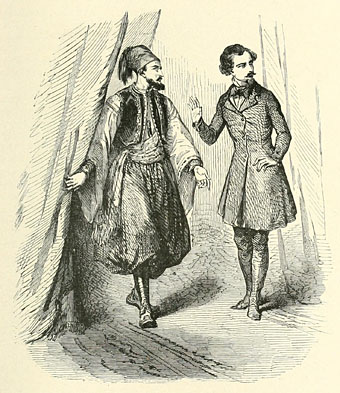
Illustration by Pierre-Gustave-Eugène Staal.

I mentioned at the weekend that my current reading is the Dumas père doorstop The Count of Monte Cristo. One of the things I enjoy about reading novels like these that “everyone knows” (ie: everyone knows mostly from truncated film or television adaptations) is finding something surprising about the story that you’ve never seen mentioned before. The following passage from chapter 31 turns out to be quite well-known as it happens, but only to those who’ve read the original text, not the Reader’s Digest version.

The story so far: Baron Franz d’Épinay has hired a boat to take him to the uninhabited Mediterranean island of Monte Cristo where he hopes to do a spot of hunting. On reaching the island Franz and his crew discover a small group of bandits camped there, with a leader dressed in Arabian clothes. This man—our hero, Edmond Dantès—insists on concealing his identity with a pseudonym, “Sinbad the Sailor”, and suggests that Franz might wish to do the same. The latter chooses the name “Aladdin”, and the pair retire to a sumptuously decorated cave for an evening meal. When the meal is over “Sinbad” offers “Aladdin” a special treat:

“You cannot guess,” said he, “what there is in that small vase, can you?”

“No, I really cannot.”

“Well, then, that green preserve is nothing less than the ambrosia which Hebe served at the table of Jupiter.”

“But,” replied Franz, “this ambrosia, no doubt, in passing through mortal hands has lost its heavenly appellation and assumed a human name; in vulgar phrase, what may you term this composition, for which, to tell the truth, I do not feel any particular desire?”

“Ah, thus it is that our material origin is revealed,” cried Sinbad; “we frequently pass so near to happiness without seeing, without regarding it, or if we do see and regard it, yet without recognizing it. Are you a man for the substantials, and is gold your god? taste this, and the mines of Peru, Guzerat, and Golconda are opened to you. Are you a man of imagination—a poet? taste this, and the boundaries of possibility disappear; the fields of infinite space open to you, you advance free in heart, free in mind, into the boundless realms of unfettered reverie. Are you ambitious, and do you seek after the greatnesses of the earth? taste this, and in an hour you will be a king, not a king of a petty kingdom hidden in some corner of Europe like France, Spain, or England, but king of the world, king of the universe, king of creation; without bowing at the feet of Satan, you will be king and master of all the kingdoms of the earth. Is it not tempting what I offer you, and is it not an easy thing, since it is only to do thus? look!”

At these words he uncovered the small cup which contained the substance so lauded, took a teaspoonful of the magic sweetmeat, raised it to his lips, and swallowed it slowly with his eyes half shut and his head bent backwards. Franz did not disturb him whilst he absorbed his favourite sweetmeat, but when he had finished, he inquired:

“What, then, is this precious stuff?”

“Did you ever hear,” he replied, “of the Old Man of the Mountain, who attempted to assassinate Philippe Auguste?”

“Of course I have.”

“Well, you know he reigned over a rich valley which was overhung by the mountain whence he derived his picturesque name. In this valley were magnificent gardens planted by Hassen-ben-Sabah, and in these gardens isolated pavilions. Into these pavilions he admitted the elect, and there, says Marco Polo, gave them to eat a certain herb, which transported them to Paradise, in the midst of ever-blooming shrubs, ever-ripe fruit, and ever-lovely virgins. What these happy persons took for reality was but a dream; but it was a dream so soft, so voluptuous, so enthralling, that they sold themselves body and soul to him who gave it to them, and obedient to his orders as to those of a deity, struck down the designated victim, died in torture without a murmur, believing that the death they underwent was but a quick transition to that life of delights of which the holy herb, now before you, had given them a slight foretaste.”

“Then,” cried Franz, “it is hashish! I know that—by name at least.”

“That is it precisely, Signor Aladdin; it is hashish—the purest and most unadulterated hashish of Alexandria—the hashish of Abou-Gor, the celebrated maker, the only man, the man to whom there should be built a palace, inscribed with these words, A grateful world to the dealer in happiness.”

“Do you know,” said Franz, “I have a very great inclination to judge for myself of the truth or exaggeration of your eulogies.”

“Judge for yourself, Signor Aladdin—judge, but do not confine yourself to one trial. Like everything else, we must habituate the senses to a fresh impression, gentle or violent, sad or joyous. There is a struggle in nature against this divine substance—in nature which is not made for joy and clings to pain. Nature subdued must yield in the combat, the dream must succeed to reality, and then the dream reigns supreme, then the dream becomes life, and life becomes the dream. But what changes occur! It is only by comparing the pains of actual being with the joys of the assumed existence, that you would desire to live no longer, but to dream thus forever. When you return to this mundane sphere from your visionary world, you would seem to leave a Neapolitan spring for a Lapland winter—to quit paradise for earth—heaven for hell! Taste the hashish, guest of mine—taste the hashish.”

Franz does as requested and thereafter passes the night in an erotic delirium. The whole sequence is an example of the personal preoccupations of the author entering his fiction, Dumas having been a member of the Club des Hashishins in Paris, whose monthly “séances” took place at a hotel on the Île Saint-Louis. Other members of the club included Victor Hugo, Charles Baudelaire, Gérard de Nerval, and Honoré de Balzac. The “magic sweetmeat” which Franz is offered was just that, a greenish paste from Algeria known as Dawamesc which disguises the bitter taste of the hashish with honey, pistachio and spices. (This page has a recipe should you require it.) Reading about the history of the hashish club I see that the hotel was located on the Quay d’Anjou, the river-facing street which is also the location of Baroness Ungern’s occult library in The Dumas Club by Arturo Pérez-Reverte. The Dumas thread in that novel (which is omitted from the film adaptation, The Ninth Gate) concerns rare manuscript pages of the “Anjou Wine” chapter from The Three Musketeers yet I don’t recall any mention of the Club des Hashishins in the story. I wish now I’d known all this before I spent a week in Paris; the Île Saint-Louis was one of my favourite places in the city, and I walked along the Quay d’Anjou one evening, photographing the river views.

Further reading: Franz d’Épinay’s night of dreams is recounted in The Green Jam of Doctor X, an essay by Mike Jay which explores the history of the literary hashish club.

Previously on { feuilleton }
More trip texts
The Art of Tripping, a documentary by Storm Thorgerson
Haschisch Hallucinations by HE Gowers

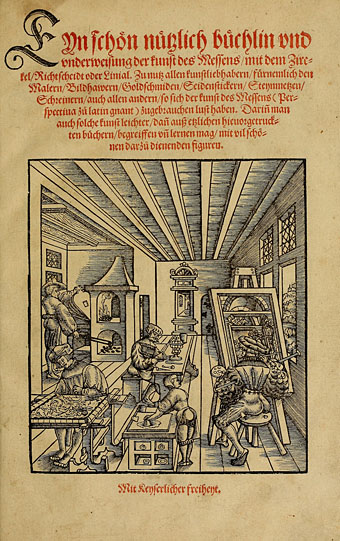
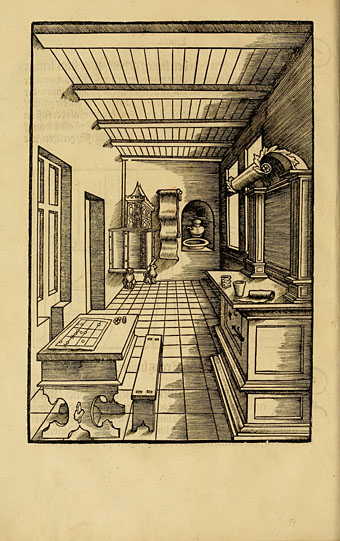
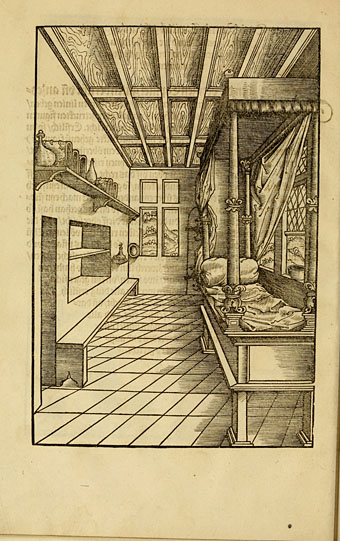
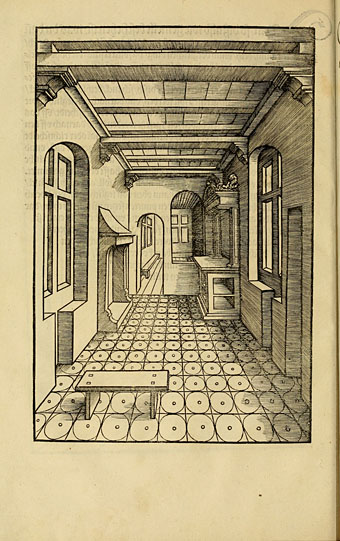
Rodler’s Fine, Useful Booklet

rodler01.jpg

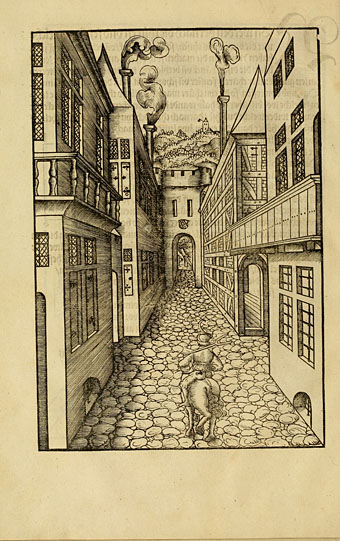
Another treatise on perspective, and an older one than Pozzo’s so the drawings are somewhat cruder. Eyn schön nützlich büchlin und underweisung der kunst des Messens (A Fine, Useful Booklet and Instruction in the Art of Measurement) by Hieronymus Rodler was published in 1531, and features a number of full-page views where the perspective is accurate but also alarmingly severe in places. The emptiness and unusual appearance of the scenes has an unintentional charm, they remind me of the illustrations from The Dumas Club (1993) by Arturo Pérez-Reverte where the mysterious drawings—based on old alchemical illustrations—contain subtle variations. Rodler’s book made an appearance at Giornale Nuovo in 2005 so I’ll point you there for further discussion of its technical qualities. The book itself may be browsed here or downloaded here.

rodler02.jpg

rodler03.jpg

rodler04.jpg

rodler05.jpg

Continue reading “Rodler’s Fine, Useful Booklet”

Polanski details

polanski01.jpg

Roman Polanski as Alfred in Dance of the Vampires (1967).

I’ve always admired the attention to detail in Roman Polanski’s films, a quality evident not only in his careful adaptations but also in areas that lesser filmmakers might ignore. Dance of the Vampires (1967) is a good example (sorry, I refuse to call it by the title MGM used for its edited US release): the sets and decor are remarkable, and the editing and camera work so skilfully blends studio constructions with location shots that for years I was convinced the film was made in a genuine European castle. The atmosphere is so carefully sustained that I found the whole thing as terrifying on first viewing as any Hammer film, despite the broad humour. In the set-piece moments Polanski (and soundtrack composer Krzysztof Komeda) put many of the later Hammer vampire films to shame.


The Vampire Portraits

polanski02.jpg

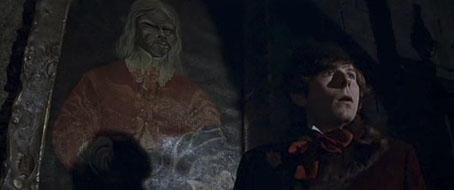
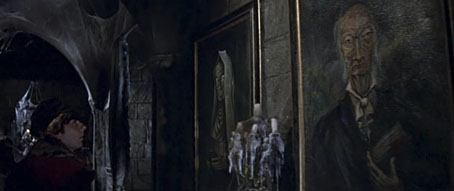
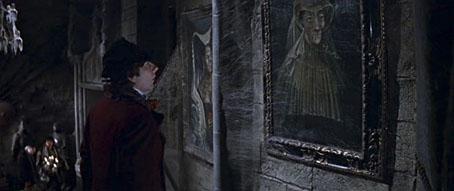
The production design and art direction for Dance of the Vampires was created by Wilfred Shingleton and Fred Carter, both of whom later worked on Polanski’s Macbeth, and who fill the rooms with mouldering furnishings and rotting decoration. One striking sequence concerns a walk through a gallery of vampire portraits that are the creepiest paintings seen on film since Ivan Albright’s portrait of a decrepit Dorian Gray. Film credits in the 1960s were sparse so there’s no indication of the artist responsible. However, one portrait glimpsed at the end of the gallery (below) is a copy of the “Ugly Duchess” painting by Quinten Matsys.

polanski03.jpg


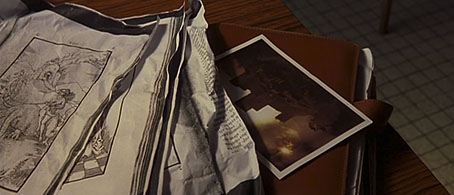
Rosemary’s Book

polanski04.jpg

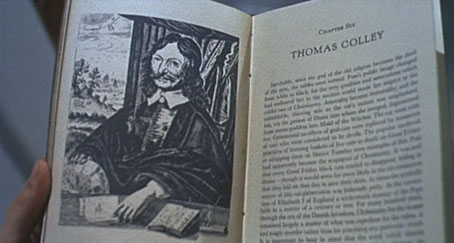
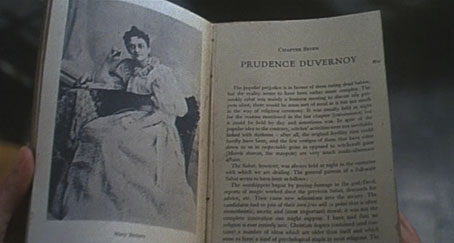
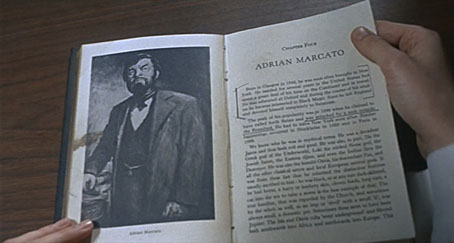
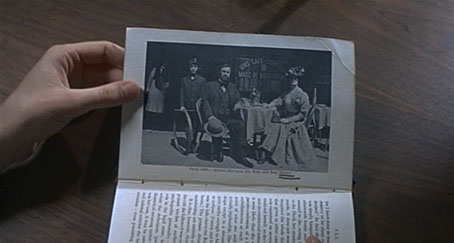
A sign that filmmakers care about detail is when they make their fictional books look like the genuine article. The history of witchcraft in Rosemary’s Baby (1968) could easily have been glimpsed very briefly but Polanski shows Rosemary leafing through its pages in a sequence of Hitchcock-like view-reaction-view shots that make it appear as convincing as possible. The shots also make the viewer examine the book through Rosemary’s eyes, something Polanski does throughout the film.

polanski05.jpg

polanski06.jpg

polanski07.jpg


Trelkovsky’s Paintings

polanski09.jpg

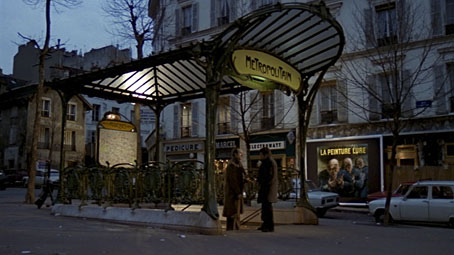
The Tenant (1976) is Polanski’s third study of apartment-dwelling paranoia, a superb adaptation of Roland Topor’s novel, Le Locataire chimérique (1964). The screenplay removes some of Topor’s ambiguity—and the film is spoiled by unsympathetic dubbing of the French actors—but in every other respect it’s as good as Repulsion for its portrait of an isolated individual (here portrayed by Polanski himself) surrendering to madness.

polanski10.jpg

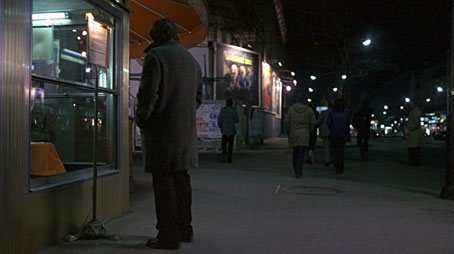
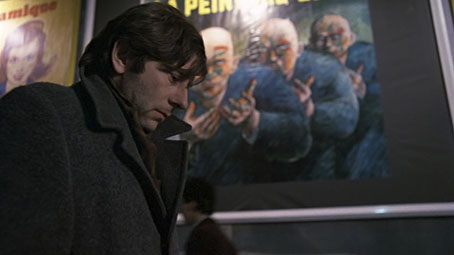
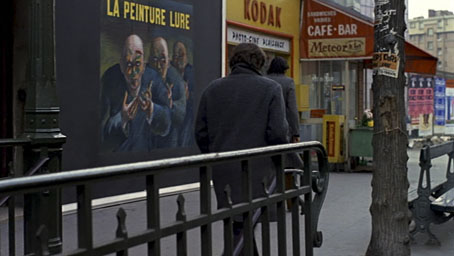
Among the many visual details which add to the unease is the appearance halfway through the film of billboards advertising…what? A painting exhibition? Or something more sinister? We never find out. The presence of these figures and their slogan—”La Peinture Lure”—remains as cryptic as many of the other unresolved questions which prey upon the beleaguered Trelkovsky.

polanski11.jpg

polanski12.jpg


Corso’s Postcard

polanski13.jpg

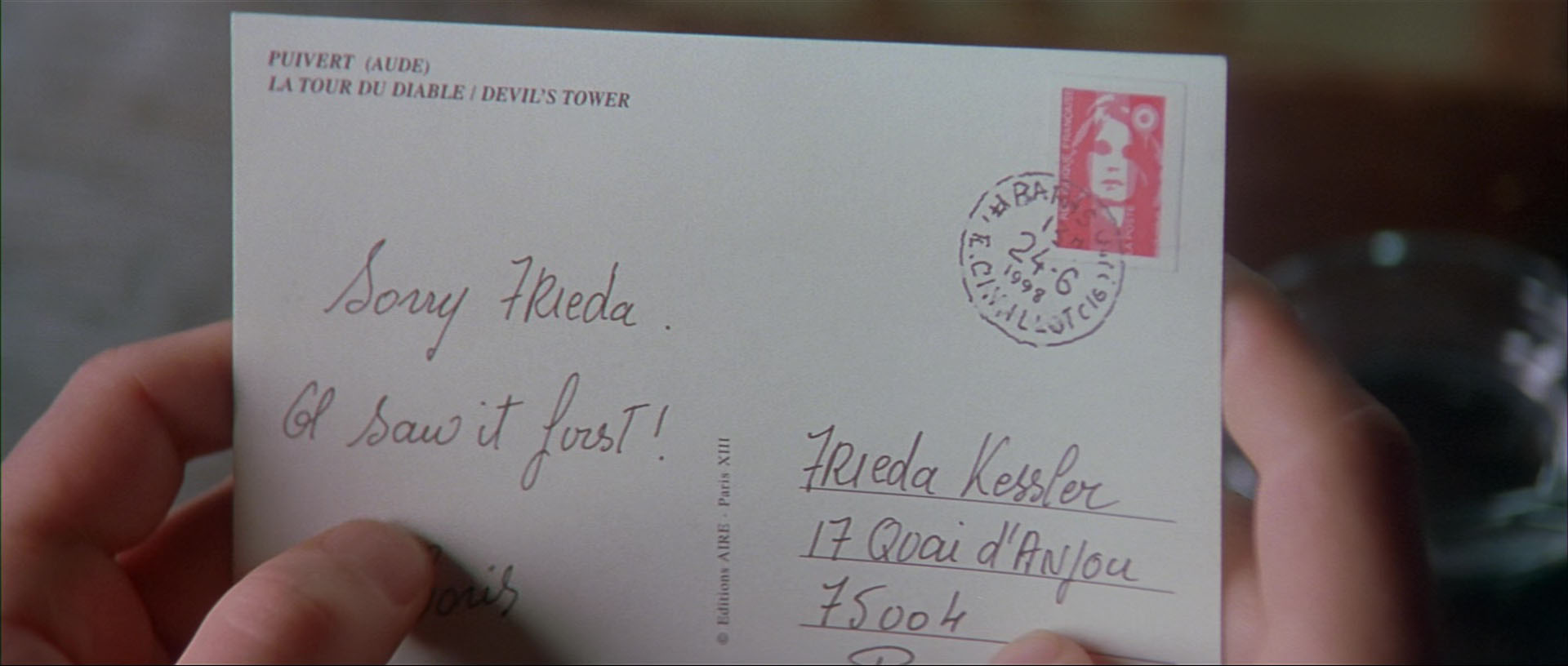
I’m in the minority of people who like The Ninth Gate (1999) a great deal even though it takes some liberties with Arturo Pérez-Reverte’s wonderful novel The Dumas Club. Once again, the bibliographic details are perfectly done, a crucial matter in a film about the antiquarian book trade. Near the end of the film Dean Corso (played by Johnny Depp) finds a postcard that leads him to the final location. On the back of the card there’s a blink-and-you-miss-it detail. Polanski’s wife, Emmanuelle Seigner, plays the mysterious and nameless woman who follows Corso throughout the film. By this point we already know she possesses occult powers so it’s not really surprising to see her face in the postage stamp, something that Corso doesn’t seem to notice.

polanski14.jpg

Previously on { feuilleton }
Repulsion posters
Atalanta Fugiens
Le Grand Macabre
Les Temps Morts by René Laloux
The writhing on the wall