Black Lodge 2600: The Twin Peaks Video Game

peaks2.jpg

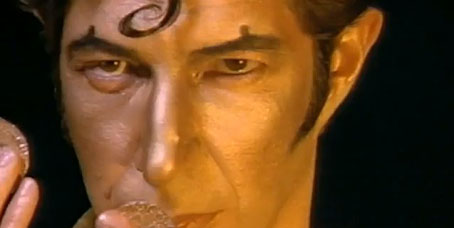
“That gum you like is going to come back in style.” Kyle MacLachlan and Michael J. Anderson in the Black Lodge.

After the chance discovery last week of photo panoramas by Twin Peaks “Giant” Carel Struycken I was doubly-surprised this week when random searching turned up a small Twin Peaks video game. Black Lodge 2600 is a free game for Macs and PCs that emulates the crude graphics and audio of an Atari 2600 cartridge. Jak Locke is the programmer, and his creation appeared last year which is again surprising since I’d have expected to hear about it by now.

blacklodge1.jpg

The accompanying manual describes the challenge facing the player:

A day in the FBI was never like this before! You are Special Agent Dale Cooper and you’ve found yourself trapped inside of the Black Lodge, a surreal and dangerous place between worlds.

Try as you might, you can’t seem to find anything but the same room and hallway no matter which way you turn. Worse yet, your doppelganger is in hot pursuit! You have no choice but to keep running through the room and hallway (or is it more than one?) and above all else, don’t let your doppelganger touch you! Your extensive physical training in the FBI will provide you a seemingly limitless supply of energy to run as long as necessary, but running out of breath is the least of your worries!

You’ll find quickly that you’re not alone in the Black Lodge, though your friends are few and far between. Not only that, the lodge itself seems to be actively trying to trip you up at all times! You’ll be dodging chairs and crazed Lodge residents all while trying to keep your own insanity. How long can this go on?

blacklodge2.jpg

I racked up 800 points before the Bad Dale caught up with me. Those who want to try their hands can download Black Lodge 2600 here.

blacklodge3.jpg

Previously on { feuilleton }
Carel Struycken’s panoramas
Bohren & Der Club Of Gore
Through the darkness of future pasts

Cthulhoid and Artflakes

cthulhoid.jpg

Cthulhoid (2012).

Hot on the scaly heels of my recent Cthulhu God comes a new collage work I was messing with over Christmas. This was done in part as a reaction to the earlier picture which I’m very happy with but which looks cleaner and flatter than I prefer for Lovecraft-related things. I’d also found some new books of copyright-free cephalopoda that I wanted to try playing with. There are trace elements here of Haeckel’s Kunstformen der Natur but I’ve plundered Haeckel so much in the past it’s better to search elsewhere for source material.

cthulhoid-detail.jpg

I’ve been selling reproductions of works such as this at CafePress but now have an additional outlet with a new print venture, Artflakes, who asked me late last year to contribute to their site. Artflakes is a German company operating as CafePress does: artists upload their pictures which can then be sold on a variety of products. The product range is smaller than their rivals but they do canvas prints which CafePress don’t. These are costly items but canvas prints tend to be expensive anyway, even at a high street copy shop. On the plus side, being based in Germany means the shipping costs will be slightly cheaper inside Europe. I’ve not uploaded much at the moment but this new piece is there together with six other works. More will be added in the next couple of months.

Elsewhere on { feuilleton }
The Lovecraft archive

Elie Grekoff’s Tirésias

grekoff1.jpg

Elie Grekoff (1914–1985) is the illustrator, a Russian-born French artist. Tirésias (1954) is a short work of homoerotica originally published anonymously in an edition of 150. The Grekoff website describes the volume (via Babel Fish) thusly:

One of the most beautiful text of the homosexual literature, a work which circulated under the coat, and which was condemned by the courts in 1964 and which make also this work an extremely rare publication. Publication of 92 pages.

The author, Marcel Jouhandeau (1888–1979), apparently spent much of his life oscillating between licentiousness and guilt thanks to his Catholicism but nevertheless managed to produce an acclaimed piece of gay fiction. Us Anglophones have to take the acclaim on faith, however, since the story doesn’t yet appear to have been translated into English. Given the increasing interest in gay fiction past and present this is a surprising oversight but we can still appreciate Grekoff’s illustrations, a rather fine series of fifteen wood engravings. There was also an additional run of fifteen copies of the book containing five “refusées” prints.

grekoff2.jpg

Grekoff illustrated a variety of novels and poetry in different styles. His work for Tirésias is reminiscent of Jean Cocteau’s in its outline figures and especially the stars for nipples, the star being a recurrent Cocteau motif. Jouhandeau’s wife, Élisabeth Toulemont, was a friend of Cocteau’s so this may have been deliberate although it’s hard to tell either way given the scarcity of information.

The excellent Bibliothèque Gay should be commended for making these rare illustrations public. See the complete set here. At the same site recently was a substantial post about Jean Cocteau’s Le livre blanc (1930).

Continue reading “Elie Grekoff’s Tirésias”

Carel Struycken’s panoramas

struycken1.jpg

The Bradbury Building by Carel Struycken.

An idle search for a panorama view of the interior of the Bradbury Building in Downtown Los Angeles fetched me up at my favourite panorama site 360Cities and this photo by Carel Struycken. Mr Struycken is better known as an actor whose great height has seen him cast as The Giant in the Twin Peaks TV series, and Lurch in the Addams Family films. 360Cities has a page of his panorama views most of which are taken in and around Los Angeles. The strangely ossified landscape around California’s Monolake is more familiar from this photo by Hipgnosis for Pink Floyd’s Wish You Were Here album.

struycken2.jpg

Urban Light by Carel Struycken.

struycken3.jpg

Monolake in Winter by Carel Struycken.

Elsewhere on { feuilleton }
The panoramas archive

Previously on { feuilleton }
Through the darkness of future pasts
The Bradbury Building: Looking Backward from the Future