The Daughters of Izdihar by Hadeer Elsbai

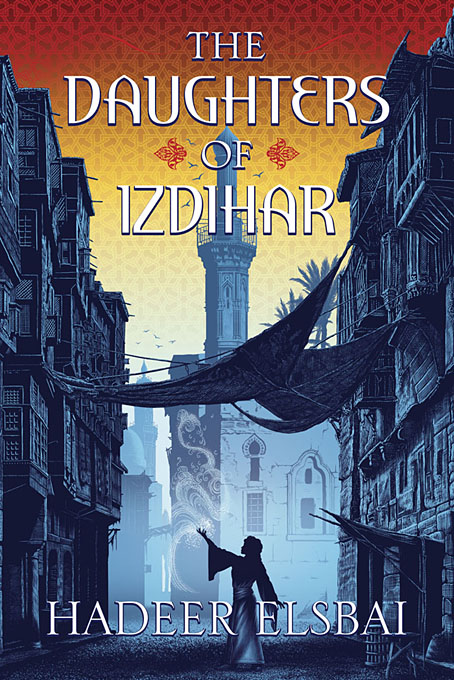
daughters.jpg

Another new cover of mine, this one suits the weather which today in Britain is giving us temperatures more usually found in regions further south:

From debut author Hadeer Elsbai comes the first book in an incredibly powerful new duology, set wholly in a new world, but inspired by modern Egyptian history, about two young women—Nehal, a spoiled aristocrat used to getting what she wants and Giorgina, a poor bookshop worker used to having nothing—who find they have far more in common, particularly in their struggle for the rights of women and their ability to fight for it with forbidden elemental magic.

As a waterweaver, Nehal can move and shape any water to her will, but she’s limited by her lack of formal education. She desires nothing more than to attend the newly opened Weaving Academy, take complete control of her powers, and pursue a glorious future on the battlefield with the first all-female military regiment. But her family cannot afford to let her go—crushed under her father’s gambling debt, Nehal is forcibly married into a wealthy merchant family. Her new spouse, Nico, is indifferent and distant and in love with another woman, a bookseller named Giorgina…. (more)

The design bears a superficial resemblance to the one I created for The Ingenious by Darius Hinks, one of the requests from the art director being for a similar view down a street and the sky filled with an interlaced pattern. The new artwork isn’t as fantastic, however, since the city of Almaxar in Hadeer’s novel is based on old Cairo. This was very convenient for the research process, Cairo was a popular destination for western travellers in the 19th century so there are many sketches and engravings of its narrow lanes. My street is an amalgam of several different views, with an emphasis on those mashrabiya windows which are designed to help cool buildings. (On a side note, the subject of ventilation and passive cooling in Middle-Eastern architecture is a fascinating one, as this page about windcatchers demonstrates.)

The knotwork pattern was the third design I tried after the first two turned out to be too obtrusive for the background. Both this one and the pattern used for The Ingenious were taken from templates in Les Éléments de l’Art Arabe – Le Trait des Entrelacs (1879) by Jules Bourgoin, a book which shows how to create these interlacings from scratch. I always prefer to do this when possible, rather than using stock imagery; the creation of the pattern doesn’t take too long once you’ve worked out the portion that will be repeated.

The Daughters of Izdihar will be published early next year by Harper Voyager (US) and Orbit Books (UK).

Previously on { feuilleton }
The Ingenious by Darius Hinks

Diamonds

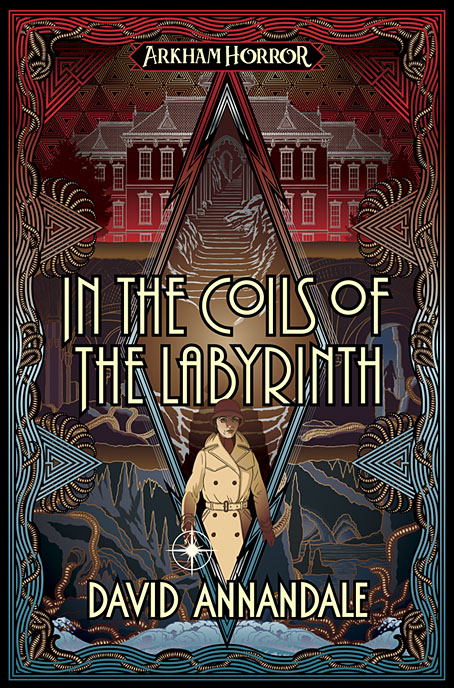
coils.jpg

I’ve finally found time to update the website a little so here are the last two book covers I was working on last year. In the Coils of the Labyrinth by David Annandale is another tale of Lovecraftian horror for Aconyte:

Professor Miranda Ventham is having bad dreams—nothing new in 1920s Arkham—but hers are horrifying glimpses of a dark future. Now seriously ill, she books herself into the new sanatorium, Stroud Home. With luck, the town’s eldritch taint won’t reach her there. And yet the nightmares worsen. Aided by her friend, Agatha Crane, they delve into the background of the sanatorium’s enigmatic director, Donovan Stroud. Plagued by doubts, delusions, and terrifying visions, Christine must unravel the shrouded history of the Strouds before she is trapped in a labyrinthine nightmare. Something sinister lurks at its heart, and it longs to be set free.

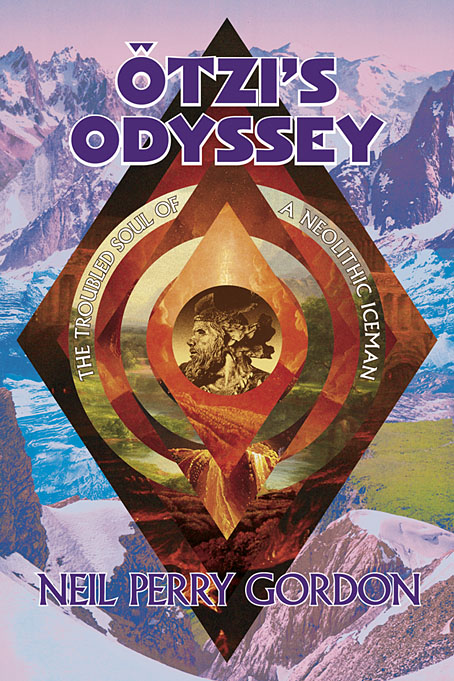
otzi.jpg

Otzi’s Odyssey by Neil Perry Gordon is a metaphysical drama which posits a fictional life and afterlife for the neolithic iceman whose body was discovered in the Alps:

Ötzi’s Odyssey – The Troubled Soul of a Neolithic Iceman, opens in the year 1991 with the remarkable sighting of a mummified man, half frozen in glacial ice, whom two hikers stumble upon. Along with this profound archeological discovery, the soul of this five-thousand-year-old iceman is awakened.

?Ötzi the iceman’s adventure takes him to the modern era, where his observant soul tries to comprehend why it remains tethered to the frozen mummy, as well as to make sense of a technologically advanced world. The story then returns to 3300 BCE, to the life and times of clan chief Bhark as he lives with his family in a peaceful village upon stilt homes clinging to the shore of the great Lake Neith, located in the shadows of ominous Similaun Mountain.

Both these covers use an elongated diamond shape in their designs, a repetition that I wasn’t intending. I did this first on Otzi’s Odyssey since the story has four infernal realms that the character’s soul travels through. A diamond shape subsequently became necessary for In the Coils of the Labyrinth when a central panel was required that wouldn’t cover too much of the background imagery while also connecting the upper and lower levels and providing a graphic link with my previous covers in this series. There’s a similar shape on my cover for The Voice of the Fire so I should probably avoid doing this for a while…

Still to be announced from last year is an album cover design that I managed to fit in despite several months of serious overwork. This was my first proper album cover for some time (as opposed to the layout I’m usually doing on albums where the artists provide their own art) but the release seems to have been delayed for some reason. More about that one when/if it appears.

Elsewhere on { feuilleton }
The Lovecraft archive

Previously on { feuilleton }
The Devourer Below
Litany of Dreams
The Last Ritual

A Penrose pentagram

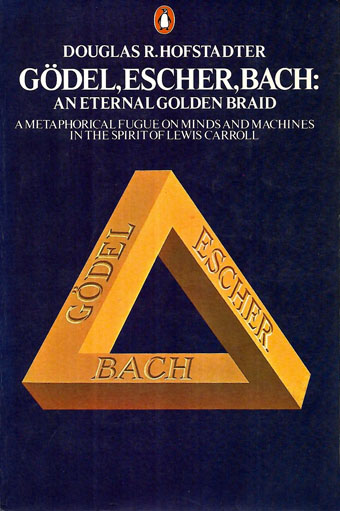
hofstadter.jpg

A classic text although that cover art always looks a little off. I’m sure MC Escher would have insisted on the triangle being equilateral.

Most people are familiar with the Penrose triangle by sight even if they don’t know who “Penrose” was. (Psychiatrist Lionel, together with his son, Roger, the celebrated mathematician and physicist.) I’ve been playing with these things for years, most notably on the cover art I created for Zones by Hawkwind, although the triangle also formed the basis for the robot pathways I created a couple of years ago when illustrating Bruce Sterling’s Robot Artists and Black Swans.

pentagram.jpg

Earlier this week it occurred to me that I hadn’t tried applying the Penrose effect to a pentagram. For a fleeting moment I thought the idea might be a novel one but a quick web search disabused me of this; plenty of similar examples exist already. Here it is anyway, after 20 minutes or so in Illustrator. I’m tempted to try a few more things like this when I have the time. Many possibilities present themselves.

Previously on { feuilleton }
More Swans and Robots

All the Things

needful.jpg

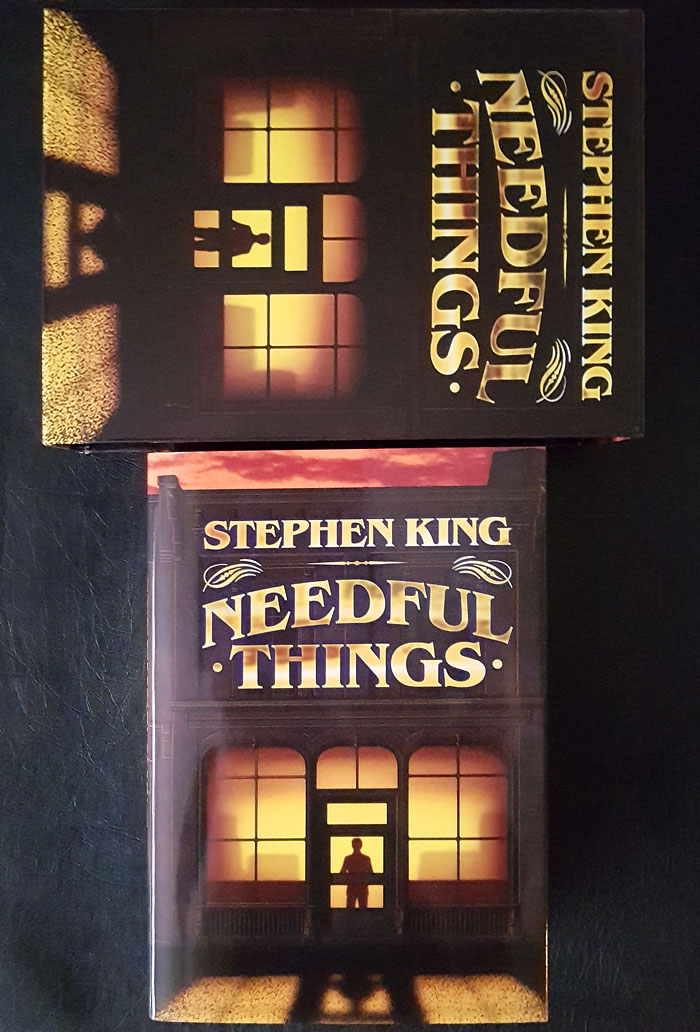
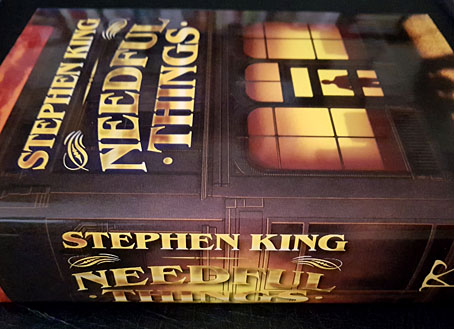
Over the weekend I braved repetitive strain injury and solvent delirium from the fumes emitted by metallic markers while autographing this stack of signing sheets. The weighty pile is now on its way back to PS Publishing which means that the forthcoming illustrated edition of Needful Things is closer to being with its needful purchasers.

Cocteau and Lovecraft

cocteau.jpg

This one arrives via Tentaclii, via ST Joshi’s news page. Jean Cocteau paying homage in pencil to HP Lovecraft is both unlikely and almost too good to be true. But the drawing, circa 1951, is from a Beverly Hills gallery where other Cocteau artwork is up for sale so it can be accepted as the genuine article.

Cocteau’s enthusiasm for Lovecraft’s fiction doesn’t seem to be news either, even though this is the first I’ve heard of it. Another of Joshi’s links is to this newspaper feature from 1954 in which Cocteau together with various notables of the time are asked to choose their books of the year. While the other contributors list the kinds of titles you’d expect, Cocteau has a book about Atlantis by Denis Saurat, books about parapsychology and “les soucoupes volantes” (flying saucers), plus the first French collection of Lovecraft’s stories, translated by Jacques Papy. I knew that Cocteau had a mystical side—you’d expect nothing less from the director of Orphée—but this combination of Lovecraft and full-on crankery is a surprise. He lived just long enough to see the first publication of Pauwels and Bergiers’ Ur-text of the 70s’ crankosphere, The Morning of the Magicians, so I can imagine him lapping up that one as well.

gessner.jpg

As for the doodle, this is Cocteau’s version of a sea-monster illustration from Conrad Gessner’s Historia Animalium (1551–1558), a five-volume study which includes a number of fantastic creatures among its descriptions of the animal life known to 16th-century Europeans. Gessner has a page or two about the so-called “sea bishop” which includes this illustration together with another one I adapted myself in 2010 for the Neil Gaiman story in Lovecraft’s Monsters. Good to know that Cocteau and I were on the same page, as it were.

deep-one.jpg

Elsewhere on { feuilleton }
The Lovecraft archive

Previously on { feuilleton }
Cocteau drawings
Querelle de Brest
Halsman and Cocteau
La Belle et la Bête posters
The writhing on the wall
Le livre blanc by Jean Cocteau
Cocteau’s sword
Cristalophonics: searching for the Cocteau sound
Cocteau at the Louvre des Antiquaires
La Villa Santo Sospir by Jean Cocteau