Uncopyable

moldover.jpg

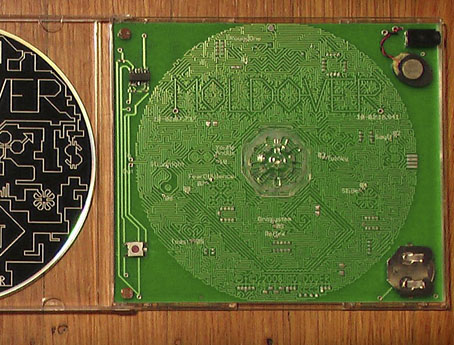
Moldover’s CD case: a working theremin.

In May this year, Brian Eno was writing in Prospect magazine about the current state of the music business as it continues to be assailed by digital technology. Among the things Eno discussed was the packaging of music:

The duplicability of recordings has had another unexpected effect. The pressure is on to develop content that isn’t easily copyable—so now everything other than the recorded music is becoming the valuable part of what artists sell. … That suggests to me the possibility of a refreshingly democratic art market: a new way for visual artists, designers, animators and film-makers to make a living. So, as one business folds, several others open up. (More.)

Having started out as an album cover artist (I wasn’t a designer back then), and working still as a CD designer, this is naturally an attractive thesis. Earlier this week John Walsh in The Independent wrote a potted history of the album cover and noted that the big record companies are also realising again that contemporary music as an artform is more than merely a collection of audio tracks:

Apple, creator of the iPod and the iTunes store—the sworn enemies of commercially-packaged music—is getting into bed with the four largest record labels, to help them stimulate album sales. They’re working with EMI, Sony Music, Warner Music and Universal Music Group on something called “Project Cocktail” that will produce all manner of extras to go with albums: interactive booklets, sleeve notes, photographs, lyric sheets, even video clips. Buyers will be able to call up album tracks through the interactive booklet, while leafing through pictures of the band and trying to make sense of the lyrics.

This, however, seems to be missing the point. Absolutely anything digital can be copied and passed on, and that applies equally to album extras as to the tracks themselves. What can’t be copied, of course, is a desirable object which contains the music. The lavish album sleeves of the 1970s were very much desirable objects which contained music, and no end of facsimile CDs of Physical Graffiti will match the impact of Peter Corriston and Mike Doud’s design for the vinyl release.

Which brings us to Moldover‘s extraordinary light-operated theremin-in-a-CD-case, a beautiful design and a really clever use of the wretched jewel case box. The music on Moldover’s accompanying CD may be swapped around illicitly but no one is going to copy the hardware. The “Awesome Edition” of this work costs $50 and can be ordered here.

perich.jpg

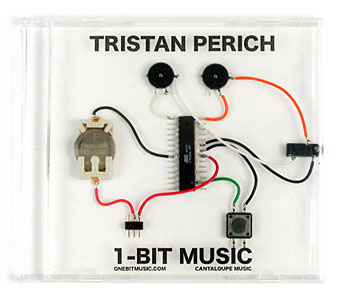
Moldover’s theremin is only an adjunct to his music, albeit a delightful one. Tristan Perich, on the other hand, like Fm3’s Buddha Machine, makes the case and the instrument one, and in Perich’s case (so to speak) possibly takes the 8-bit/chiptune thing to a definitive extreme. This is the kind of invention we could use more of, not some lazy Flash applications appended to a pop release then dumped onto the iTunes Store as an “exclusive”. It’s notable that the one thing all these works have in common is that they’re the inventions of no-budget independent artists, not big record labels.

While we’re on the subject of the Buddha Machine, the guys at Mountain*7 noted this YouTube loop work which extends the drone-loop idea into the audio/visual realm.

Elsewhere on { feuilleton }
The album covers archive

Previously on { feuilleton }
Buddha Machine Wall
God in the machines
Layering Buddha by Robert Henke
Generative culture

Caldwell & Co

caldwell.jpg

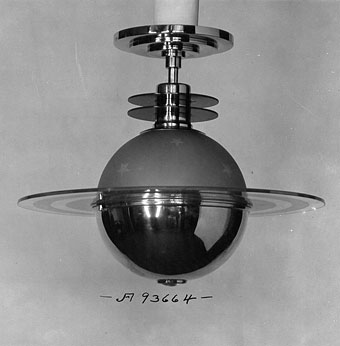
A cosmic pendant lamp by New York lighting manufacturer, Caldwell & Co, created for the Rockefeller Center in 1932. The company’s Art Deco-styled designs for that building feature a number of other flying saucer pendants although none as striking as this one. The photo is one of many made available by the Smithsonian Institute on a site which catalogues the company’s history.

Edward F. Caldwell & Co., of New York City, was the premier designer and manufacturer of electric light fixtures and decorative metalwork from the late 19th to the mid-20th centuries. Founded in 1895 by Edward F. Caldwell (1851–1914) and Victor F. von Lossberg (1853–1942), the firm’s legacy of highly crafted creations includes custom made metal gates, lanterns, chandeliers, ceiling and wall fixtures, floor and table lamps, and other decorative objects that can be found today in many metropolitan area churches, public buildings, offices, clubs, and residences.

Previously on { feuilleton }
Hugh Ferriss and the Metropolis of Tomorrow

Automates Ki

automates_ki

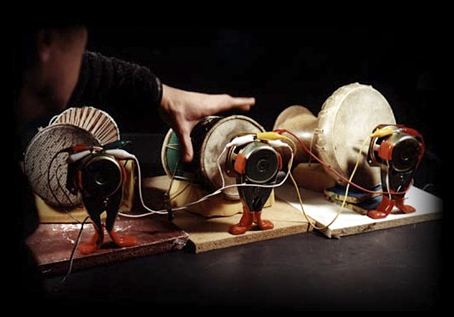
Following the post last week about the Gamelatron, Masha left a comment referring me to the similar, if less harmonious, Automates Ki systems of Canadian composer Maxime De La Rochefoucauld who describes his constructions as “musical robots activated by inaudible frequencies”. He also says:

Ki is a japanese concept : roughly, it is the invisible vital energy that makes things move. I use this word as an allegory for the energy that animates my automatons. The listener and spectator only hears and sees the consequences of this vibration. In this context, my Automates Ki are “spokespersons” for the vibration instead of invented musical instruments, since to build them I use previously created instruments gathered from various countries.

For several years I have worked on a system of my own invention that animates the automatons, producing a music centered on percussion. The Systeme Ki™ transforms inaudible low-frequency modulations into an acoustic phenomenon.

The Automates Ki comprises a speaker joined to a musical instrument. A pliable firing pin is set on the speaker. The firing pin, when animated by the vibration of the speaker, hits the acoustic instruments (drums, cymbals, strings instruments) in an oscillating manner.

There’s a website devoted to these works, and a MySpace page, but the best appraisal can be had by viewing some of the composer’s YouTube clips.

Previously on { feuilleton }
The Gamelatron
Metronomes
Cristalophonics: searching for the Cocteau sound
Max Eastley’s musical sculptures
The Reactable
The Ondes Martenot

The Gamelatron

gamelatron.jpg

The Gamelatron at Galapagos Art Space March 2009. Photo by Gisella Sorrentino.

A laptop-controlled gamelan orchestra by Zemi17 aka A. Taylor Kuffner. See it in operation here. (Is it Gamelatron or GamelaTron? Their spellings differ…)

The GamelaTron is the fruit of a collaboration between The League of Electronic Musical Urban Robots (LEMUR) and the composer Zemi17: A. Taylor Kuffner.

Modeled after traditional Balinese and Javanese gamelan orchestras, the GamelaTron is an amalgamation of traditional instruments with a suite of percussive sound makers. MIDI sequences control 117 robotic striking mechanisms that produce intricately woven and rhythmic sound. Performances follow an arc similar to classic Indonesian gatherings, where stories from great epics, such as the Ramayana, are told and settings given in words that are continued in music.

Sounds overly-mechanical to my ears but then that’s probably inevitable given the way the instruments are being controlled. The classic Nonesuch Explorer recordings of Javanese and Balinese gamelan orchestras follow less rigid rhythmic patterns. And being recorded outdoors the Indonesian music is augmented by background atmospheres from birds and insects.

For more variations on the gamelan theme, there’s 23 Skidoo’s Urban Gamelan album (recently reissued) and the many chiming electronic exercises by Paul Schütze.

Previously on { feuilleton }
Paul Schütze online
Metronomes
Cristalophonics: searching for the Cocteau sound
Max Eastley’s musical sculptures
The Reactable
The Ondes Martenot