The Smirking Chimp

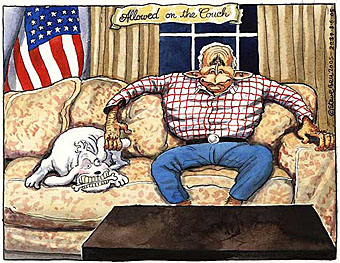
bell_bush.jpg

Cartoon by the wonderful Steve Bell.

I keep resolving to stop posting so much political stuff, there’s enough of that elsewhere and generally I’d prefer not to have the names, faces and actions of these miserable wretches polluting my web space. This was too good to miss, however. And this piece of polemic makes a good companion piece.

Jonathan Chait: Is Bush Still Too Dumb to Be President?
You can’t run a country on horse sense.
The Los Angeles Times
July 16, 2006

WAY BACK when he first appeared on the national scene, the rap against George W. Bush was that he might be too dumb to be president. As time passed, questions about Bush’s mental capabilities faded away.

After 9/11, his instinctive rather than analytical view of the world seemed to be just what we needed, and Americans of all stripes were desperate to see heroic qualities in him. (As Dan Rather announced at the time: “George Bush is the president; he makes the decisions; and, you know, as just one American, wherever he wants me to line up, just tell me where.”)

On top of that, Democrats decided it was politically counterproductive to attack Bush’s intelligence. Bruce Reed of the Democratic Leadership Council said in 2002, for instance, that calling Bush dumb “plays directly into Bush’s strength, which is that he comes across as a regular guy.” And so, for most of the last six years, the question of Bush’s intelligence has remained off the table.

Oh, sure, a few of us have brought it up from time to time, but we have generally been dismissed out of hand as wacky Bush-haters. By 2004, the question had been turned around completely. Democrats had almost nothing to say about Bush’s lack of intellect, while Republicans joyfully and repeatedly attacked John Kerry as an egghead. Anti-intellectualism was triumphant.

Yet it is now increasingly clear that Bush’s status as non-rocket scientist is a serious problem. The problem is not his habit – savored by late-night comedians – of stumbling over multisyllabic words. It is his shocking lack of intellectual curiosity.

Ron Suskind’s new book, “The One Percent Doctrine,” paints a harrowing picture of Bush’s intellectual limits. Bush, writes Suskind, “is not much of a reader.” He prefers verbal briefings and often makes a horse-sense judgment based on how confident his briefer seems in what he’s saying. In August 2001, the CIA was in a panic about an upcoming terrorist attack and drafted a report with the title, “Bin Laden Determined to Strike in U.S.” When a CIA staffer summed up the memo’s contents in a face-to-face meeting with Bush, the president found the briefer insufficiently confident and dismissed him by saying, “All right, you’ve covered your ass, now,” according to Suskind. That turned out to be a fairly disastrous judgment.

Bush loyalists like to dismiss Suskind’s reporting, but it jibes with the picture that has emerged from other sources. L. Paul Bremer III’s account of his tenure as head of Iraq’s Coalition Provisional Authority depicts Bush as uninterested in the central questions of rebuilding and occupying the country.

Video of a presidential meeting that came to light this year showed Bush being briefed on the incipient Hurricane Katrina. His subordinates come off as deeply concerned about a potential catastrophe, but Bush appears blase, declining to ask a single question. And of course there was the famous 2001 incident in which Russian President Vladimir Putin conveyed to Bush a story of being given a cross by his mother. Bush invested deep significance in the story. “I found him to be very straightforward and trustworthy,” he told reporters. “I was able to get a sense of his soul.”

Bush’s supporters have insisted for the last six years that liberal derision of the president’s intelligence amounts to nothing more than cultural snobbery. We don’t like his pickup truck and his accent, the accusation goes, so we hide our blue-state prejudices behind a mask of intellectual condescension.

But the more we learn about how Bush operates, the more we can see we were right from the beginning. It matters that the president values his gut reaction and disdains book learnin’. It’s not just a question of cultural style. The president’s narrow intellectual horizons have real consequences, sometimes cataclysmic ones.

It’s true that presidents can succeed without being intellectuals themselves. The trouble is that Bush isn’t just a nonintellectual, he viscerally disdains intellectuals. “What angered me was the way such people at Yale felt so intellectually superior and so righteous,” he told a Texas Monthly reporter in 1994.

When I went to college at Michigan, I occasionally played pickup basketball with varsity football players. They obviously felt athletically superior to me. I didn’t resent them for it – because they were.

The Middle East now

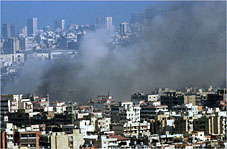
beirut.jpg

Arthur magazine‘s recent feature on life in the Middle East by Daniel Chamberlin was an excellent mix of travelogue/reportage. Iraq and the ongoing Israeli/Palestinian conflict aside, the region was fairly peaceful last year. How quickly things change. This is from the latest Arthur email bulletin.

FROM ARTHUR CONTRIBUTING EDITOR DANIEL CHAMBERLIN:

Last summer I went traveling with my brother Paul in Egypt, Lebanon and Syria. The result was “Dr. Moustache and The Egyptian Gentleman,” a three-part series in the November 2005 and January 2006 issues of Arthur.

Paul returned to Damascus this summer to refine his Arabic and research his thesis – he’s getting a Ph.D. in diplomatic history at Ohio State University – in Syria’s governmental archives.

The first sign that my brother’s tour of Syrian libraries might not go as planned came on June 25 when Palestinian guerillas linked to the Hamas government kidnapped an Israeli soldier and killed two others. The ensuing conflict with Israel was escalated on July 12 when some Hezbollah guys sneaked from Lebanon into Israel, killing eight soldiers and kidnapping two others, prompting Israel to start dropping bombs all over Lebanon, destroying the country’s infrastructure to the tune of several billion dollars and killing over 200 civilians as of July 18. Hezbollah shot more of their wildly inaccurate rockets back into Israel, killing some 13 civilians.

Paul is living in Damascus though, not Beirut, Haifa or Gaza City. But Khaled Meshal, the exiled leader of Hamas, also lives in Damascus with the permission of the government- he moved there after Israeli Mossad agents tried to assassinate him in Jordan in 1997 by putting poison in his ear. Israel expressed its discontent at this arrangement by having fighter jets buzz Syrian President Bashir Asad’s summer pad in Latakia shortly after things started getting bloody in Gaza.

As for Hezbollah, they do their own thing-whether it’s firing Katyushas into Israeli settlements, selling keychains in the gift shops on the Israeli border that Paul and I visited last summer or serving as members of Lebanon’s parliament – but they receive support from both Syria and Iran. The U.S. and Israeli governments have indicated they hold Syria responsible for the actions of both Hezbollah and Hamas. In an interview with Charlie Rose, the Israeli representative to the United Nations characterized this as not only part of the “War on Terror,” but went so far as to say that it was one of the early chapters of World War III. Tehran and Damascus, it should be mentioned, have agreed to back the other should Israel or the U.S. decide to attack.

Paul and I talk frequently via e-mail, and the following is his daily journal of what life in Damascus has been like lately.

Daniel Chamberlin Los Angeles July 18, 2006

LETTERS FROM DAMASCUS by Paul Chamberlin

*** Friday 14 July*** Tonight we met a man who fought in the Syrian army in the Golan during the 1973 war. He seemed considerably less concerned about the situation here than us, explaining that the people here could sense when a war was coming, and everything was fine.

***Saturday 15 July*** Things got worse today. I went to the internet cafe this morning to find my inbox full of emails from the United States urging me to evacuate Damascus immediately. My advisor at Ohio State-a historian of U.S.-Israeli relations-is suggesting that it might not be a bad idea to get out of the region as soon as possible while my friend Steve in Beirut recommends that I might consider heading north to Turkey. Apparently he’s heard from a contact in the State Department that the situation could escalate to conflict with Syria in the very near future. Rumor has it that the Israeli fleet is massing off of Tripoli in preparation to begin bombing the northern highways to Syria. Apparently he hasn’t heard anything from the U.S. Embassy in Beirut even though the city has been under Israeli attack for two days. To make matters worse, I find another email from my friend Mariam, also in Beirut, relating her plans to head to Damascus via the same northern roads that the Israelis are planning to attack. I send a cautionary email to her, convinced that it won’t reach her in time to make any difference.

Continue reading “The Middle East now”

Same shit, different day

“The Oriental doesn’t put the same high price on life as does the Westerner. Life is cheap in the Orient.” General William Westmoreland, commander of US military operations during the Vietnam War, speaking in Hearts and Minds (1974).

Yahoo News, Mon Jul 17, 2006, 4:47 PM ET
UNITED NATIONS (AFP) – US Ambassador John Bolton said there was no moral equivalence between the civilian casualties from the Israeli raids in Lebanon and those killed in Israel from “malicious terrorist acts”.

Asked to comment on the deaths in an Israeli air strike of eight Canadian citizens in southern Lebanon Sunday, he said: “it is a matter of great concern to us…that these civilian deaths are occurring. It’s a tragedy.”

“I think it would be a mistake to ascribe moral equivalence to civilians who die as the direct result of malicious terrorist acts,” he added, while defending as “self-defense” Israel’s military action, which has had “the tragic and unfortunate consequence of civilian deaths”.

Designers take a stand

Some of the honourees of America’s National Design Awards tell the President’s wife why they won’t be attending a special gala breakfast at the White House.

Dear Mrs. Bush:

As American designers, we strongly believe our government should support the design profession and applaud the White House sponsorship of the Cooper Hewitt National Design Museum. And as finalists and recipients of the National Design Award in Communication Design we are deeply honored to be selected for this recognition. However, we find ourselves compelled to respectfully decline your invitation to visit the White House on July 10th.

Graphic designers are intimately engaged in the construction of language, both visual and verbal. And while our work often dissects, rearranges, rethinks, questions and plays with language, it is our fundamental belief, and a central tenet of “good” design, that words and images must be used responsibly, especially when the matters articulated are of vital importance to the life of our nation.

We understand that politics often involves high rhetoric and the shading of language for political ends. However it is our belief that the current administration of George W. Bush has used the mass communication of words and images in ways that have seriously harmed the political discourse in America. We therefore feel it would be inconsistent with those values previously stated to accept an award celebrating language and communication, from a representative of an administration that has engaged in a prolonged assault on meaning.

While we have diverse political beliefs, we are united in our rejection of these policies. Through the wide-scale distortion of words (from “Healthy Forests” to “Mission Accomplished”) and both the manipulation of media (the photo op) and its suppression (the hidden war casualties), the Bush administration has demonstrated disdain for the responsible use of mass media, language and the intelligence of the American people.

While it may be an insignificant gesture, we stand against these distortions and for the restoration of a civil political dialogue.

Michael Rock, Susan Sellers, Georgie Stout, Paula Scher and Stefan Sagmeister.

This story is causing some heated debate over at Design Observer, both for and against. For my part I’m glad to see it and would support their decision; the more people taking a principled stand against these despicable wretches, the better. Too often—as Jonathan Barnbrook never tires of pointing out—designers seem happy to take the money (and awards) and run, ignoring any broader context with regard to their work. Maximum respect.