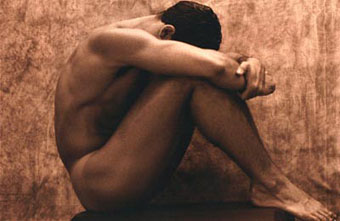
It’s that man again… Another instance of the perennial Flandrin pose, this time from photographer MJ Cardozo. The earlier examples are linked below.
Elsewhere on { feuilleton }
• The recurrent pose archive
A journal by artist and designer John Coulthart.

Photography
It’s that man again… Another instance of the perennial Flandrin pose, this time from photographer MJ Cardozo. The earlier examples are linked below.
Elsewhere on { feuilleton }
• The recurrent pose archive
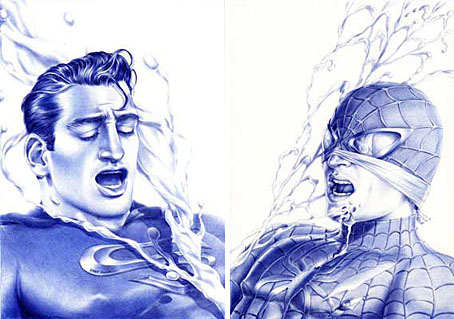
left: Sperman (2007) by Cary Kwok; right: Here Cums the Spider (2007) by Cary Kwok.
NSFW, as if you need to be told. It’s almost a commonplace of contemporary art that there are so many artists around today, producing such a volume of work, that any newcomer (as it were) has to find a niche and stay there if they want their efforts to stand out from the crowd. Cary Kwok’s niche seems to be the seminal emission which he depicts in a variety of ways, including showing various well-known comic-book characters shooting their respective loads. Kwok’s work has been shown recently at the Herald Street gallery, London, and Hard Hat, Geneva.
I like Kwok’s drawings, they’re carefully-done and funny, and serve to remind one that the cum shot is under-represented in art. Despite various Biblical prohibitions, women have been subject to no end of sexual display throughout art history, from copulations with gods in the form of animals to Danaë’s impregnation by Zeus as a literal golden shower. But male sexuality, especially at its most essential moment, has rarely been depicted outside the pages of pornography. The irony of this, as with arguments against erections in art, is that if it wasn’t for ejaculations we wouldn’t be here to discuss their pros and cons. Gay artists have been in the vanguard of addressing the sperm-drought, possibly because they have more than a passing interest in these matters; Michael Petry’s work earlier this year took a lateral view. There’s another sample (as it were) of Cary Kwok’s work below the fold plus some other seminal (as it were) artworks through the ages.

40th Street Shop by Jack Delano (1942).
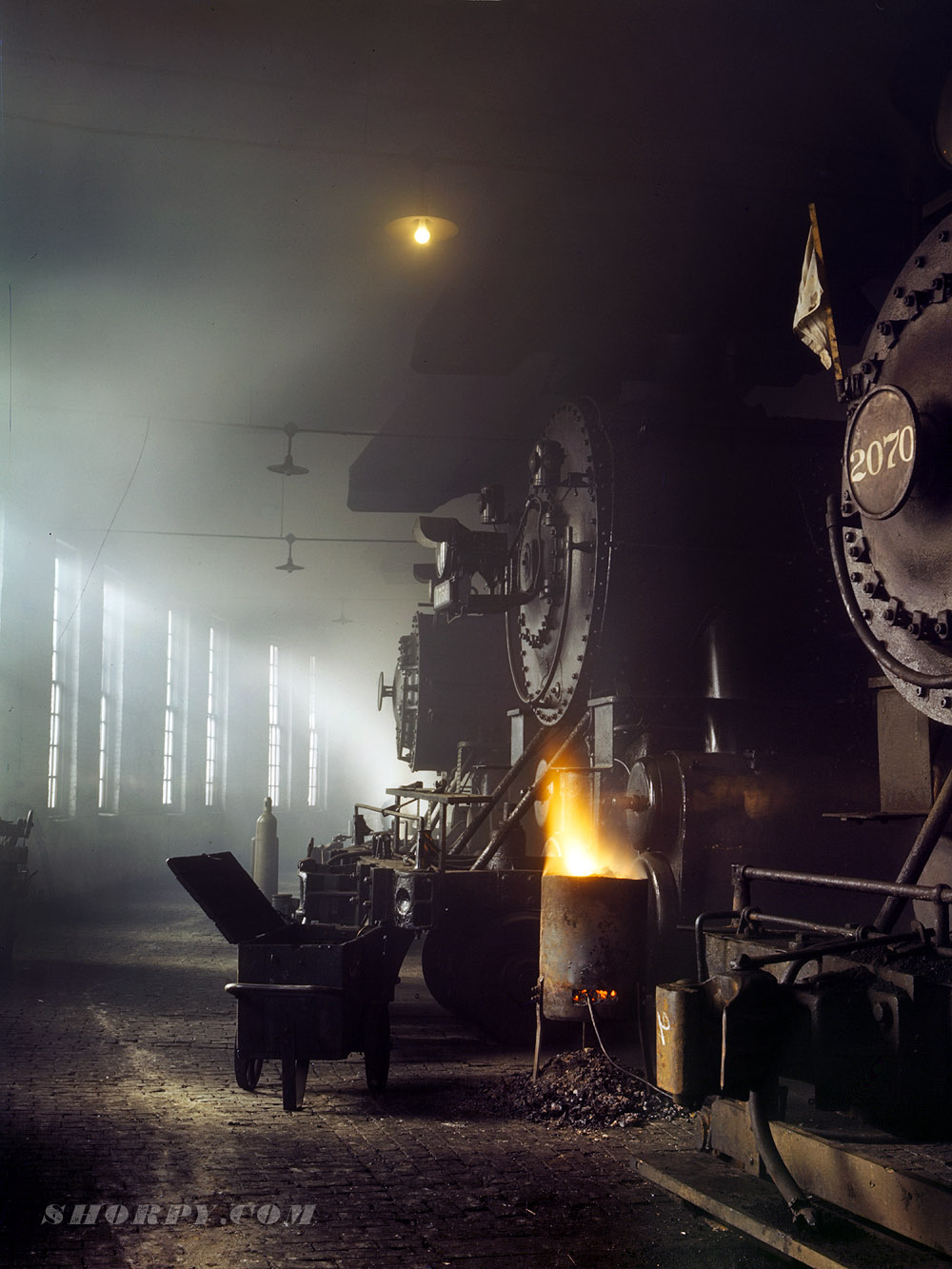
Locomotive Dreams by Jack Delano (1942).
Just two of many marvellous antique photographs available from the Juniper Gallery that can be viewed in high-res versions. A variety of prints are available from each picture.

A monthly global image composite from Nasa’s Earth Observatory project, showing topographic and bathymetric shading.
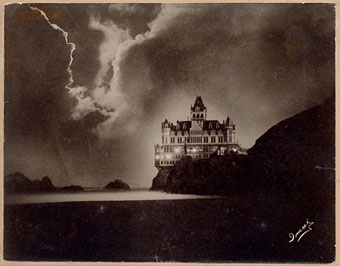
The Cliff House in a storm by Tsunekichi Imai (c. 1900).
The Cliff House Project has a wealth of information and ephemera about the late Victorian incarnation of the Cliff House restaurant in San Francisco. There were several Cliff Houses but the one built by Adolph Sutro in 1896 was the most spectacular, partly for the lack of other buildings around it but mostly for its typically Victorian take on a Gothic style which gave it the nickname “the Gingerbread Palace.”
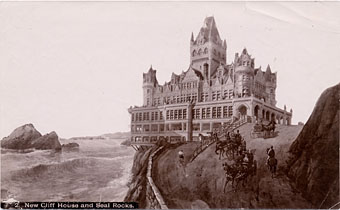
I’d never seen this building before until comics writer Tom Veitch sent me a picture postcard of it in the early Nineties. Given its age I’d always assumed it must have been destroyed in the 1906 earthquake but it turns out that the building survived that disaster only to perish in a fire the year after. The Cliff House site has many wonderful photographs, nearly all of which convey the impression that the building was about to slide into the sea at any moment—or maybe set sail if the tide was up. There’s also a short piece of film from 1903 showing a slow pan around a throng of beach revellers which eventually comes to light on the house. Long-vanished buildings often possess an air of unreality in photographs; this one seems more unreal than most due to its unlikely appearance.
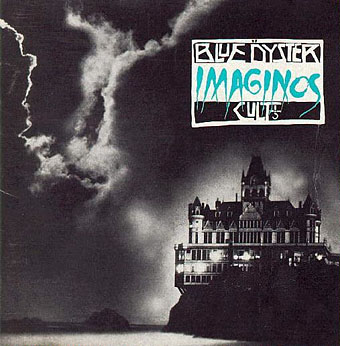
Update: Nephilim2038 reminds us that Blue Öyster Cult used Imai’s photograph of the Cliff House on the cover of their Imaginos album in 1988. This seems to have eluded my attention despite my having a CD-single from that album (although in truth I bought it for Don’t Fear The Reaper which was included as a bonus track).
Previously on { feuilleton }
• Passages 2
• Hungarian water towers
• Karel Plicka’s views of Prague
• Atget’s Paris