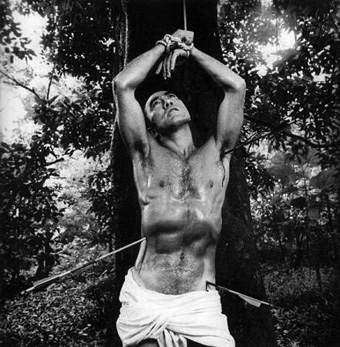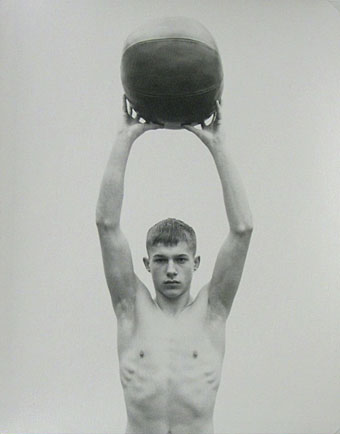
Whitman 2 (2005).
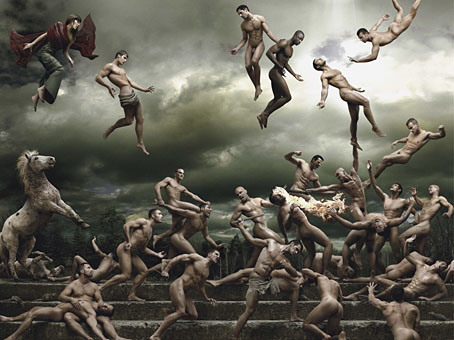
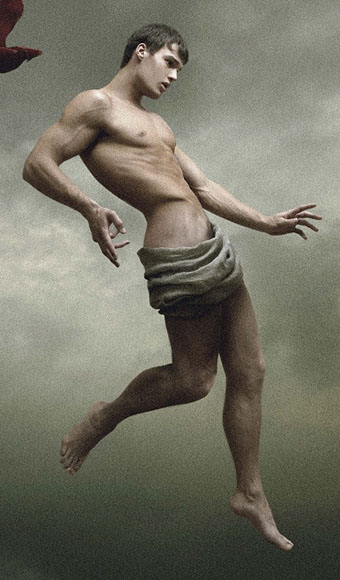
One of Anthony Gayton‘s Caravaggio-styled photographs from his exhibition, The Fall, at the Galería Mito, Barcelona, until January 26, 2008.
Elsewhere on { feuilleton }
• The gay artists archive
A journal by artist and designer John Coulthart.
Photography
Whitman 2 (2005).
One of Anthony Gayton‘s Caravaggio-styled photographs from his exhibition, The Fall, at the Galería Mito, Barcelona, until January 26, 2008.
Elsewhere on { feuilleton }
• The gay artists archive
After writing about Abelardo Morell’s remarkable camera obscura photographs last month, filmmaker Allie Humenuk left a comment about her documentary which explores Morell’s work and working methods.
Shadow of the House is about looking closely. Filmed over seven years, it is an intimate portrait of photographer Abelardo Morell, revealing the mystery and method of his artistic process. The narrative skips across time and space from his early childhood escape from Castro’s regime to his status as a world-renowned photographer. The film explores his daily working life as an artist and his eventual return to Cuba after 40 years of living in exile. Shadow of the House uncovers the deep layers of a man who is pushed to confront his past and his familial allegiances as it explores his unique artistic vision.
The film website has a lot more information, including details of North American screenings, and a trailer.
Previously on { feuilleton }
• Abelardo Morell’s camera obscura
• Abelardo Morell
It wouldn’t surprise me if there are more examples of the fashion world borrowing the Flandrin pose but this is the only one I’ve seen so far, part of a 1998 art-inspired photo series by Mario Sorrenti for Yves Saint-Laurent. There don’t seem to be any larger copies available, unfortunately.
Elsewhere on { feuilleton }
• The recurrent pose archive
Previously on { feuilleton }
• Last Suppers and last straws
• The last circle of the Inferno

The Royal Arch, Dundee, photographed by Edwin Smith.
It’s an odd thing to discover that a structure you’ve known about for years has been demolished for almost as long as you’ve been alive. It took a review of Britain’s Lost Cities by Gavin Stamp to inform me that the curious Royal Arch in Dundee, Scotland, built between 1849 and 1853, was no more. I only knew it from this photograph in an old Thames & Hudson book, Scotland (1955) by Edwin Smith and GS Fraser.

Even though the arch had an official function—providing a ceremonial gateway for Queen Victoria—in its free-standing singularity and historical confection it’s not very far removed from the numerous follies that still litter the British countryside. Being a long-time fan of the pointless architectural confection, I like to know that these things are still around even if they’re not so good to look at; they make the world a more interesting place.

The architect of this pastiche, which looks like a chunk of Norman cathedral dumped on the dockside, was one John Thomas Rochead whose oddly-shaped and frequently spectacular Wallace Monument still stands. I think it’s the incongruity I like about the arch, its setting and style are completely at odds and it has the fake ruin aspect of many follies, looking like a fragment of something larger. Monuments are often a sub-class of folly and Scotland has another fine example with the Scott Monument in Edinburgh.

Rochead’s arch was demolished in 1964 to make way for the Tay Road Bridge, another victim of the Sixties’ purge of Victorian eccentricity. I don’t always disagree with those purges, the Victorians had no qualms about demolishing older buildings and some of the structures whose demolition Gavin Stamp complains about were pretty awful. Euston Station in London is a soulless glass barn but I can’t see how its exterior would be improved if the heavy and dull Euston Arch had been allowed to remain as its gateway. What we’re seeing today is a reaction to that reaction, with the concrete buildings that were raised on the rubble of their Victorian forebears suffering their own waves of demolition. What goes around, comes around, and even the most apparently permanent structure can be swept away when attitudes change.
Previously on { feuilleton }
• Lenin Rising
• Dead Monuments
• The Triangular Lodge
• Pyramid mausoleum
A moody riff on the Flandrin pose entitled Melancholy.
From this Flickr page.
Elsewhere on { feuilleton }
• The recurrent pose archive