So Much Fire to Roast Human Flesh

bast008.jpg

So Much Fire to Roast Human Flesh

A benefit album curated
by Josephine Foster

“All profits from sales of this
compilation will be distributed to
specific counter-military recruitment
and pacifist organizations and
programs. We hope to assist them
in their efforts promoting peace
and non-militarism in the United States.

“All of the musicians represented
here are US citizens. Our voices
join with many others across this
land that freely question and
openly oppose war.”

Josephine Foster

Track listing:
THE CHERRY BLOSSOMS – ‘Dragonfly’ (live)
FEATHERS – ‘Dust’
MICHAEL HURLEY – ‘A Little Bit of Love for You’
MEG BAIRD – ‘Western Red Lily (Nunavut Diamond Dream)’
ANDREW BAR – ‘Don’t Trust That Man’
GOATGIRL – ‘President Combed His Hair’
DEVENDRA BANHART – ‘I Know Some Souls’ (demo)
KATH BLOOM – ‘Baby Let It Come Down On Me’
CHARLIE NOTHING – ‘Fuck You and Your Stupid Wars’
DIANE CLUCK – ‘A Phoenix and Doves’
JOHN ALLINGHAM & ANN TILEY – ‘Big War’
JOSEPHINE FOSTER – ‘Would You Pave the Road?’
ANGELS OF LIGHT – ‘Destroyer’
RACHEL MASON – ‘The War Clerk’s Lament’
PAJO – ‘War Is Dead’
MVEE – ‘Powderfinger’
KATHLEEN BAIRD – ‘Prayer for Silence’
LAY ALL OVER IT – ‘A Place’

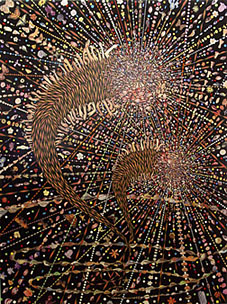
Cover artwork by Fred Tomaselli

Available August 1. $12US/14Can/17World postpaid.
Click here for info on pre-ordering.

Summer of Love Redux

The New York Times finally gets hip to the new folk/weird America thing.
Arthur receives a passing mention.

Summer of Love Redux

By WILL HERMES
Published: June 18, 2006

ASA IRONS of the Vermont musical collective Feathers is stroking his beard. It is formidable beard; a biblical beard. He and his band mates—who mainly operate out of a rural farmhouse without cellphones, Internet, manager or booking agent—are at WNYC radio to perform their enigmatic, pixie-ish folk-rock on the long-running show “Spinning on Air.” Today their instruments include a lap harp, a toy xylophone, a Middle Eastern hand drum and an acoustic guitar hand-painted with animals and rainbows.

Ruth Garbus, a dark-eyed 24-year-old whose T-shirt depicts tractors flying through space, is talking about conjuring mystery with music, “that whole psychedelic thing of letting your mind go where it will.” Mr. Irons, 24, his long hair tied up in a bun, chimes in with a story about working as a carpenter and about growing up with parents who were “woods hippies, not town hippies.”

“I’m all about the old world, man,” Mr. Irons says with a mischievous laugh.

Perhaps. But he and his band mates are also about a new world: one of the most creatively vigorous strains of underground music. Initially dubbed “freak folk,” it looked like a trend of the moment a couple of years ago, when two California artists, Joanna Newsom and Devendra Banhart, attracted attention with charmingly shaggy, deceptively whimsical, largely acoustic albums.

But the scene they spearheaded has grown steadily and expanded sonically, getting less folkie and more, well, freaky. It has also gone international. And this season—the Summer of Love 2.0—it comes into full, wild bloom with releases, tours and festival appearances that promise nothing less than a new age of Aquarius.

Continue reading “Summer of Love Redux”

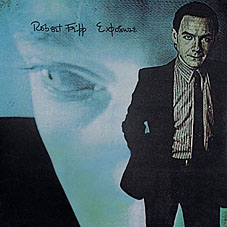
Exposure by Robert Fripp

exposure.jpg

Robert Fripp’s 1979 album, Exposure (DGM0601), was intended to form part of a trilogy together with Peter Gabriel’s second solo album and Sacred Songs, by Daryl Hall. Fripp produced all three albums and also plays on all three. As things turned out, the scheme was too much for “dinosaur” (Fripp’s term) record company executives, they regarded Hall’s album as uncommercial then buried its release.

Exposure is (for me) the most successful of the three. Although it mixes styles and vocalists (Daryl Hal, Peter Hammill, Terry Roche and Peter Gabriel singing his own Here Comes The Flood), it manages to maintain a consistent atmosphere very much influenced by Fripp’s life in New York and his connections with the NYC New Wave of the time (he played on Fade Away And Radiate by Blondie). It also forms the bridge between the King Crimson of old and what would become the Eighties’ Crimson. Fripp’s experimental side is to the fore here, with the first showcasing of his “Frippertronics” in a musical setting and many taped conversations being mixed into the music.

The new CD set released this week manages to reinvent the album to some degree, presenting the original album on one disc then a whole disc of different vocal mixes on the other, some of which use different singers, such as Daryl Hall singing on tracks that featured Peter Hammill originally. The sound is also considerably enhanced, making the heavier pieces sound especially ferocious. An album that’s nearly thirty years old suddenly sounds fresh again.

More details after the jump.

Continue reading “Exposure by Robert Fripp”

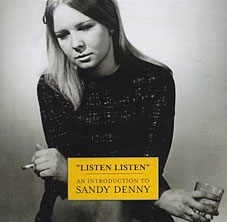
Sandy Denny

sandy_denny.jpg“We don’t hear Sandy Denny on the radio these days. Her records, few that they are, don’t fit the current formats, don’t send the programmers into paroxysms, don’t have listeners voting in. She couldn’t be considered for Sixties, Seventies hit nostalgia; she never had hits. Rock album stations? Never sold enough albums. Even Nick Drake sneaks into the odd Easy Listening show, the music lulling and deceiving, with its attractive surfaces hiding the pain within, something romantic for a cult to cling to. But where is Sandy’s cult? Where are the graveside vigilants à la Jim Morrison? The colour supplemental cultural dissections? The South Bank Show eulogies, the bad TV- and film-biopics telling us who should be important in our lives? Somewhere the taste gurus have failed the flock, have failed to tell us, after twenty years of hindsight opportunity, that Sandy Denny was the greatest British female artist of her generation.”

Richard Thompson