The music of Igor Wakhévitch

igor1.jpg

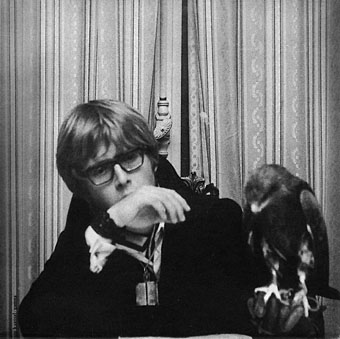
Igor Wakhévitch and feathered friend.

Continuing the Francophile theme, I felt that now was a good time to plumb the mysteries of the enigmatic Igor Wakhévitch. Who? Well… In 20th century music there’s strange and there’s weird and then there’s off-the-wall unclassifiable which is the place where we have to file Igor’s compositions. After half a lifetime spent trawling record shops for unusual music these albums had somehow managed to remain off the radar until a CD reissue set, Donc…, appeared courtesy of Fractal Records and a friend with similarly outré tastes (hi Gav!). The obscurity of these remarkable recordings can’t solely be due to Monsieur Wakhévitch being French; Richard Pinhas, Bernard Szajner and (of course) Magma, have been given enough attention over the years.

So what does this stuff sound like? Thankfully the redoubtable Alan Freeman tackled the problem of describing the albums in Audion (reproduced below), a task I would have found rather daunting. Docteur Faust is probably my favourite, a crazily eclectic and doomy album which lurches from rock freakout to contemporary orchestral/choral to electro-acoustics and back again. Imagine the witch cult from Rosemary’s Baby jamming with Alpha Centauri-era Tangerine Dream while Peter Maxwell Davies and Amon Düül 2 slug it out in the background. The clincher is a great cover by French comic artist Philippe Druillet.

One other notable album that the Donc… collection omits is the 1974 recording of Salvador Dalí’s opera, Être Dieu. Dalí wrote the libretto in 1927 with Federico Garcia Lorca but the piece wasn’t recorded until Wakhévitch provided a score. The result is pretty much the same as Wakhévitch’s other work, with the added bonus of the Surrealist master declaiming and frequently shrieking over the music.

For more information about Donc… and Igor Wakhévitch see the Fractal Records review page.

Continue reading “The music of Igor Wakhévitch”

The genius of Captain Beefheart

beefheart.jpg

Mission: unlistenable
His music is described as a metal sock, an action painting and a mad, giant watch—yet it has inspired bands from Talking Heads to the White Stripes. John Harris gets to grips with Captain Beefheart

John Harris
Friday August 4, 2006
The Guardian

IN THE 1980s, American researchers found that the average album was played 1.6 times. Given the new practice of impatiently scouring a CD for one or two highlights and then discarding it, the iPod age has presumably seen that figure tumble, but the basic point remains: most of the music we buy lies pretty much unplayed – either because it is rubbish, or because it says a lot more about our vanity than what we actually like. On the latter score, history’s most shining example may be Trout Mask Replica by Captain Beefheart and His Magic Band, an allegedly classic album that must surely sit undisturbed in thousands of households. Playing it—or rather, attempting to—is a bit like being in one of those cartoons in which the principal characters cagily open a door, only to find all hell – elephants, possibly, or a speeding train – breaking loose behind it, whereupon they slam it shut again. Its opening moments let you know what you’re in for: a discordant racket, all biscuit-tin drums and guitars that alternately clang and squall, eventually joined—apparently by accident—by a growling man complaining that he “cannot go back to your land of gloom”. Skipping through the remaining 27 tracks does not throw up anything much more uplifting. Indeed, one song finds the same voice rather distastefully evoking the Holocaust: “Dachau blues, those poor Jews/ Dachau blues, those poor Jews/ One mad man, six million lose.”

When this kind of experience happens to a rock critic, it can easily bring on a chill feeling of inadequacy. After all, Beefheart—those in the know rarely use the “Captain”—remains a gigantic influence on so much rock music that has claimed to stand as something more than mere entertainment, from the post-punk likes of Pere Ubu, Talking Heads, Gang of Four and Public Image Limited, through names as varied as Tom Waits and Happy Mondays, and on to such talents as PJ Harvey, Franz Ferdinand and the White Stripes. Equally importantly, he is a crucial part of the gnomic culture through which those people (men, mostly) whose lives have been hopelessly afflicted by music commune with one another. It’s not in the film, but the Jack Black character in High Fidelity was surely a Beefheart obsessive.

Continues here.

Generative culture

eno_tokyo.jpg

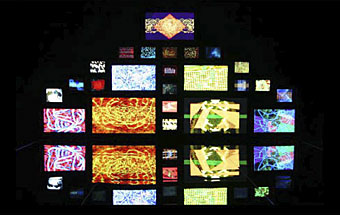
77 Million Paintings by Brian Eno, Laforet Museum, Harajuku, Tokyo.

Brian Eno is in the latest Wire talking about his forthcoming DVD-ROM, 77 Million Paintings. He also mentions coining the term “generative music” in 1995 to a resounding silence. 77 Million Paintings continues the generative project:

This will be available later in the year as a DVD-ROM (which will play on most modern computers) and a DVD featuring Brian talking about the project. It also includes an extensive booklet covering Brian’s long and successful career as a visual artist.

The name 77 Million Paintings comes from the possible number of images that can be created from a huge number of combinations. Anyone familiar with Brian’s audio-visual installations will instantly recognise the inspiration behind the project. The music is from Brian’s installation collection.

Ambient stuff for the eyes, in other words. I’d be looking forward to this if I still had a TV (mine packed up a few years ago) as I used to program my primitive Spectrum computer (which still works!) to generate simple patterns, turning the TV screen into an abstract artwork for a few hours. The difference with Eno’s project, of course, is the greater variety, quality and degree of intent involved. I saw one of his installation works, The Quiet Club, at the Hayward Gallery in 2000 which used similar audio and visual processes. With 77 Million Paintings you’ll be able to turn your living room into a quiet club of your own.

In a similar generative vein, there’s WolframTones: “A New Kind of Music – Unique cellphone ringtones created by simple programs from renowned scientist Stephen Wolfram’s computational universe.” Too complicated to explain; go and play around with it.