
One nation under a Moog | Synth Britannia.
Category: {electronica}
Electronic music
Gristleism

In which the Buddha Machine returns as a bespoke instrument/greatest hits package from Industrial music outfit Throbbing Gristle. Having been a TG aficionado for many years, and being the proud owner of a Buddha Machine, this item looks like an essential purchase.
Thirteen original TG loops: a mix of experimental noise, industrial drone, and classic melodies and rhythms.
Built-in 50mm speaker, volume control, pitch-shift control and loop selector switch.
Features more loops and almost twice the frequency range of the original Buddha Machines.
Powered by two AA batteries.
Palm-Sized: W 67mm x H 69mm x D 35mm
Available in three colours: Black, Chrome and Red
UK Retail Price: 19.99 GPB
Designed by: Throbbing Gristle & Christiaan Virant
Concept by: Christiaan Virant
Manufactured by: Industrial Records Ltd
Music by: Throbbing Gristle
While we’re on the subject of music/noise and musical noise, there’s a couple of other recent discoveries worthy of mention. Inudge is another music-making web toy using loops and a grid system. Very easy to use and fun to play with. Less frivolously, the British Library opened its Archival Sound Recordings to the public earlier this month. I grew up by the sea, and still miss being near it, so the lapping wave soundscapes are a pleasant balm.
Previously on { feuilleton }
• A=P=P=A=R=I=T=I=O=N
• Uncopyable
• Buddha Machine Wall
• God in the machines
• Layering Buddha by Robert Henke
• Generative culture
La Roux: ‘Of course Lady Gaga’s not my thing’
La Roux: ‘Of course Lady Gaga’s not my thing’ | Elly Jackson on pop life, androgyny and related matters.
A=P=P=A=R=I=T=I=O=N

A=P=P=A=R=I=T=I=O=N is a collaboration between artist Cerith Wyn Evans and Throbbing Gristle, the once notorious Industrial music act now enjoying a resurgence of activity and attention. Evans and TG have an earlier connection via Derek Jarman, for whom Evans worked as an assistant. Given how much I enjoy seeing mirrors used in art, I’m very taken with these, and knowing that they function as drifting speakers transmitting specially recorded TG audio makes them doubly interesting. The mirrors-plus-audio aspect is reminiscent of Josiah McElheny’s recent Island Universes with Paul Schütze but that’s not to imply any influence, both artists have been following their individual paths for some time.
The title of this work comes from a poem by Stephan Mallarmé (1842–1898), a poet closely associated with the Symbolists. Looking at an English translation, the piece ends with the line “a snow of white bouquets of perfumed stars”; that final, impossible flourish—perfumed stars—is a very Symbolist touch. Claude Debussy, who took the title of his Prélude à l’après-midi d’un faune from Mallarmé, set Apparition to music in 1884.
A=P=P=A=R=I=T=I=O=N can be seen at Tramway, Glasgow until September 27, 2009.
• A=P=P=A=R=I=T=I=O=N test run on Chris Carter’s Flickr pages.
Previously on { feuilleton }
• In the Shadow of the Sun by Derek Jarman
• The art of Josiah McElheny
Uncopyable
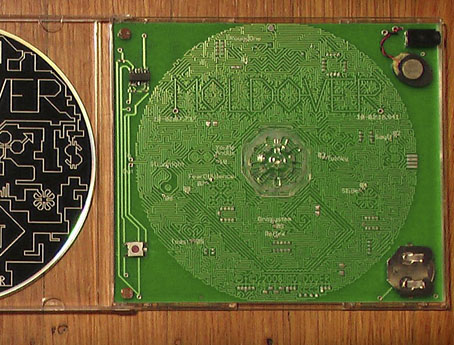
Moldover’s CD case: a working theremin.
In May this year, Brian Eno was writing in Prospect magazine about the current state of the music business as it continues to be assailed by digital technology. Among the things Eno discussed was the packaging of music:
The duplicability of recordings has had another unexpected effect. The pressure is on to develop content that isn’t easily copyable—so now everything other than the recorded music is becoming the valuable part of what artists sell. … That suggests to me the possibility of a refreshingly democratic art market: a new way for visual artists, designers, animators and film-makers to make a living. So, as one business folds, several others open up. (More.)
Having started out as an album cover artist (I wasn’t a designer back then), and working still as a CD designer, this is naturally an attractive thesis. Earlier this week John Walsh in The Independent wrote a potted history of the album cover and noted that the big record companies are also realising again that contemporary music as an artform is more than merely a collection of audio tracks:
Apple, creator of the iPod and the iTunes store—the sworn enemies of commercially-packaged music—is getting into bed with the four largest record labels, to help them stimulate album sales. They’re working with EMI, Sony Music, Warner Music and Universal Music Group on something called “Project Cocktail” that will produce all manner of extras to go with albums: interactive booklets, sleeve notes, photographs, lyric sheets, even video clips. Buyers will be able to call up album tracks through the interactive booklet, while leafing through pictures of the band and trying to make sense of the lyrics.
This, however, seems to be missing the point. Absolutely anything digital can be copied and passed on, and that applies equally to album extras as to the tracks themselves. What can’t be copied, of course, is a desirable object which contains the music. The lavish album sleeves of the 1970s were very much desirable objects which contained music, and no end of facsimile CDs of Physical Graffiti will match the impact of Peter Corriston and Mike Doud’s design for the vinyl release.
Which brings us to Moldover‘s extraordinary light-operated theremin-in-a-CD-case, a beautiful design and a really clever use of the wretched jewel case box. The music on Moldover’s accompanying CD may be swapped around illicitly but no one is going to copy the hardware. The “Awesome Edition” of this work costs $50 and can be ordered here.

Moldover’s theremin is only an adjunct to his music, albeit a delightful one. Tristan Perich, on the other hand, like Fm3’s Buddha Machine, makes the case and the instrument one, and in Perich’s case (so to speak) possibly takes the 8-bit/chiptune thing to a definitive extreme. This is the kind of invention we could use more of, not some lazy Flash applications appended to a pop release then dumped onto the iTunes Store as an “exclusive”. It’s notable that the one thing all these works have in common is that they’re the inventions of no-budget independent artists, not big record labels.
While we’re on the subject of the Buddha Machine, the guys at Mountain*7 noted this YouTube loop work which extends the drone-loop idea into the audio/visual realm.
Elsewhere on { feuilleton }
• The album covers archive
Previously on { feuilleton }
• Buddha Machine Wall
• God in the machines
• Layering Buddha by Robert Henke
• Generative culture