Weekend links 83

hackett.jpg

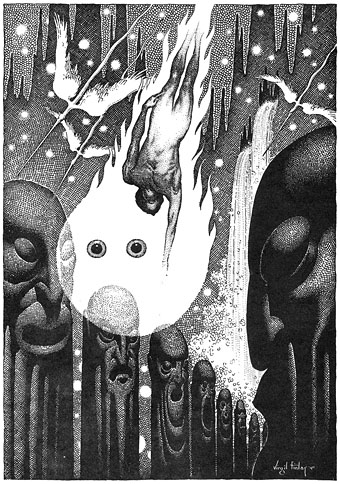
In Memory by Caitlin Hackett who describes her astonishing drawings as “contemporary mythology”.

• David Lynch’s solo album, Crazy Clown Time has just been released so The Guardian last Friday let the artist/director/musician edit their G2 supplement. Xan Brooks tried to get Lynch to open up about his inspirations while elsewhere Lynch had a chat with ZZ Top’s Billy Gibbons. Of more interest to me was news that some of the deleted sequences from Blue Velvet have been discovered. I’ve known about these for years from a feature in Video Watchdog magazine but never thought we might get to see them. Related: a mixtape by David Lynch & musical collaborator/engineer ‘Big’ Dean Hurley.

• “Book jackets these days, for reasons I won’t unpack, seem to revel, overtly, in wit, conceptual deviousness, unusual clever or droll juxtapositions – we, as a professional community, seem to have elevated the visual bon mot above all other virtues.” Peter Mendelsund in a great post about certain problems in book design, starting with the very problematic question of what to do with Nabokov’s Lolita. Related: Covering Lolita, a gallery of covers through the ages which run the gamut of bad decisions.

• “For his sins Pinocchio is not only hanged but robbed, kidnapped, stabbed, whipped, starved, jailed, punched in the head, and has his legs burned off.” Nathaniel Rich goes back to Carlo Collodi’s original Pinocchio. Disney it ain’t.

wolpe.jpg

Some of Berthold Wolpe’s Faber cover designs are now available as prints from wire-frame whose Pelham/Ballard prints were mentioned here recently. Related (and worth another visit): Faber 20th century classics at Flickr.

Technical Vocabularies – Games for May, a small collection of poems by Alan Moore & Steve Moore, is now online with authorial permission. Alan’s Beardsley pastiche on the cover is a bonus.

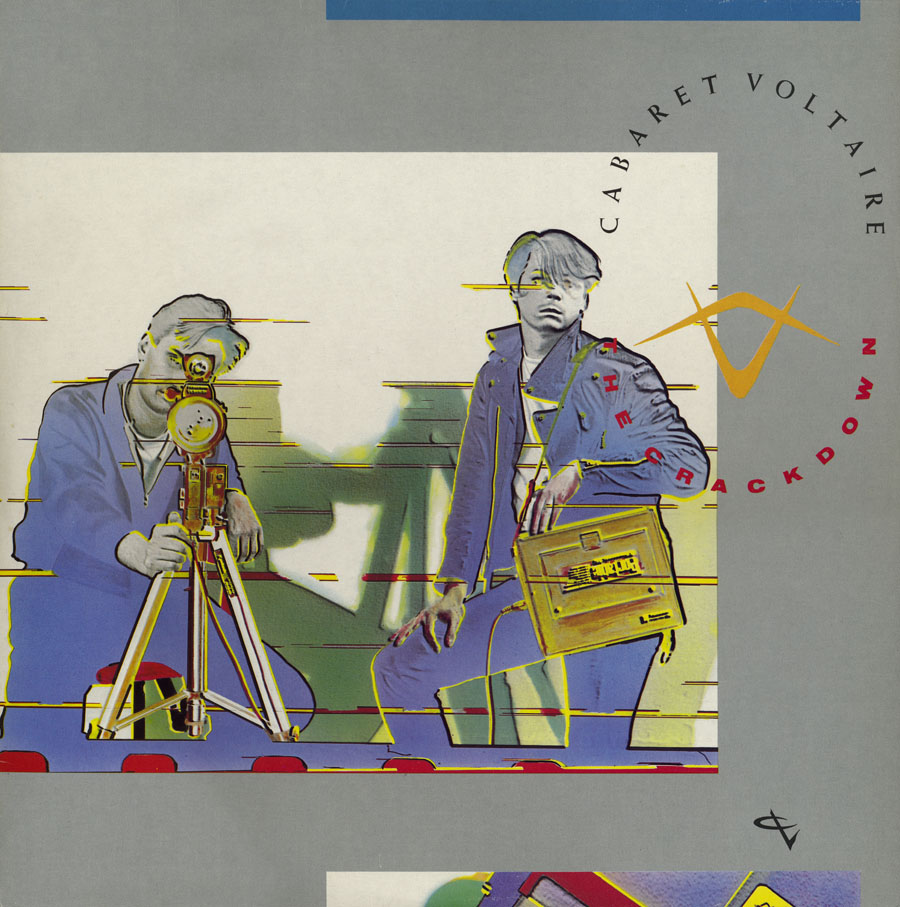
• Cabaret Voltaire’s Richard H. Kirk says the group’s Virgin albums will be reissued next year by Mute. A new edition of The Crackdown? Yes, please.

• “Homo Riot can only think of six or seven street artists in the world who regularly feature gay themes in their work, and he knows all of them.”

Rub Out The Words: Letters from William Burroughs and Philip K. Dick on the language virus theory of William Burroughs.

L’exilé de Capri: the connections between Jacques d’Adelswärd-Fersen and Roger Peyrefitte explored at Strange Flowers.

• Flying cars and monorails: Soviet Russia in the 1960s also had a Gerry Anderson view of the future.

Are You An Anarchist? The Answer May Surprise You.

Baby’s On Fire (1973) by Brian Eno | Baby’s On Fire (live, 1974) by Eno & The Winkies | Baby’s On Fire (live, 1976) by 801 | Baby’s On Fire (1998) by The Venus In Furs.

A playlist for Halloween: Orchestral and electro-acoustic

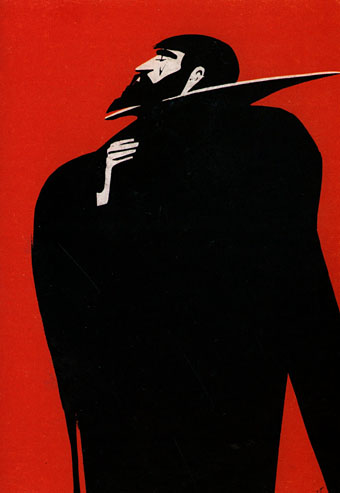
kass.jpg

Bluebeard (1982) by János Kass.

I thought I might not be able to do a fresh playlist this year, so much has already been covered by the previous lists (see the links below to earlier posts).

The search for new tonalities and timbres in 20th-century orchestral music led many composers to produce works that sound like—and have been used as—horror film soundtracks although you’ll never find critical discussion acknowledging such a vulgar reaction. This is a very masculine list although some of the performers are women. I might have included Diamanda Galás but she was in the first list, as was Delia Derbyshire with her associates in White Noise, the subject of a longer post here.

The Isle of the Dead (1909) by Sergei Rachmaninov
Mentioned here a few days ago, Rachmaninov’s suitably sombre piece is one of many compositions to borrow the medieval Dies Irae hymn for one of its themes.

Bluebeard’s Castle (1911) by Béla Bartók
Frank Zappa once said that his initial response upon hearing the music of Edgard Varèse was “These chords are mean; I like these chords.” I feel the same about Bartók’s music which can get very mean indeed. The obvious piece to mention would be the Adagio from Music for Strings, Percussion and Celeste which Stanley Kubrick used in The Shining. Instead I’ve selected Bartók’s only opera, a psychodrama for two performers and orchestra in which Bluebeard’s new wife, Judith, explores the castle (which also represents her husband’s character) only to find everything there stained with blood.

Visage (1961) by Luciano Berio
In which Berio records his wife and frequent collaborator, Cathy Berberian, then dissects her vocalisations to disturbing effect. “Visage contains no singing, and virtually no words,” says Martin Butler. “The product of days of gruelling recording for Berberian (leaving her physically damaged), it instead consists of her laughter, moans and groans, snorts and wheezes, and gibberish, all brilliantly edited, filtered, distorted and mixed with electronic backing. It is a remarkable demonstration of the power of the wordless voice. The effect is shocking and extreme, but also hilarious and touching – and often all these things simultaneously.”

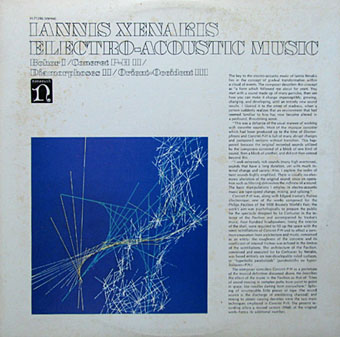
Bohor (1962) by Iannis Xenakis
In addition to making some of the most thrilling and advanced new music of the 20th century, Xenakis chose great titles for his compositions, frequently unusual words. Bohor is a recording of layered sound sources that include a Laotian mouth organ, prepared piano, Iraqi and Hindu jewellery, and should ideally be heard with the sounds surrounding the listener. Intended by its composer to represent “the onset of madness”.
xenakis.jpg

Design by Paula Bisacca.

Uaxuctum: The Legend of the Maya City, Destroyed by Themselves for Religious Reasons (1966) by Giacinto Scelsi
And speaking of great titles… The Italian composer uses orchestra, a choir and an Ondes Martenot to convey an ancient apocalypse. Part III was selected by Robbie Robertson (along with works by other composers listed here) for the Shutter Island soundtrack.

Lontano (1967) by György Ligeti
Stanley Kubrick used Ligeti’s music in three of his films. Lontano‘s piercing harmonics and growling chords prowl through The Shining together with pieces by Bartók and Penderecki.

Black Angels: Thirteen Images from the Dark Land (1970) by George Crumb
Many of the pieces here jangle the nerves but none more than Crumb’s composition for string quartet, glass and metal instruments, a part of which is used in The Exorcist. Composed “in time of war”, it’s a howl of despair whose opening manages to be even more disturbing than Penderecki’s Threnody for the Victims of Hiroshima. The 1990 Kronos Quartet recording is essential.
logos.jpg

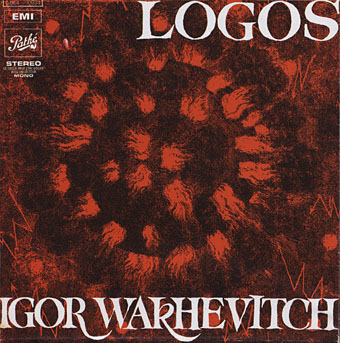
Logos (Rituel Sonore) (1970) by Igor Wakhévitch
“Sound ritual for pop group, mixed choir and magnetic tape.” The first album by the elusive French composer, a composition for a ballet, described by Alan Freeman as “a soprano singer, strange orchestral textures and percussives (drums, cymbals, gongs, etc.) blended with effects and processing. As the ominous percussion sets off with drum-rolls and ritualistic tension, the mood is of a looming anticipation of what is to come. Here we go through phases of weird swirling effects, vivid reverb and atmosphere. The tension becomes overpowering, yet we are led on…”

The Dream of Jacob (1974) by Krzysztof Penderecki
The Polish composer wrote for film soundtracks as well as the concert hall so it’s no surprise that his work can be heard in The Exorcist, The Shining and Shutter Island. The atmosphere of sustained malevolence in this piece is perfect for Kubrick’s haunted house. Whatever Jacob was dreaming about, it wasn’t pleasant.
zorn.jpg

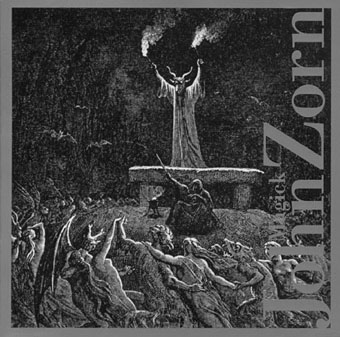
Design by Heung-Heung Chin.

Necronomicon (2004) by John Zorn
A five-part composition for string quartet from Zorn’s Magick album.

Previously on { feuilleton }
Powell’s Bluebeard
A playlist for Halloween: Drones and atmospheres
A playlist for Halloween: Voodoo!
Dead on the Dancefloor
Another playlist for Halloween
A playlist for Halloween
The music of Igor Wakhévitch

Looking for the Wild Boys

wildboys-calder.jpg

Calder & Boyars, 1972. Design by John Sewell.

This must be the first space novel, the first serious piece of science fiction—the others are entertainment.

Mary McCarthy defending The Naked Lunch in the New York Review of Books, June, 1963.

Mary McCarthy’s view—echoed a year later by Michael Moorcock and JG Ballard in the pages of New Worlds magazine—has never been popular or even particularly acceptable. William Burroughs gets touted as an sf writer by other writers, and John Clute gives him an entry in the Encyclopedia of Science Fiction, but Burroughs’ sf scenarios are guaranteed to offend those readers who prefer their narratives presented in a neat, linear form with detailed explanations of How The Future Would Actually Work, or the physics behind some piece of imaginary technology. The books which immediately follow The Naked LunchThe Soft Machine, The Ticket that Exploded, and Nova Express—all feature sf scenes or ideas. The latter was deemed sufficiently generic to prompt Panther Books in the UK to publish it three times as “Panther Science Fiction” although given the severe criticism that Moorcock sustained for trying to broaden the horizons of readers in the late 60s I don’t expect sales were encouraging.

The Wild Boys, published in 1971 (1972 in the UK), was Burroughs’ first novel after Nova Express, and his first book of fresh material after mining the stack of writing that birthed The Naked Lunch and the titles which followed. The novel is subtitled A Book of the Dead (as in the Egyptian or Tibetan Books of the Dead), and is certainly science fiction although I’ve never seen it marketed as such or noticed any sf reader include it in a list of notable genre novels of the period. My Calder & Boyers hardback offers a précis of the fractured narrative:

The year is 1988. The Wild Boys, adolescent guerilla armies of specialized humanoids, are destroying the armies of the civilized nations and ravaging the earth. The wild boys, who began in the pre-present past as petrol gangs, dousing their victims with petrol and setting them on fire for kicks, have grown to an army, dedicated to violence. One of them is used in a cigarette commercial. He becomes a new cult figure, a demi-god responsible for great destruction, and it is left to strong man Arachnid Ben Driss to exterminate the wild boys. He slaughters them, but the battle continues underground until all civilization collapses, revealing a future of horrifying dimensions. The originality of the theme and the very special Burroughs style together make this one of the most unusual science fiction novels ever, a prophetic exploration of the future, that should quickly establish itself as one of the classics of the present time.

That’s accurate, up to a point, although like many book blurbs it misrepresents the content somewhat. It also neglects to say how funny the book is. For anyone with a black sense of humour Burroughs has always been a great comic writer, and The Wild Boys has some prime examples, not least the opening chapter, Tío Mate Smiles, which is best appreciated in the author’s own reading.

Having gone through the novel in the past week, and going through its follow-up/appendix/remix Port of Saints at the moment, a couple of things occurred to me. The first was the way The Wild Boys strongly prefigures later works like Cities of the Red Night and The Place of Dead Roads. This is a fairly obvious point but it’s one that hadn’t fully clicked until now. The Wild Boys takes the problems of repressive control systems posed in the first few novels and offers a possible solution: a homoerotic utopia/dystopia where gangs of teenage boys hide out in depopulated regions, waging war against the rest of humanity with sex, magic and a mastery of weapons, including biological and viral varieties. While doing this they are steadily mutating so they can leave behind all human concerns with nation, family, laws and written language. Cities of the Red Night was Burroughs first novel after The Wild Boys and presents a less radical proposal, ranging through time with its anarchist pirate colonies and the six cities of the title. In The Place of Dead Roads Kim Carsons has his band of outlaw cowboys, The Wild Fruits, and the book gives us the conflict between the Johnsons—those who “mind their own business”—and the Shits: lawmen, politicians, tycoons, all the usual agents of Control.

Continue reading “Looking for the Wild Boys”

Weekend links 80

holberg.jpg

Niels Klim’s descent to the planet Nazar from the 1845 edition of Nicolai Klimii Iter Subterraneum (Niels Klim’s Underground Travels) (1741) by Ludvig Holberg.

BibliOdyssey posts illustrations from different editions of Ludvig Holberg’s satirical fantasy, appends the usual informative links and draws our attention Stories of a Hollow Earth at The Public Domain Review. I’d not come across the latter site before but it’s now bookmarked.

• While the economy of Europe continues to circle the toilet bowl it’s good to know that our Prime Minister is focusing on the important issues such as…limiting access to internet pornography. “Look at the implementation, and no matter where you stand on porn, I think you’ll see this plan is going to cause a lot of problems on its way to the eventual fail bin,” says Violet Blue. I was wondering how the four targeted ISPs would feel about a filtering plan that would drive many new customers elsewhere. The Register reports their response which comes down to offering guidelines rather than attempting the difficult and contentious task of filtering millions of websites.

• Related: Won’t you fuck off, Reg Bailey, in which the report by the small Christian pressure group that started all the fuss is eviscerated. | Elsewhere: Porn is good for society says Anna Arrowsmith, while Tristan Taormino asserts that “writing and publishing erotica, especially for minorities, is a political act.” Then there’s Pornsaints, “an artistic approach to porn, a pornographic approach to art, a pornartistic approach to religion.”

• In the music world: Richard H Kirk and Peter Care discuss Cabaret Voltaire and Johnny YesNo, Roy Harper talks to Alexis Petridis, and soundtrack composer Cliff Martinez is interviewed (and pictured playing a Cristal).

Witch’s Cradle at Strange Flowers (Maya Deren, Marcel Duchamp and Peggy Guggenheim), The Ghosts of Senate House, London, and Aleister Crowley’s Abbey of Thelema as it is today.

• RIP Frank Kameny, co-founder of the Mattachine Society, and a tireless gay rights advocate from the early 1960s on.

Bruce Weber photographs some of the dancers from Matthew Bourne’s Dance Company.

Terry Gilliam says “I used to think I could will things into existence. Not any more.”

• Charts at Business Insider: What the Wall Street protesters are so angry about.

Five From…: assorted wit and wisdom in the Tumblr labyrinth.

• Glass art by Jasmine Targett.

Ballard Geocoded.

Porno Base (1982) by 23 Skidoo | Kylie Minogue (2003) by Satanicpornocultshop | Tantric Porno (live) (2009) by Bardo Pond.

Main aesthetics

main01.jpg

Hydra-Calm (1992).

It’s always good to find a group of musicians who not only make the kind of sounds you like but also package their work effectively. Having read the Quietus interview with Robert Hampson last week I was going back through the catalogue of Hampson’s 90s group Main and thinking again how well the design of their digipak singles and albums complemented their music. Main evolved out of an earlier rock outfit, Loop, and the earliest Main productions still bear some trace of the trancey Loop approach to rock structures. The first Main album, Hydra-Calm, was released on Situation Two, and comes packaged like the first album from Faust, with an X-ray of a skull on a transparent sheet replacing the X-ray fist of the German group.

main02.jpg

Dry Stone Feed (1993).

With a move to the Beggars Banquet label a year later, a different design approach was adopted which set the template for nearly all the Main releases during the 1990s. An outfit (or person) named Avida is credited with Main’s design, with the name being adjusted on various releases to Avida Design, Avida Formations, Avida Hydroforms and Avida Iceforms. The decision to dwell on varieties of texture matches the evolution of the group’s music from arrangements of guitar, bass and drums to abstract and increasingly minimal fields of sound; in this respect, Deliquescence was a perfect title. Hampson and co. created their sound fields by subjecting guitar noise to unspecified sampling and effects processes. When Simon Reynolds invented the term “Post-rock” to describe some of the musical developments happening in the 1990s, Main always seemed to be exemplars of the term, they really did go from being a bona fide rock band to a group pushing sound far beyond anything to do with rock music at all.

main03.jpg

Firmament (1993).

The photos used by Avida Design start out as shots of TV screens or computer monitors then range through the natural world with close-ups of rock formations, lichen, wood grain and underwater ice. The typography is nearly always Copperplate Gothic (or a sans serif variation) printed in metallic silver ink. The most satisfying release for me was the Hz set of six CD-singles released from mid-1995 to 1996, the last of which came with a box to place the singles in and a booklet containing symbols which relate to each disc. Hz is the peak of their output, and although it was later released as a double-disc set I prefer the box.

Anyone looking for these releases today can find copies for sale at Discogs.com. Robert Hampson is still active, his site is here. A few more Main covers follow.

Continue reading “Main aesthetics”