The recurrent pose 29

slimane.jpg

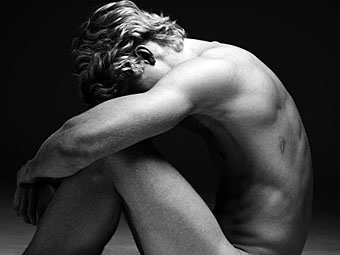
Taner photographed by Hedi Slimane.

No, I don’t go looking for these deliberately, they just keep turning up. This latest manifestation of the Flandrin pose is from a photo shoot by Hedi Slimane. I was going to write a bit more on this subject but haven’t had the opportunity today since the webhost has been having problems and the site was down for a few hours. Something for later. Meanwhile, a commenter recently pointed out this similar example by John Jude Palencar, a Flandrinesque painting for a book cover.

Elsewhere on { feuilleton }
The recurrent pose archive

Uranian inspirations

gloeden2.jpg

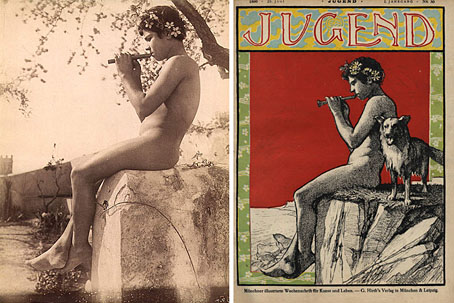
left: Sicilian boy by Wilhelm von Gloeden (no date); right: Jugend cover by Hans Christiansen (1896).

My current reading is The Secret Life of Oscar Wilde (2003), a long and fascinating study by Neil McKenna which attempts to disentangle the true nature of Wilde’s sex life from the myths and evasions of his biography and biographers. Among the pictures in the book, McKenna shows a couple of the “Uranian” photographs by Wilhelm von Gloeden (1856–1931) which Wilde owned. Von Gloeden’s views of naked Sicilian boys were described as “Classical” in a barely-believable subterfuge familiar during the 19th century, and it’s understandable why Wilde, who’d been praising the attractions of Mediterranean youth for most of his adult life, would have found these pictures worthy of purchase. Wikimedia Commons has a substantial set of the photos, although it should be noted that provenance is often uncertain; there were other photographers active in Taormina at the time who catered to a similar market. One photo in particular stood out recently when I recognised it as the possible source for the figure on a Hans Christiansen cover for Jugend magazine of 1896. The cover above has appeared here before but this is the first time I made the photographic connection.

gloeden1.jpg

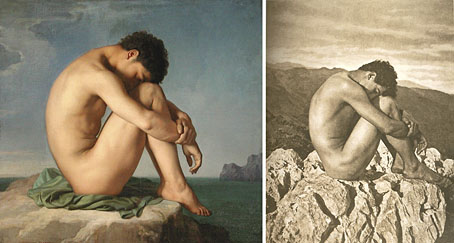
left: Jeune homme assis au bord de la mer by Jean Hippolyte Flandrin (1836); right: Cain by Wilhelm von Gloeden (c. 1902).

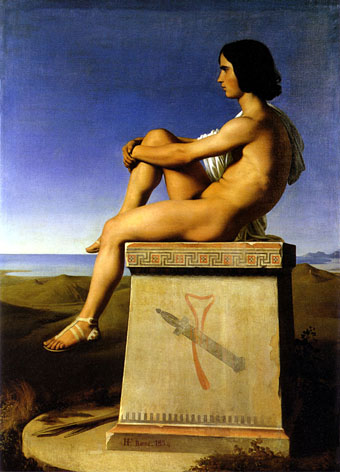
Gloeden, of course, was one of the first people to use the Flandrin pose, as I noted in the original post on that theme. I wonder if he knew he’d been copied in turn? That Jugend cover and its inspiration reminds me a little of Flandrin’s other depiction of Classical youth, his portrait of Polites, a painting which Oscar would no doubt have enjoyed.

polites.jpg

Polites, Son of Priam, Observes the Movements of the Greeks by Jean Hippolyte Flandrin (1834).

Elsewhere on { feuilleton }
The recurrent pose archive
The Oscar Wilde archive

Previously on { feuilleton }
Forbidden Colours
Jugend Magazine
Evolution of an icon

Fencing fashion again

afanador1.jpg

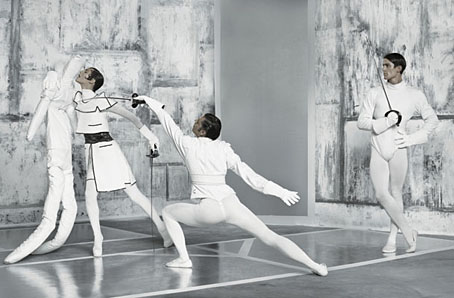
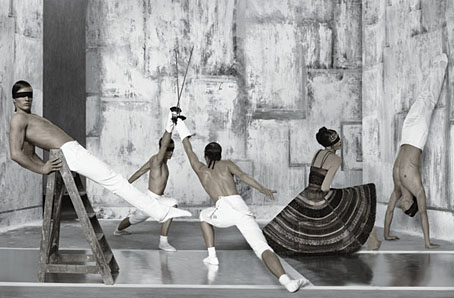
A brace of elegant fencers posing for an Elle Italia spread by photographer Ruven Afanador whose Torero series was highlighted here in April. Afanador’s recent work is worth a look for the set showing a model posing in an antiquated schoolroom among bones and stuffed animals. Via Homotography.

afanador2.jpg

Elsewhere on { feuilleton }
The men with swords archive

Previously on { feuilleton }
Torero

An apology for Alan Turing

turing.jpg

Sometimes petitions work. A few weeks ago one such was launched by computer scientist John Graham-Cumming on the UK government website requesting a public apology for the terrible treatment accorded mathematician and wartime codebreaker Alan Turing in 1952. Turing was prosecuted after admitting a gay affair to police investigating another matter and given the choice of imprisonment or parole with chemical castration; in order to carry on working he took the latter choice but subsequent depression led to his suicide. The law used was the same which sent Oscar Wilde to prison in 1895, and Turing’s case was probably the worst treatment of a notable figure on the basis of sexuality since Wilde. During the Second World War Turing had saved countless lives by helping crack the Enigma code, and his early computer research led to the development of machines like the one on which you’re reading these words. In 1999 TIME Magazine put him in a list of the 100 Most Important People of the 20th Century.

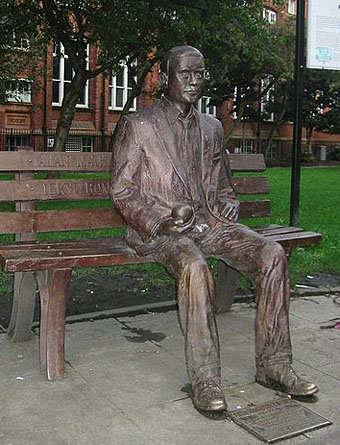
Turing has always felt like a local hero to me even though he only lived in Manchester for a few years. The house where he died isn’t far from where I live, and he has a memorial statue (above) in Sackville Park in the city centre, midway between the gay village and the Institute of Science and Technology where he worked. The petition gained a lot of support—30,805 signatures—including endorsement from high-profile figures such as Richard Dawkins and Stephen Fry. I signed it although I was sceptical it would lead to anything; this government doesn’t have much of a record for paying attention to the wishes of its citizens. So colour me surprised now that PM Gordon Brown has issued an apology:

Thousands of people have come together to demand justice for Alan Turing and recognition of the appalling way he was treated. While Turing was dealt with under the law of the time and we can’t put the clock back, his treatment was of course utterly unfair and I am pleased to have the chance to say how deeply sorry I and we all are for what happened to him. Alan and the many thousands of other gay men who were convicted as he was convicted under homophobic laws were treated terribly. Over the years millions more lived in fear of conviction.

I am proud that those days are gone and that in the last 12 years this government has done so much to make life fairer and more equal for our LGBT community. This recognition of Alan’s status as one of Britain’s most famous victims of homophobia is another step towards equality and long overdue. (More.)

I take a consistently dim view of the present administration when it comes to its diminishing of our civil liberties and its involvement in other people’s wars. But when it comes to gay issues, Blair and Brown have been the best Prime Ministers since 1967, when another Labour government overturned the law which killed Wilde and Turing. The best, bar none. This announcement is another plus in that direction.

Previously on { feuilleton }
Stonewall forty years on
Over the rainbow
Forty years of freedom after centuries of injustice