The Beard, a film by Ian Emes

beard.jpg

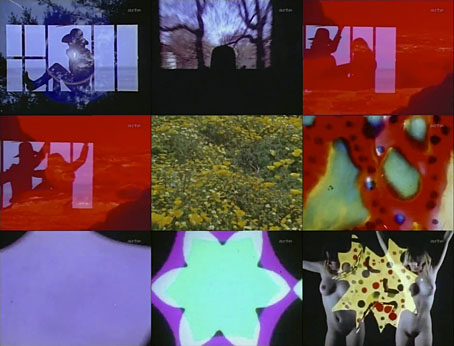
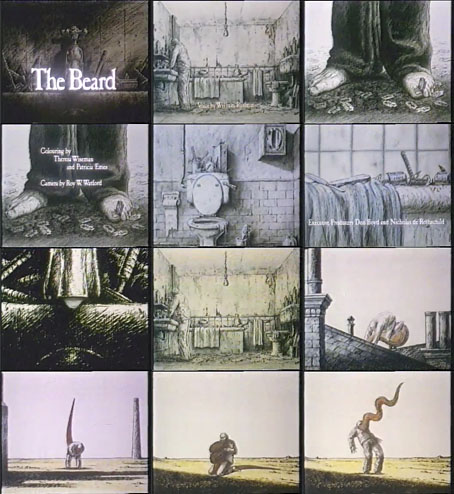
The Beard (1978) is a short, surreal animated film, directed by Ian Emes and based on an idea and illustrations by Peter Till. Electronic musician Adrian Wagner provided the soundtrack. I’d been looking for this on YouTube for a while, hoping to see it again. It’s a great piece of work, opening in a comical fashion when a shaving man (voiced by William Rushton) finds his beard taking on a life of its own, then turning increasingly nightmarish. A low-res copy sourced from video tape does no justice to the detailed drawings but it’s still worth a watch.

Somewhat better known, if not quite so strange, is Martin Scorsese’s student film, The Big Shave (1967), which may be seen here.

Eyetoon, a film by Jerry Abrams

eyetoon1.jpg

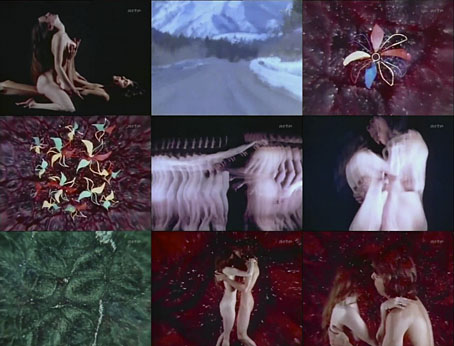
“Fuck for Peace” declares a title card at the end of Jerry Abrams’ Eyetoon, an 8-minute slice of psychedelia from 1968 whose second half has a hippyish couple doing exactly that as they run through a few hardcore Kama Sutra moves. The rest of the film is comprised of rapid editing and some brief animated overlays, together with street shots of the residents of what I’m guessing is San Francisco. The buzzing, twittering electronic score is by David Litwin. A year before this Abrams had documented the Human Be-In, the first major hippy gathering in Golden Gate Park in January 1967. His equally psychedelic film of that event can be seen here.

eyetoon2.jpg

Previously on { feuilleton }
Street Fair, 1959
San Francisco by Anthony Stern

Weekend links 202

carrington.jpg

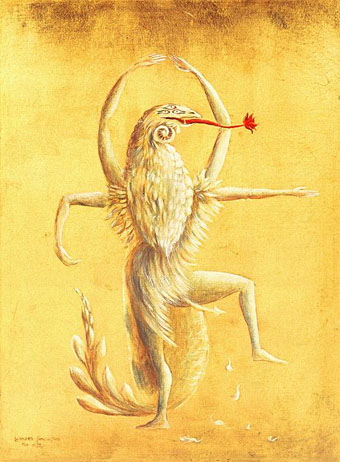
Figuras Miticas: Bailarin II (1954) by Leonora Carrington.

• The 26th Annual Lambda Literary Award Finalists have been announced. Ghosts in Gaslight, Monsters in Steam; Gay City: Volume 5 made the LGBT Anthology list, so congratulations to editors Evan J. Peterson & Vincent Kovar, and everyone else involved. I illustrated and designed the cover of that volume which also contains a piece of my fiction, Study in Blue, Green, and Gold.

Music in School (1969), episode 4: “A New Sound”. Amazing BBC TV programme for schools showing children playing avant-garde compositions using bowed metal sheets, tape loops, and primitive electronic equipment. I was at school then, and can’t help but feel a little jealous. Related: Delia Derbyshire Day approaches.

Voices Of Haiti (1953), recorded during ceremonials near Croix Des Missions and Petionville in Haiti by Maya Deren.

These days it’s hard to remember that Whistler’s Symphony in White, No. 1: The White Girl caused a bigger uproar at the Salon des Refusés of 1863 than Manet’s Déjeuner sur l’herbe, or that Monet was more influenced by Whistler than vice-versa. The delicacy of Whistler’s perceptions and his willingness to sacrifice everything for the sake of harmony make for an art less bracing than that of Degas or Pissarro. And yet how much life there is in his little Thames riverscapes. Perhaps we need another major exhibition—there hasn’t been one for twenty years—to re-evaluate him.

Whistler’s Battles by Barry Schwabsky

• Mix of the week (and a very good one it is): Abandoned Edwardian Schoolhouse by The Geography Trip.

Morton Subotnick tells Alfred Hickling how recording Silver Apples of the Moon blew his mind.

• The fantasy artwork of Ian Miller. A new book, The Art of Ian Miller, is published next month.

Queen for a Day by Alison Fensterstock. A look at the Mardi Gras Queens of New Orleans.

Tex Avery (1988): A 50-minute BBC documentary about the great animation director.

• The Gentle Revolutionary: Peter Tatchell talks to Joseph Burnett about Derek Jarman.

The Soaring and Nearly Forgotten Arches of New York City.

Dennis Hopper‘s photos of American artists in the 1960s.

Vodun at Pinterest.

Litanie Des Saints (1992) by Dr. John | Dim Carcosa (2001) by Ancient Rites | Far From Any Road (2003) by The Handsome Family

Mr Bradly Mr Martin Hear Us Through The Hole In Thin Air

bradly1.jpg

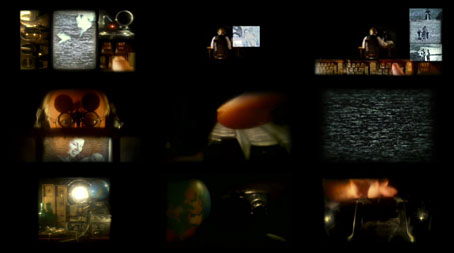
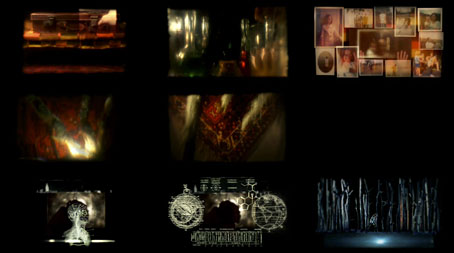
Vimeo swarms with Burroughs-related films, many of which might not have been made had it not been for the profusion of recordings of the author reading his work. This short from 2010 is one of the better examples, a combination of live-action film and animation by Greig Johnson that crams a considerable amount of invention into five minutes. The text is from the mulch of cut-ups that formed Nova Express, the recording being one of the tracks on Burroughs’s first album of readings, Call Me Burroughs (1965). Given the film’s style and short running time it makes a good double-bill with Philip Hunt’s Ah Pook Is Here (1994).

bradly2.jpg

Elsewhere on { feuilleton }
The William Burroughs archive

The Last Words of Dutch Schultz, a film by Gerrit van Dijk

lastwords.jpg

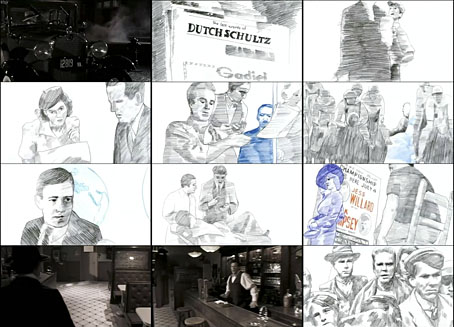
Gerrit van Dijk’s combination of live-action sequences and rotoscoped animation is tangentially related to William Burroughs, it being Burroughs who popularised the deathbed ramblings of New York gangster Arthur “Dutch Schulz” Flegenheimer with a “fiction in the form of a film script” also entitled The Last Words of Dutch Schultz (1970).

Flegenheimer was gunned down in the toilet of the Palace Chop House in Newark, New Jersey, in October 1935. Three of his associates had also been shot but he survived, and he spent two days muttering in his hospital bed while a police stenographer took notes. Burroughs was fascinated by the dissociated stream-of-conscious nature of the transcript which revealed little about his assailants but drifted feverishly through memories and hallucinations. The shooting and the deathbed ramblings were further popularised in 1975 by the publication of the Illuminatus! trilogy by Robert Shea and Robert Anton Wilson in which some of Flegenheimer’s more surreal pronouncements—”A boy has never wept nor dashed a thousand kim”—acquire occult significance. Flegenheimer and his last words also turn up in Exterminator! (1973), and Burroughs further fragmented the transcript in at least one of his own recordings where he reads out the equally strange phrases from transcripts of so-called electronic voice phenomena over an earlier reading of Flegenheimer’s words; the voices of the (supposed) dead wiping out the voice of the dying.

Burroughs’ Last Words of Dutch Schultz is nicely presented in its original form, the pages being laid out like a screenplay interposed with crime-scene photos from the period, Flegenheimer’s mug-shots and Art Deco graphics. The scene descriptions range through Flegenheimer’s life and mob history; whether they would make a good film or not would no doubt depend on the director. A film based on the script would be feature-length, and the narrative is a very fragmented one. Gerrit van Dijk’s film runs for 23 minutes and takes a similar approach, dramatising the shooting from different angles while juxtaposing the live action with animated sequences that are often anachronistic. Rutger Hauer supplies Flegenheimer’s dying voice. The anachronistic moments don’t contribute much unless we’re meant to regard Flegenheimer’s fever as being some kind of precognitive vision. Given the nature of the material—Depression-era gangsters, hallucinations, the Burroughs connection—I’m sure this won’t be the last film we see on the subject.

Elsewhere on { feuilleton }
The William Burroughs archive