Secret Joy of Falling Angels, a film by Simon Pummell

angels.jpg

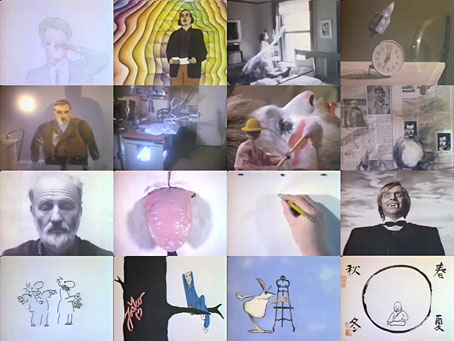
An animated film from 1991, Secret Joy of Falling Angels layers a variety of ink and paint effects, sketched outlines and a silhouetted bird skeleton. This creates a very different group of animated angels to those in Borowczyk’s Les Jeux des Anges and Bokanowski’s L’Ange although taken together all three films would make for a strange and unique triple-bill. In a previous post I quoted producer Keith Griffiths enthusing about Bokanowski’s masterwork, and Griffiths happens to be the producer of Simon Pummell’s film. Pummell also offers thanks to those regular Griffiths collaborators (and fellow Bokanowski enthusiasts) the Brothers Quay. (Note: the Vimeo page has “Fallen Angels” but the title on the film is “Falling Angels”.)

The Nose, a film by Alexandre Alexeieff & Claire Parker

nose.jpg

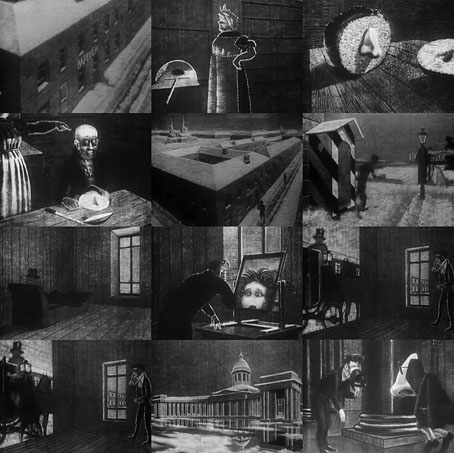
The last time I wrote about the animated films of Alexandre Alexeieff & Claire Parker the only copies available were low-grade things on YouTube which have long-since vanished (one of many reasons I don’t embed YT players in these posts). Happily a new copy of The Nose (1963) has appeared that’s not only better quality but isn’t split into two as was the case earlier.

The Nose is based on the Gogol story of the same name, a tale of a St Petersburg official who wakes to find his nose has left his face and is masquerading as a civil servant. I’ve not read Gogol’s story but I do have Nabokov’s book about Gogol which dwells not only on the prominent nose of the author, but also his traumatic death which was hastened in part by a quack physician who treated Gogol by applying leeches to his nose. Neither story or film contain anything as horrific. The film version is a wordless animation made using the pinscreen technique which Alexeieff & Parker developed in order to create greyscale animated films without recourse to smudgy materials like pencil, pastel, charcoal, etc. As I’ve mentioned before, the most notable application of this technique is the prologue the pair created for Orson Welles’ film of The Trial (1962). What’s striking about the Alexeieff & Parker use of the pinscreen is how skilfully they use it to manipulate light and shade. Where other animators like Jacques Drouin used the technique more impressionistically, Alexeieff & Parker’s films at times give the impression of watching an animated engraving. The Nose is one of their finest pieces. (Thanks to Gabe for the tip!)

Previously on { feuilleton }
Alexandre Alexeieff and Claire Parker

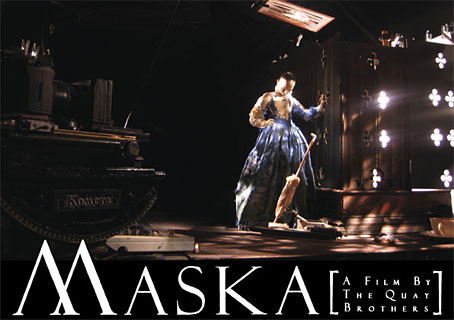
Maska: Stanisław Lem and the Brothers Quay

maska1.jpg

Did I mention the Brothers Quay? This is a mesmerising piece, and another short film to add to the growing number of Quay works yet to be collected on DVD. Maska (2010) is a 23-minute digital animation based on Stanisław Lem’s short story, The Mask (1976), which the producers have recently made available on YouTube. It was perhaps inevitable that if the Quays were going to venture into science fiction they’d use an Eastern European source. Lem’s story concerns a sophisticated technological society which is nonetheless still a monarchy. The narrator is an artificial woman who the aristocracy have created for a special mission; her human exterior conceals a robot interior, but this is no Maria from Metropolis. Midway through the story the robot breaks free of its human shell and is revealed to be a mantis-like creature.
maska2.jpg

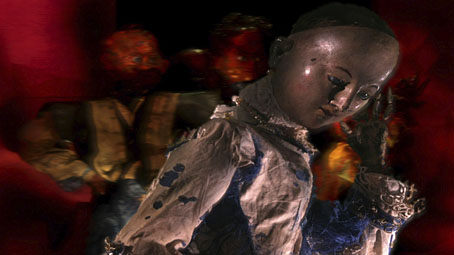
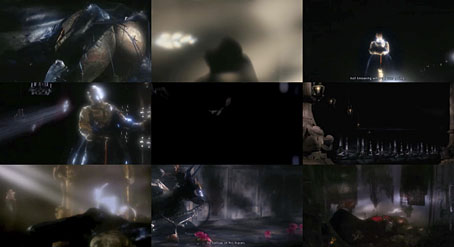
The Quays’ corpus has tended to avoid genres of any kind so it’s fascinating seeing how they wrangle both sf and horror into a mise-en-scène which is remote from their decaying European scenarios but which, in its details, is completely familiar: puppet characters, flickering light, shifting focus, everything immersed in shadow. Maska also departs from form by having a spoken narration which offers some rudiments of explanation. The habitual atmosphere of unease is still present, however, and pushed to outright horror in places, assisted by extracts from Penderecki’s nerve-jangling De Natura Sonoris No. 1.
maska3.jpg

As with Piotr Kamler’s Chronopolis, this is a good reminder of how science fiction can be presented in a less obvious manner by animation, offering a view into a world that doesn’t have to be explained down to the last detail. Some of the best written SF, and some comic-strip SF (usually the Continental titles), delivers a strangeness that’s completely absent from most filmed science fiction. Vast budgets demand simple-minded narratives with mass appeal so it’s left to animation and low-budget films to venture into areas that would be off-limits elsewhere. Maska is an impressive film, one of the best Quay shorts I’ve seen for some time. Watch it here.

Elsewhere on { feuilleton }
The Quay Brothers archive

The Beard, a film by Ian Emes

beard.jpg

The Beard (1978) is a short, surreal animated film, directed by Ian Emes and based on an idea and illustrations by Peter Till. Electronic musician Adrian Wagner provided the soundtrack. I’d been looking for this on YouTube for a while, hoping to see it again. It’s a great piece of work, opening in a comical fashion when a shaving man (voiced by William Rushton) finds his beard taking on a life of its own, then turning increasingly nightmarish. A low-res copy sourced from video tape does no justice to the detailed drawings but it’s still worth a watch.

Somewhat better known, if not quite so strange, is Martin Scorsese’s student film, The Big Shave (1967), which may be seen here.

Eyetoon, a film by Jerry Abrams

eyetoon1.jpg

“Fuck for Peace” declares a title card at the end of Jerry Abrams’ Eyetoon, an 8-minute slice of psychedelia from 1968 whose second half has a hippyish couple doing exactly that as they run through a few hardcore Kama Sutra moves. The rest of the film is comprised of rapid editing and some brief animated overlays, together with street shots of the residents of what I’m guessing is San Francisco. The buzzing, twittering electronic score is by David Litwin. A year before this Abrams had documented the Human Be-In, the first major hippy gathering in Golden Gate Park in January 1967. His equally psychedelic film of that event can be seen here.

eyetoon2.jpg

Previously on { feuilleton }
Street Fair, 1959
San Francisco by Anthony Stern