
June 26 Bassacs (2005) and others at the Timothy Taylor Gallery, London.
A journal by artist and designer John Coulthart.

Painting
June 26 Bassacs (2005) and others at the Timothy Taylor Gallery, London.
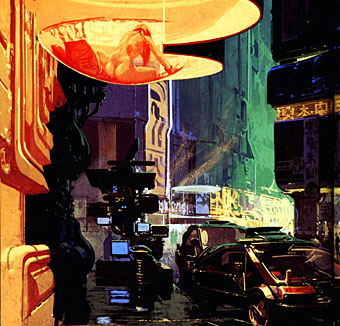
Blade Runner concept painting by the great Syd Mead.
Several reliable news sources are reporting that Blade Runner is to finally receive a decent DVD release.
In September of 2006, Warner Home Video will release a restored and remastered version of the Blade Runner 1992 Director’s Cut for a special four month limited release, in anticipation of a series of exciting and unprecedented releases of the film in theaters and on DVD.
Following a four month run of the remastered Blade Runner DVD, this disc will be placed on moratorium, by WHV. In 2007, Warner will follow with a limited theatrical run of Blade Runner: The Final Cut, which is being touted as Ridley Scott’s definitive version. Subsequently, there will be a multi-disc Special Edition DVD release which will contain three alternate versions of the film: the original U.S. theatrical cut, the expanded international theatrical cut and the 1992 director’s cut. “Ample, groundbreaking bonus features will also be included,” according to the WHV press release.
Blade Runner has been on DVD already in a very shoddy edition that’s now happily deleted, a rush release from the early days of DVD. Most news reports don’t seem to mention that the re-issue of the film was held up by various legal wrangles; the Blade Runner fan site, BRmovie.com, details the whole sorry tale. Here’s hoping Ridley’s masterpiece will be given the same treatment as the excellent (if unfortunately named) Alien Quadrilogy which had great transfers of the films and an insane amount of extras.
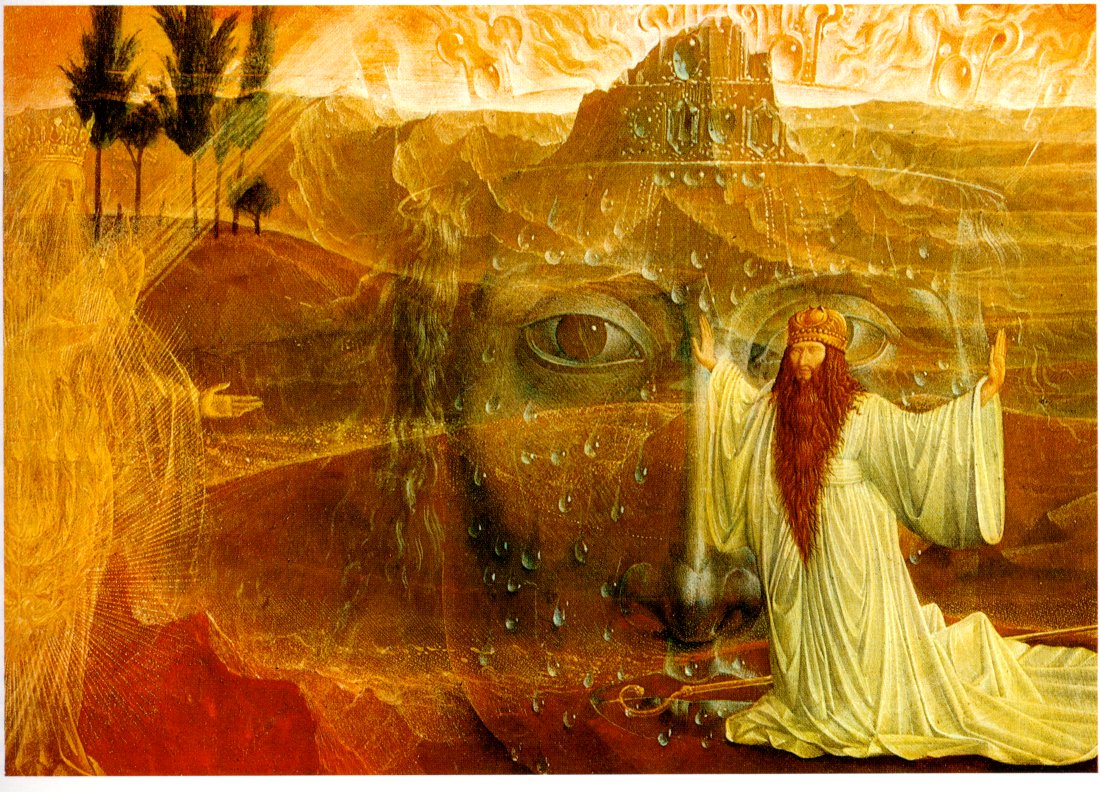
Ernst Fuchs, one of the founders of the Vienna School of Fantastic Realism in 1946, and a big influence on a later generation of artists such as HR Giger and Robert Venosa.


Elsewhere on { feuilleton }
• The fantastic art archive

Today is the 50th anniversary of the death of one of my favourite artists, Austin Osman Spare.
Like many people in the 1970s, I was introduced to the work of Austin Spare by Man, Myth and Magic, a seven volume “illustrated encyclopedia of the supernatural” published weekly in 120 112 parts by Purnell. My mother was a Dennis Wheatley reader so we had a couple of occult paperbacks in the house, among them one of William Seabrook‘s accounts of voodoo in Haiti and a copy of Richard Cavendish’s wonderful magical primer, The Black Arts, (later retitled The Magical Arts). Cavendish had been chosen as editor of Man, Myth and Magic and included occultist and writer Kenneth Grant on his editorial staff, a decision that gave the book’s producers access to Grant’s collection of Spare pictures. In a rather bold move, they launched Man, Myth and Magic in 1970 with a detail of a Spare drawing on the cover, a work often referred to as The Elemental although the authoritative Spare collection, Zos Speaks has it titled as The Vampires are Coming. It’s a shame that AOS didn’t live for a few more years to see this; after labouring in poverty and obscurity for most of his life he would have found his work flooding Britain, with this first issue on sale all over the country and the cover picture being pasted on billboards and sold as posters. It’s possible there were even television adverts for the book (although I don’t recall any), since there usually were for expensive part works like this.

L’abattoir.
From ‘Visionary Art in France’, The Visionary Review, Fall 2004:
Poumeyrol shares with Margotton a fascination for the interior landscape, where dimly illuminated grottos resonate with the remains of past epochs. And yet, his barren and abandoned spaces are often redolent with signs of the artists’ own lost memories.
In his early works, Jean-Marie Poumeyrol was recognized as a master of erotica, combining hallucinogenic and macabre imagery in an unparalleled manner. But, in his maturity, the artist has displayed a marked fascination for landscapes, particularly the enclosed spaces of sewers, industrial waste and disposal plants. Yet, the amazing accuracy and finesse of rendering which enlivened his early works has not left him and, if anything, only increased with age.