“Weirdsley Daubery”: Beardsley and Punch

punch1.jpg

Britannia à la Beardsley by ET Reed (1895).

Pickings grow slim for the dedicated Beardsleyphile after you’ve bought a few books. Despite his prolific career, Aubrey B was dead at 25 and the better collections of his work, especially Brian Reade’s essential monograph, Beardsley (1967), tend to contain almost his entire corpus, juvenilia and all. So you find yourself seeking out the work of his imitators, his successors, and even the weak but not altogether unsuccessful “Nichols” fakes from the 1920s.

Continue reading ““Weirdsley Daubery”: Beardsley and Punch”

Doris Salcedo’s Shibboleth

salcedo.jpg

Art for crack addicts.

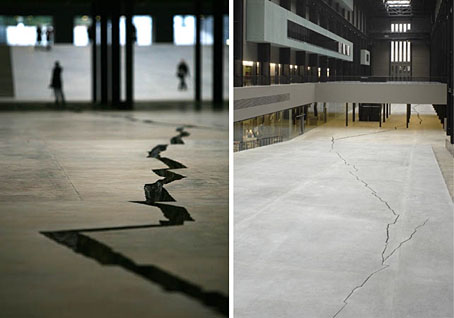
Tate Modern’s Turbine Hall is so vast and empty it’s quite a challenge for an artist to do anything interesting with it. One option is to try and fill the space which is what Anish Kapoor did with his enormous Marsyas, the first of the Turbine works I saw there in 2002.

Colombian artist Doris Salcedo has caused a stir this week by unveiling her own offering which seems to ruin the concrete floor with a succession of cracks that run the length of the building. I say “seem” because it looks from photos like she’s installed a series of large concrete slabs over the original floor (she won’t say how it’s been made), something that the structure of the cracks in close-up would seem to confirm. The rationale for this—that the work is “addressing a long legacy of racism and colonialism that underlies the modern world”—isn’t remotely obvious, a perennial problem with contemporary art; a crack in the floor can mean any number of things, after all, and it’s difficult to see how an unbriefed visitor would arrive at that conclusion. However, I’d still like to see this in situ even if it doesn’t match the splendour of Olafur Eliasson’s Weather Project from 2003.

Shibboleth can be seen from October 9th 2007–April 6th 2008.

Update: Builders and an architect ponder the mystery of the crack’s creation.

Shibboleth at Tate Modern
A video at The Guardian

Previously on { feuilleton }
Olafur Eliasson’s Serpentine Pavilion
Cloud Gate by Anish Kapoor

Custom creatures

brewer.jpg

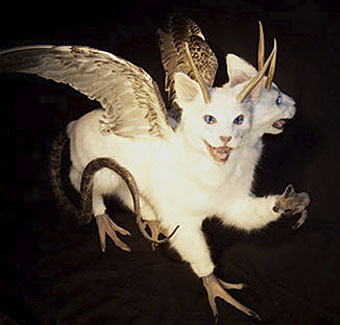
If Polly Morgan’s animal corpse art seems macabre, it looks positively mundane next to Serina Brewer’s creations. Her Custom Creatures include many multi-headed inventions like the cat thing shown here. She also does a fine line in carcass art, pickled pets and jewellery made from various extremities, should you be searching for those elusive alligator feet earrings.

Elsewhere on { feuilleton }
The fantastic art archive

Previously on { feuilleton }
Polly Morgan, fine art taxidermist
Cryptozoology
Insect Lab
The art of Jessica Joslin
The Museum of Fantastic Specimens

Polly Morgan, fine art taxidermist

morgan1.jpg

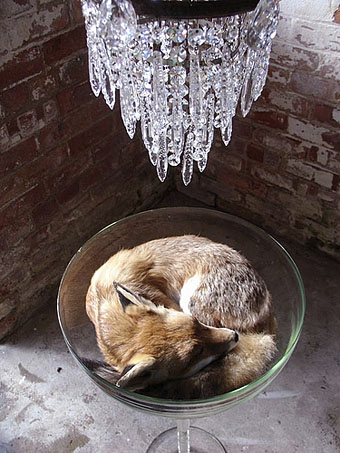
Still Life After Death (fox) (2006).

morgan2.jpg

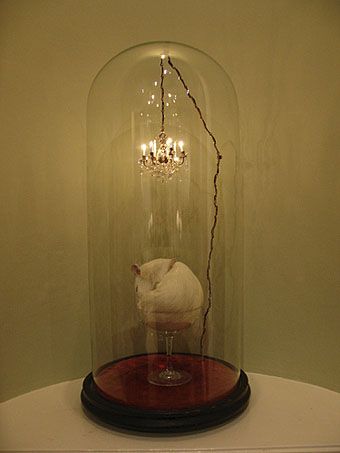
Rest a Little in the Lap of Life (2005).

Polly Morgan‘s work is on display at The Exquisite Corpse exhibition, Trinity Church, Marylebone Road, London, until October 19th. (No exhibition website.)

Previously on { feuilleton }
Cryptozoology
Insect Lab
The art of Jessica Joslin
The Museum of Fantastic Specimens

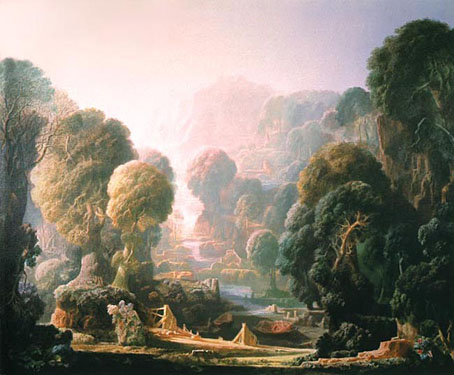
The art of Harold Hitchcock

hitchcock.jpg

Sunrise in a Valley (1974).

It’s difficult to say whether the work of Harold Hitchcock (born 1914) is rarely seen in his native country because of those British art critics who’ve often regarded fantastic or sacred themes with suspicion—or whether it’s merely because people find his work to be bad. Sometimes the latter accusation appears to be a disguise for the former belief, especially among those who follow the pack rather than drawing their own conclusions. At times the English Channel has acted as an aesthetic as well as a physical barrier. British art never quite got to grips with Surrealism, despite the best efforts of Roland Penrose and others, while Symbolism was almost exclusively a Continental movement whose existence was largely expunged from later art histories; the 1959 Penguin Dictionary of Art and Artists, for instance, has entries for minor groupings such as the Hudson River School and the Nazarenes, but no entry at all for Symbolism. Fantasy was allowable in illustration but not elsewhere; no wonder Mervyn Peake took up writing.

So much for polemic. Hitchcock’s work comprises very detailed landscapes that present a Claude Lorraine-like approach to light with more Modernist forays reminiscent of Expressionist painters such as Franz Marc. His fanciful works remind me of his Surrealist contemporary Leonora Carrington, with their creation of a self-contained, often naive, private world. Hitchcock lives in South Devon and was still active three years ago when the BBC reported his 90th birthday. The American exhibition mentioned in that news story took place at the Phillips Gallery, Carmel, CA and their site has three pages of (rather blurred) examples of his luminous work.

Update: The official Harold Hitchcock site

Harold Hitchcock by Leonard Hitchcock
Catching the Light by Emmanuel Williams

Elsewhere on { feuilleton }
The fantastic art archive