Dutch psychedelia

psych.jpg

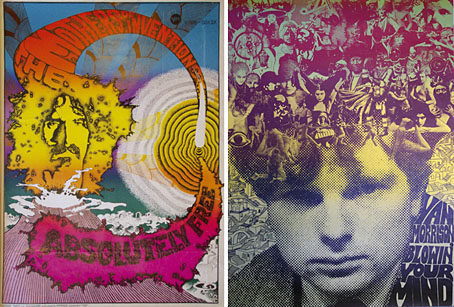
left: Absolutely Free by Theo van den Boogaard (1967).
right: Blowin’ Your Mind by Willem de Ridder (1967).

A couple of samples from similar work scattered around a Dutch auction site, along with more familiar designs from the San Francisco and London artists. All the Dutch examples are new to me; the dominance of the American and British designers of the period tends to marginalise the work of artists from Continental Europe even though Dutch design group The Fool was very prominent for a while due to The Beatles’ patronage.

Previously on { feuilleton }
Family Dog postcards

The Avant Garde Project

electronic.jpg

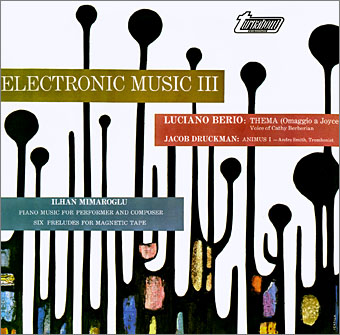
One of the great electroacoustic compilations, Electronic Music III: Berio/Druckman/Mimaroğlu, Turnabout Records (1967).

I’ve spent the past week or so immersed in the world of electroacoustic composition courtesy of torrents provided by the Avant Garde Project. Wikipedia attempts a definition of electroacoustic music and thus saves me the trouble:

While all electroacoustic music is made with electronic technology, the most successful works in the field are usually concerned with those aspects of sonic design which remain inaccessible to either traditional or electronic musical instruments played live. In particular, most electroacoustic compositions make use of sounds not available to, say, the traditional orchestra; these sounds might include pre-recorded sounds from nature or from the studio, synthesized sounds, processed sounds, and so forth.

Much of it is early electronic music, in other words, produced either with tape machines or rudimentary synth modules or a combination of the two. The Avant Garde Project is devoted to making available 20th century classical-experimental-electroacoustic recordings that are unavailable on CD. I’m less interested in the orchestral end of the project, unless it’s work by favourites such as Penderecki or Iannis Xenakis, but it’s good to know that they’re making the effort especially when much of this work remains on vinyl albums that are forty years old. The releases are listed as AGP1 onwards up to the most recent, AGP99, which happens to be music by Xenakis.

To say this stuff is challenging is something of an understatement, most people have little patience for lengthy compositions of artificial shrieks, squawks and blips, trombones fed through ring modulators or trained singers burbling extracts from Finnegans Wake. Despite the fact that many of these experiments form the foundation of today’s electronic music culture, the popular conception of the electroacoustic composer has been that he must be either a psycho rapist, like Chris Sarandon’s character in Lipstick, or a loveless neurotic, like John Hurt’s character in The Shout; decent people dig the Beatles and play guitars like, er…Charles Manson. Stereotypes aside, not all of it is necessarily alienating. Most people wouldn’t realise it but much of the early music for Doctor Who was electroacoustic, including Delia Derbyshire‘s rendering of the famous theme tune.

songmy.jpgSome of this work offers little today beyond curiosity value since a great deal of it was the product of a particular moment in the development of recording and electronic technology, a moment that passed as technology and tastes changed and many of the experiments became absorbed by pop music. Some of the composers were mere doodlers compared to later electronic artists but among the better practitioners in the AGP haul there’s Turkish composer İlhan Mimaroğlu, an expert audio collagist whose rare work is collected in three sets covering the years 1964–1983 (AGP30–32).

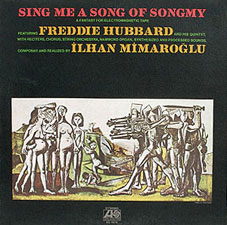
Mimaroğlu stands with one foot in the academic world and the other in the more popular areas of jazz and soundtrack composition. Together with another electroacoustic composer, Tod Dockstadter, he provided music for the score of my favourite Fellini film, Satyricon, and his position at Atlantic Records enabled him to collaborate with trumpet player Freddie Hubbard on one of the more bizarre jazz albums of a decade full of bizarre jazz works, Sing Me a Song of Songmy from 1971. Subtitled “A Fantasy for Electromagnetic Tape”, this anti-Vietnam war polemic mixes electroacoustic passages combining spoken word and musical quotes, poetry and sound effects with Hubbard’s Quintet grooving away as though they’d wandered in from the studio next door. The opening piece is always a good conversation stopper, “Threnody for Sharon Tate”, which features two women reading quotes about murder from associates of the aforementioned Mr Manson while electronic shrieks build unnervingly in the background.

Nothing on the AGP releases is this dramatic, unfortunately, but if you want a taste of Mimaroğlu’s lighter side, his Prelude for Magnetic Tape XI on AGP30 is three minutes of processed sounds from plucked rubber bands. And if the human music is too much, you could always try the cetaceans; AGP28 is the original collection of whale recordings, Songs of the Humpback Whale. The AGP page says they had to remove a few tracks that are now back in print but the copy I found on a torrent site was the complete album.

Previously on { feuilleton }
Electric Seance by Pram
White Noise: Electric Storms, Radiophonics and the Delian Mode
Ghost Box
The Photophonic Experiment
The music of Igor Wakhévitch

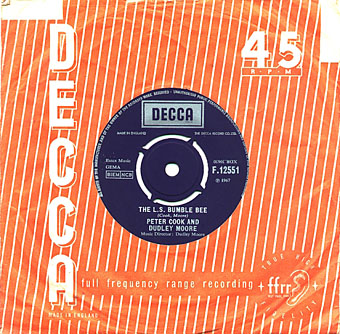
The L.S. Bumble Bee

lsb.jpg

“Freak out baby, the bee is coming!”

The L.S. Bumble Bee, a single by Peter Cook and Dudley Moore, Decca F 12551, February 1967. Mistakenly included on some Beatles bootlegs in the Seventies, about which Dudley Moore commented:

Regarding The L.S. Bumble Bee, Peter Cook and I recorded that song about the time when there was so much fuss about L.S.D., and when everybody thought that Lucy In The Sky With Diamonds was a reference to drugs. The exciting alternative offered to the world was L.S.B.!, and I wrote the music to, in some ways, satirize the Beach Boys rather than the Beatles. But I’m grateful if some small part of the world thinks that it may have been them, rather than us!”

Listen to it here. And while we’re at it, “You fill me with inertia!

Previously on { feuilleton }
Joe Orton
The trip goes on
Albert Hofmann
Please Mr. Postman
All you need is…
Hep cats

Joe Orton

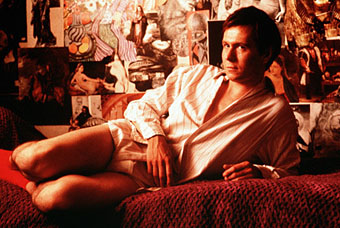
oldman_orton.jpg

Gary Oldman as Joe Orton in Prick Up Your Ears (1987).

Ken: At least you can say you’ve sat in the same chair as TS Eliot.
Joe: Yes, I’m never going to wipe my bum again.

Gay playwright Joe Orton receives a welcome renewal of attention this month with a showing of films at the ICA in London and the 20th anniversary re-release of Prick Up Your Ears, the great Orton biopic by Alan Bennett and Stephen Frears. Gary Oldman is marvellously sexy (and funny) as Orton in Frears’ film, Alfred Molina is equally good as his increasingly neurotic lover, Kenneth Halliwell (who eventually murdered Orton before killing himself), and there’s decent casting throughout, with Vanessa Redgrave playing Peggy Ramsay and Julie Walters hilarious as Orton’s mother.

Prick Up Your Ears was originally Halliwell’s title for a script Orton was writing for the Beatles (“…much too good a title to waste on a film,” said Orton.) That film idea, variously titled Up Against It and 8 Arms To Hold You, was deemed “too gay” by McCartney and co., not least because Orton had all four Beatles sleeping in the same bed. He also wrote that “…the boys, in my script, have been caught in flagrante, become involved in dubious political activity, dressed as women, committed murder, been put in prison and committed adultery. And the script isn’t finished yet.” Now you know why the third Beatles film was an animated one.

A feature in The Guardian examining Orton’s legacy, as well as the film, has this to say of Prick Up Your Ears:

it was the first mainstream British film to depict the gay underworld of West End toilets and sign language that existed in an age when homosexuality was still illegal.

And much of it was filmed on location in Orton’s haunts. Every time I’ve been through Islington tube station I think of the scene where Gary Oldman picks up a guy he’s been eying in the lift.

Orton had the misfortune to die in 1967, the year homosexuality was decriminalised in Britain. Well… decriminalised so long as you were both 21, not members of the Armed Forces and there was no one else in the room with you; Orton could have made a play out of such farcical restrictions. But the film makes it clear that the existence of a stupid law—which caused the downfall of another playwright, Oscar Wilde—did nothing to prevent him enjoying himself. The Guardian has another quote from him:

[The police] interfere far too much with private morals—whether people are having it off in the backs of cars or smoking marijuana, or doing the interesting little things one does.

They still do, Joe.

The web doesn’t serve Orton’s memory very well; the links below are some of the more interesting finds.

An interview from June, 1967
Joe Orton at the BBC Sound Archive
Joe Orton at GLBTQ
The Disappearing Gentlemens’ Lavatories of Old London
(A hymn to the public convenience by Dudley Sutton, dedicated to Joe Orton.)

Previously on { feuilleton }
Passion play
The Poet and the Pope
Please Mr. Postman
All you need is…
Queer Noises