Winter Days: a renku

winter-days.jpg

Winter Days is two things: a renku, or collaborative poem whose creation was initiated by Matsuo Bashō in Japan in 1684; and a 40-minute collaborative film from 2003 based on the same renku, with contributions by 35 animators from Japan and elsewhere, all under the direction of Kihachiro Kawamoto. The title of the poem provides the theme which the poets follow, with each poet repeating the last line of the previous stanza before adding a new of line of their own. The animators follow the same procedure, albeit much more loosely.

winter-days2.jpg

The results of this when transformed to animated sequences lacks the cohesion you’d get from a page or two of verse, especially when each sequence is self-contained. The moods of the individual sections also vary widely, from horror to broad comedy, but the film as a whole is a marvellous assembly of animation techniques, from simple drawings to clay animation, painting, puppetry, and computer graphics. The biggest attraction for animation aficionados will be the opening sequence which features a rare two minutes of film by the great Yuri Norstein. Among the other non-Japanese animators are Raoul Servais (whose piece appears to refer to Japanese ghost stories), Jacques Drouin with his pinscreen, and Britain’s Mark Baker. Wikipedia has a convenient chart that lists all the animators and the techniques they use. The Wikipedia page also notes the absence of any DVD release with English subtitles, but since all the sequences are wordless translation is only required for the intertitles and the readings that separate them. If you’re used to pairing video files with subtitles, however, you can download English subs here.

winter-days3.jpg

Given the allusions in some of the poem’s stanzas it no doubt helps when watching this to be familiar with Matsuo Bashō’s other writings, as well as the subtleties of Japanese poetry. But there’s more than enough artistry in Winter Days to warrant repeated viewing.

Previously on { feuilleton }
Tokyo Loop
Raoul Servais: Courts-Métrages
Yuri Norstein animations

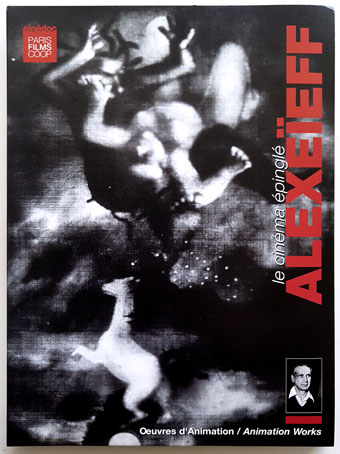
Le cinéma épinglé

alexeieff1.jpg

In yesterday’s mail, the DVD collection of Alexandre Alexeieff and Claire Parker’s animated films. I ordered this after watching the Norman McLaren film about the operation of the pinscreen, not realising that the same documentary is included here, together with a shorter film from 1960 that shows the pair creating still illustrations for an edition of Dr Zhivago. In addition to five pinscreen films by the couple there’s also Mindscape (1976) by another pinscreen animator, Jacques Drouin, together with two reels of technical experiments.

alexeieff2.jpg

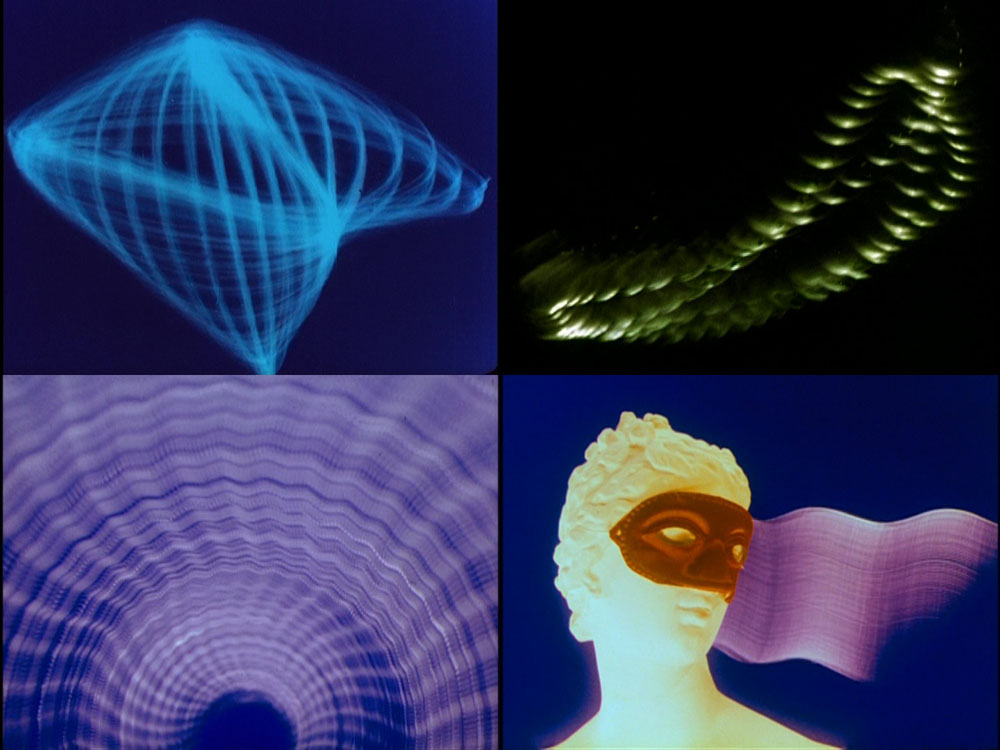
Most surprising of all is a lengthy collection of Alexeieff’s advertising films from the 1930s. These were made for French products such as Evian water, Renault cars and Gauloises cigarettes, with all of them photographed in a pre-Technicolor single-strip process, Gasparcolor, whose limitations made it difficult to use for live action but ideal for animation. The films are also surprising for being much more traditional animations of physical objects, there’s even a puppet adaptation of Sleeping Beauty. In the notes Alexeieff says:

We were the first to make colour films (Gasparcolor) in France, and immediately obtained a reputation for quality on the market. We established, I believe I am justified in saying, a class of films without precedent in this domain, and for which a certain number of progressive and powerful advertisers were ready to pay more and more… We made ourselves the champions of three-dimensional object animation. Into such one or two minutes film we decided to introduce, if only in one of its sequences, some sort of experiment, and never hesitated to invest time or money in inventions because an advertising film must strike by the novelty of its form.

The use of light and colour is indeed striking, especially when seen beside the monochrome pinscreen films, while some of the hazy, prismatic light effects are precursors of similar imagery being produced decades later by people like Jordan Belson. Alexeieff was too old to contribute to the psychedelic avant-garde but I wonder what he might have achieved if he’d been a generation younger.

Previously on { feuilleton }
Animating the pinscreen
The pinscreen works of Alexandre Alexeieff & Claire Parker
The Nose, a film by Alexandre Alexeieff & Claire Parker
Alexandre Alexeieff and Claire Parker

The Nose, a film by Alexandre Alexeieff & Claire Parker

nose.jpg

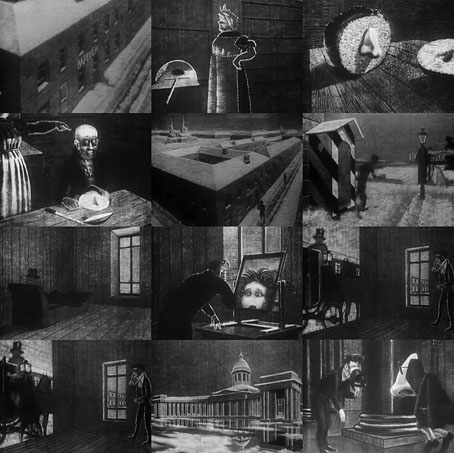
The last time I wrote about the animated films of Alexandre Alexeieff & Claire Parker the only copies available were low-grade things on YouTube which have long-since vanished (one of many reasons I don’t embed YT players in these posts). Happily a new copy of The Nose (1963) has appeared that’s not only better quality but isn’t split into two as was the case earlier.

The Nose is based on the Gogol story of the same name, a tale of a St Petersburg official who wakes to find his nose has left his face and is masquerading as a civil servant. I’ve not read Gogol’s story but I do have Nabokov’s book about Gogol which dwells not only on the prominent nose of the author, but also his traumatic death which was hastened in part by a quack physician who treated Gogol by applying leeches to his nose. Neither story or film contain anything as horrific. The film version is a wordless animation made using the pinscreen technique which Alexeieff & Parker developed in order to create greyscale animated films without recourse to smudgy materials like pencil, pastel, charcoal, etc. As I’ve mentioned before, the most notable application of this technique is the prologue the pair created for Orson Welles’ film of The Trial (1962). What’s striking about the Alexeieff & Parker use of the pinscreen is how skilfully they use it to manipulate light and shade. Where other animators like Jacques Drouin used the technique more impressionistically, Alexeieff & Parker’s films at times give the impression of watching an animated engraving. The Nose is one of their finest pieces. (Thanks to Gabe for the tip!)

Previously on { feuilleton }
Alexandre Alexeieff and Claire Parker