
Sphinxes

sphinx09.jpg

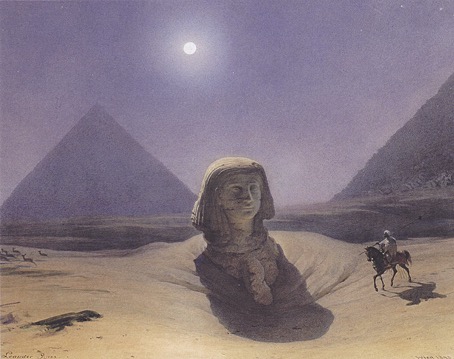
Bei den Pyramiden (1842) by Leander Russ.

A horde of sphinxes from NYPL Digital Collections and Wikimedia Commons, a pair of sites I was searching through last week. I was looking for a very particular kind of sphinx, not the Great Sphinx that sits near the Pyramids at Giza. What I wanted was something smaller and less ruined, like the sentinels that proliferated during the fads for Egyptian art and design in the early 1800s and the 1920s. My search was satisfied eventually, the results of which will be revealed in the next post.
sphinx06.jpg

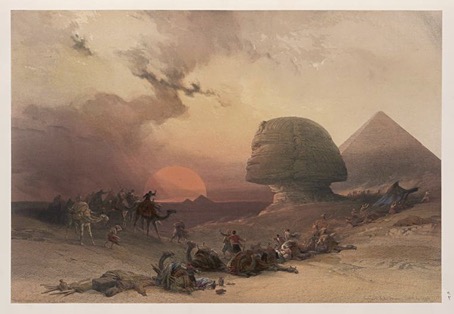
Approach of the Simoom. Desert of Gizeh (c. 1846–49) by David Roberts. 

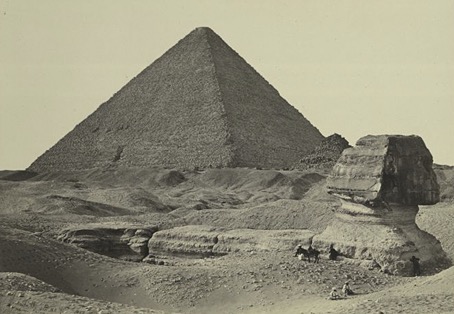
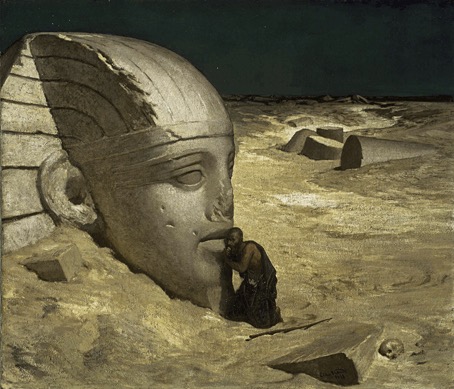
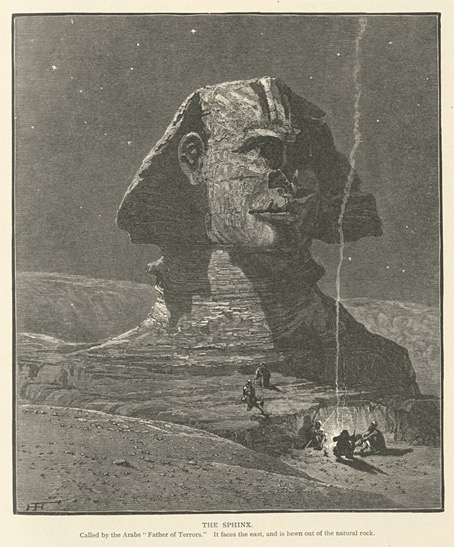
As for the Great Sphinx, I enjoy seeing artistic representations of the monument, especially those which place the creature in a dramatic setting. Older depictions tend to look bizarre or even comical, especially the ones made during the centuries when the figure was little more than a head protruding from the drifting sands. The photographs I prefer are those that show the Sphinx in the 19th century before all the restorations began, when the creature was another half-buried fragment of antiquity, not something that seems to have just been removed from a box in a museum.
sphinx08.jpg

The Sphinx and Great Pyramid, Geezeh (1858–1859).
sphinx10.jpg

The Questioner of the Sphinx (1863) by Elihu Vedder.
sphinx07.jpg

The Sphinx by Harry Fenn (1881–1884). “Called by the Arabs “Father of terrors.” It faces the east, and is hewn out of the natural rock.”

Continue reading “Sphinxes”

Eric Pape’s Arabian Nights

pape01.jpg

Eric Pape (1870–1938) was an American artist and illustrator who shouldn’t be confused with his contemporary Frank C. Papé, a Briton who was also a popular illustrator. Pape was more of a fine artist—he studied in Paris under Jean-Léon Gérôme—whose magazine illustrations are of that type that favoured realistic scenes using posed models. The illustrations in The Arabian Nights Tales of Wonder and Magnificence (1923) differ enough from his paintings to be taken for the work of another artist, the book being a substantial volume which Pape fills with many full-page ink drawings replete with stippling and detail.

pape02.jpg

The stories are a retelling by Padraic Colum with an eye to maintaining the flavour of the original (or older) texts. Books like this were aimed at a young readership but Colum begins with an introduction that describes the origin of the tales, and also weighs the pros and cons of the translations by Lane and Burton. In the stories he avoids simplifying the names of the more popular characters, so we have the six voyages of “El-Sindibad of the Sea”, and the tale of “Ala-ed-din” and his wonderful lamp. These gestures of fidelity are matched by Pape’s vignettes, many of are borrowed from Arabian or Persian sources. Pape had spent two years living and working in Egypt—his painting of the Sphinx by moonlight was a product of this period—a factor which may explain why he was offered the commission.

pape03.jpg

The pictures I’ve selected are mostly the full-page pieces which I’ve adjusted slightly to remove the grey tone of the paper. This copy of the book is a reprint from 1945, a period when print standards suffered from wartime restrictions. Older printings may be better.

pape04.jpg

pape05.jpg

Continue reading “Eric Pape’s Arabian Nights”