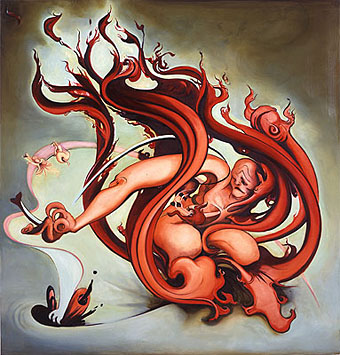
Hell scene (2003).
Paintings by American artist Inke Essenhigh whose work is currently on exhibition at the Victoria Miro gallery, London.
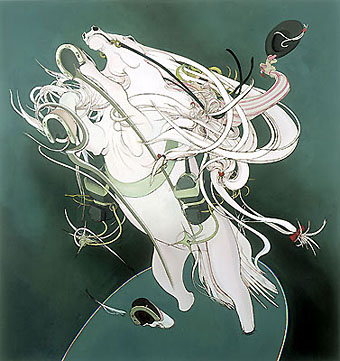
Optimistic Horse And Rider (2002).
A journal by artist and designer John Coulthart.

Hell scene (2003).
Paintings by American artist Inke Essenhigh whose work is currently on exhibition at the Victoria Miro gallery, London.
Optimistic Horse And Rider (2002).
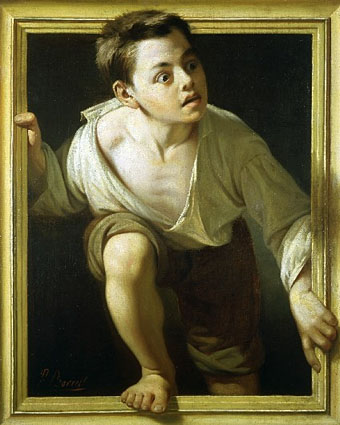
Escaping Criticism by Pere Borrell del Caso (1874).
A few eye-fooling paintings for All Fools Day.

A final visit to the Exposition Universelle of 1900 with this photograph of the Palais Lumineux, a piece of period Chinoiserie built in the Champ de Mars close to the Eiffel Tower. I forget where I found this tinted view but Wikipedia has what appears to be the same photograph coloured so as to resemble a night scene.
Previously on { feuilleton }
• Louis Bonnier’s exposition dreams
• Exposition Universelle, 1900
• The Palais du Trocadéro
• The Evanescent City
• Winsor McCay’s Hippodrome souvenirs
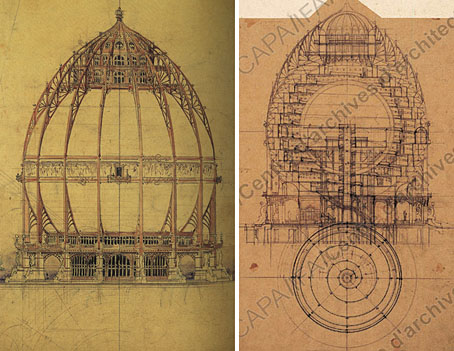
Globe terrestre.
More exposition mania. The Paris Exposition Universelle of 1900 would have been more grand/fabulous/excessive (delete as appropriate) if architect Louis Bonnier had been given free reign. The building above was intended to stand before the Palais du Trocadéro and house a huge globe which visitors could peruse from surrounding galleries. Bonnier also designed a series of kiosks (below) for different exhibitors which look more like over-sized Art Nouveau ornaments than pieces of architecture.
Three of these pictures are scanned from a book; the only site I found with examples of Bonnier’s work was this one which unfortunately spoils the pictures with enormous watermarks.
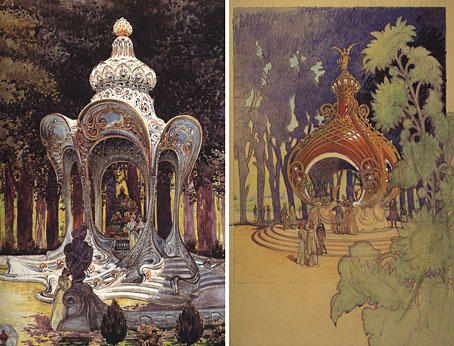
Exposition kiosks.
Previously on { feuilleton }
• Exposition Universelle, 1900
• The Maison Lavirotte
• The Palais du Trocadéro