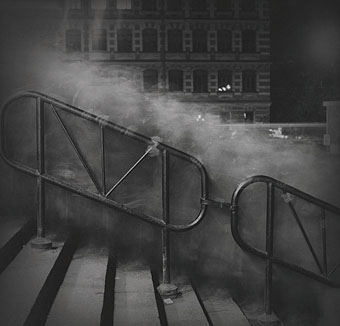
Alexey Titarenko

titarenko.jpg

Untitled (Crowd 1) (1993).

Like Atta Kim, Alexey Titarenko makes use of time-lapse and/or multiple exposure in his photographs. Of the two I prefer Titarenko’s work, not least because of his moody and spectral evocations of the streets of Havana and St Petersburg. His blurring of human figures takes on a sinister cast with the Time Standing Still and City of Shadows series which turn mundane Russian crowds into a parade of ghosts from a Gogol nightmare.

Via Ze Frank.

Previously on { feuilleton }
Abelardo Morell’s camera obscura
Eugene de Salignac
Atta Kim: On-Air

The art of Jo Whaley

whaley1.jpg

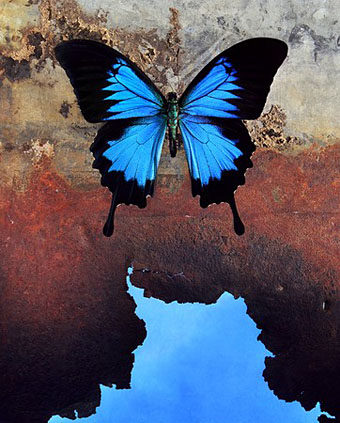
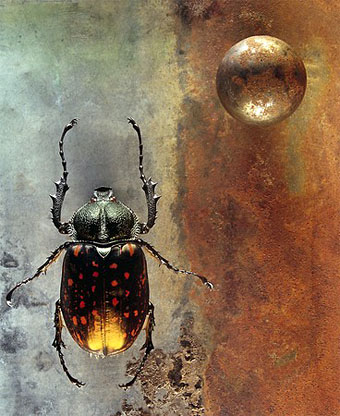
Papilio ulysses (2000).

Best. Insect Art. Ever. From a series entitled The Theater of Insects, also the name of a book devoted to Ms Whaley’s photographs which will appear from Chronicle Books later this year.

The photographs in this book are fantastic field illustrations. While the insects in these images are real, the backgrounds are imaginary altered habitats of my devising. Inspired by the old dioramas found in natural history museums, the pinned insects are arranged in constructed environments. The studio where I create the images is as much a theatrical scene shop as it is a photography studio. The prop room looks like an eighteenth-century cabinet of curiosities, in that it is filled with specimens of natural history and visual oddities of manufacture. I use free association and intuition to make decisions about arranging the insect with a particular backdrop. Looking at color, shape, and form, I move the elements about until the magic of the image appears. Lighting the scene is challenging as the sets are only about five by seven inches across with a depth of about an inch and a half. Yet the studio lighting is key to breathing a spirit into these pinned specimens and unifying the disparate elements within the mise-en-scène Finally, the performance of the image is concluded with a single click of the camera’s shutter. (More.)

whaley2.jpg

Coleoptera (2003).

Via Fabulon.

Previously on { feuilleton }
Endangered insects postage stamps
Robert Lang’s origami insects
Lalique’s dragonflies
Lucien Gaillard
Wesley Fleming’s glass insects
Insect Lab

The recurrent pose 17

lynnes1.jpg

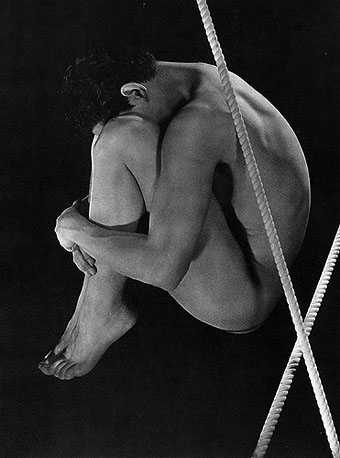
The Flandrin pose again, this time in a photograph by George Platt Lynes (1907–1955). This is from a Flickr set of Lynes’ work which was a nice find since many of the web collections are small and tend to repeat the same material.

lynnes3.jpg

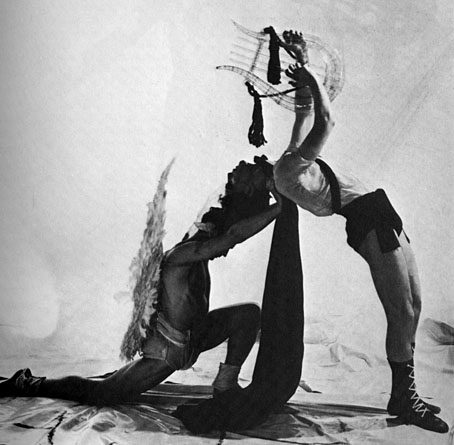
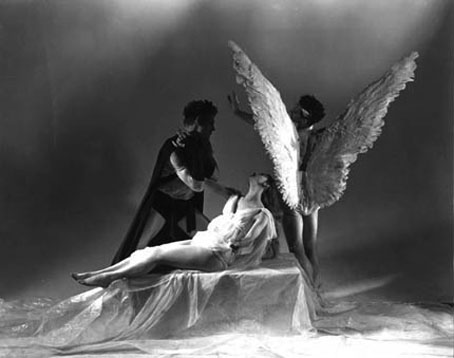
The picture above isn’t from the Flickr set, it’s a scan from Philip Core’s essential Camp: The Lie that Tells the Truth (1984), and a photograph that long fascinated me for completely unwholesome and inartistic reasons. Core credits it only as depicting dancers from Balanchine’s Icarus but I’d suspected for some time it was a Lynes picture, Lynes having photographed Balanchine’s dancers on several occasions, notably in some nude stagings of Orpheus. The Flickr picture below confirms the Lynes origin although it adds a new layer of mystery by crediting it to Balanchine’s Die Fledermaus. Given the very Classical look of the dancers’ costumes I suspect Core has the correct attribution but the confusion is also an excuse to keep searching.

lynnes2.jpg

Elsewhere on { feuilleton }
The recurrent pose archive

Previously on { feuilleton }
Philip Core and George Quaintance
George Platt Lynes