The recurrent pose 29

slimane.jpg

Taner photographed by Hedi Slimane.

No, I don’t go looking for these deliberately, they just keep turning up. This latest manifestation of the Flandrin pose is from a photo shoot by Hedi Slimane. I was going to write a bit more on this subject but haven’t had the opportunity today since the webhost has been having problems and the site was down for a few hours. Something for later. Meanwhile, a commenter recently pointed out this similar example by John Jude Palencar, a Flandrinesque painting for a book cover.

Elsewhere on { feuilleton }
The recurrent pose archive

Uranian inspirations

gloeden2.jpg

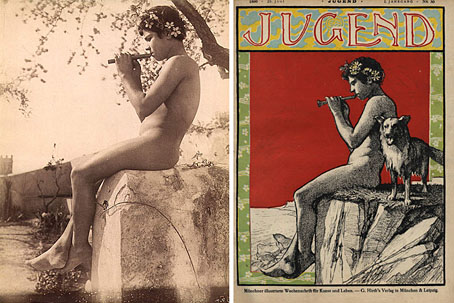
left: Sicilian boy by Wilhelm von Gloeden (no date); right: Jugend cover by Hans Christiansen (1896).

My current reading is The Secret Life of Oscar Wilde (2003), a long and fascinating study by Neil McKenna which attempts to disentangle the true nature of Wilde’s sex life from the myths and evasions of his biography and biographers. Among the pictures in the book, McKenna shows a couple of the “Uranian” photographs by Wilhelm von Gloeden (1856–1931) which Wilde owned. Von Gloeden’s views of naked Sicilian boys were described as “Classical” in a barely-believable subterfuge familiar during the 19th century, and it’s understandable why Wilde, who’d been praising the attractions of Mediterranean youth for most of his adult life, would have found these pictures worthy of purchase. Wikimedia Commons has a substantial set of the photos, although it should be noted that provenance is often uncertain; there were other photographers active in Taormina at the time who catered to a similar market. One photo in particular stood out recently when I recognised it as the possible source for the figure on a Hans Christiansen cover for Jugend magazine of 1896. The cover above has appeared here before but this is the first time I made the photographic connection.
gloeden1.jpg

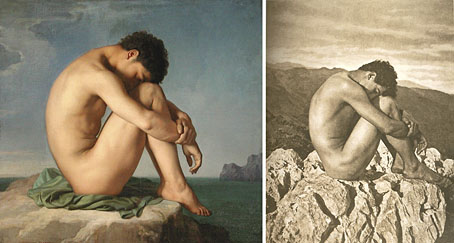
left: Jeune homme assis au bord de la mer by Jean Hippolyte Flandrin (1836); right: Cain by Wilhelm von Gloeden (c. 1902).

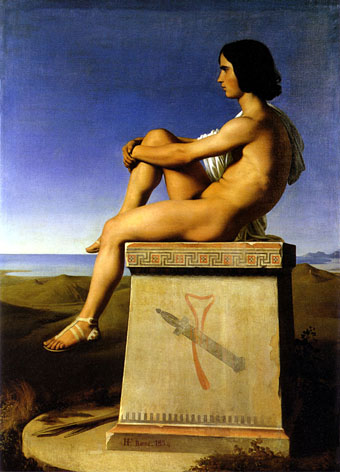
Gloeden, of course, was one of the first people to use the Flandrin pose, as I noted in the original post on that theme. I wonder if he knew he’d been copied in turn? That Jugend cover and its inspiration reminds me a little of Flandrin’s other depiction of Classical youth, his portrait of Polites, a painting which Oscar would no doubt have enjoyed.
polites.jpg

Polites, Son of Priam, Observes the Movements of the Greeks by Jean Hippolyte Flandrin (1834).

Elsewhere on { feuilleton }
The recurrent pose archive
The Oscar Wilde archive

Previously on { feuilleton }
Forbidden Colours
Jugend Magazine
Evolution of an icon

The coming of the dust

sydney1.jpg

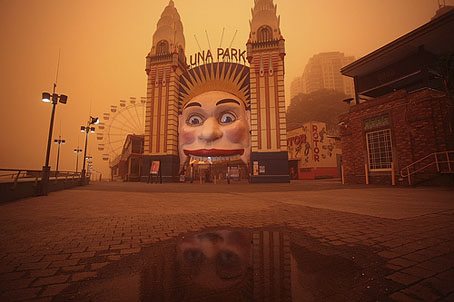
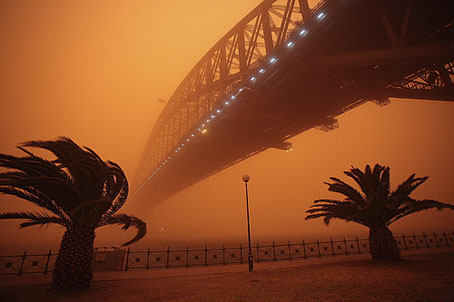
Impossible to avoid thoughts of either JG Ballard or various apocalyptic horror and science fiction scenarios when looking at these photos of Sydney, Australia, taken a few hours ago. A cloud of red dust passed over the city in the early morning and the depopulated views only add to the eerie atmosphere. These are from a Red Dust Flickr gallery. The Other Andrew writes about the inundation on his blog. I’m looking forward now to the reaction of another Sydney Melbourne resident, Simon Sellars, who runs Ballardian.

Update: The Red Sydney Project—Dust Storm Days

sydney2.jpg

Previously on { feuilleton }
Apocalypse now

Fencing fashion again

afanador1.jpg

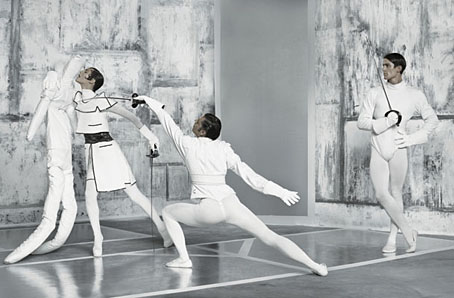
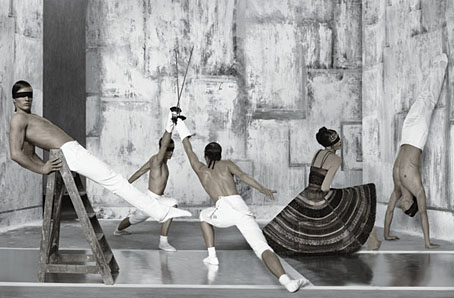
A brace of elegant fencers posing for an Elle Italia spread by photographer Ruven Afanador whose Torero series was highlighted here in April. Afanador’s recent work is worth a look for the set showing a model posing in an antiquated schoolroom among bones and stuffed animals. Via Homotography.

afanador2.jpg

Elsewhere on { feuilleton }
The men with swords archive

Previously on { feuilleton }
Torero

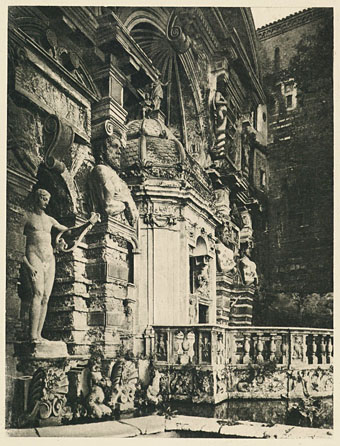
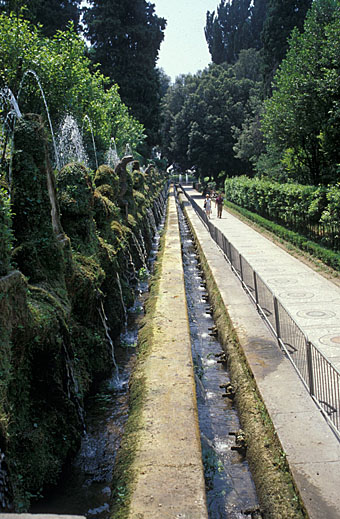
Villa d’Este

deste1.jpg

Detail of the Water Organ (1902).

Samples from a set of pictures at LUNA Commons of the wonderful water gardens at the Villa d’Este, Tivoli, Italy. Among the 164 items in the collection are plans, engravings, and photographs old and new. I’m partial to the older photos, most of which seem to be photogravure reproductions whose temporal distance and technical shortcomings only add to the mystique of the place.

deste2.jpg

Alley of the hundred fountains (1997).

Previously on { feuilleton }
Gertrude Käsebier’s crystal gazer
The Door in the Wall
Paris II: The River Fountain