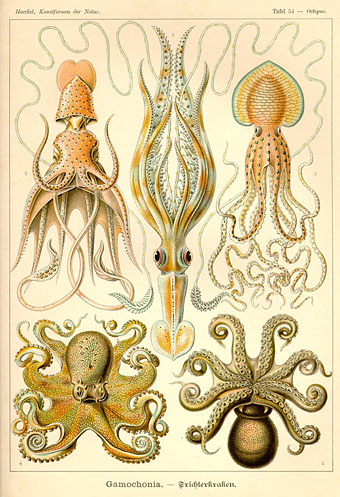
Octopi and squid from Kunstformen der Natur (1899–1904) by Ernst Haeckel.
Celebrate Darwin’s birthday by looking at Ernst Haeckel’s wonderful prints.
Previously on { feuilleton }
• The glass menagerie
A journal by artist and designer John Coulthart.

Science
Octopi and squid from Kunstformen der Natur (1899–1904) by Ernst Haeckel.
Celebrate Darwin’s birthday by looking at Ernst Haeckel’s wonderful prints.
Previously on { feuilleton }
• The glass menagerie
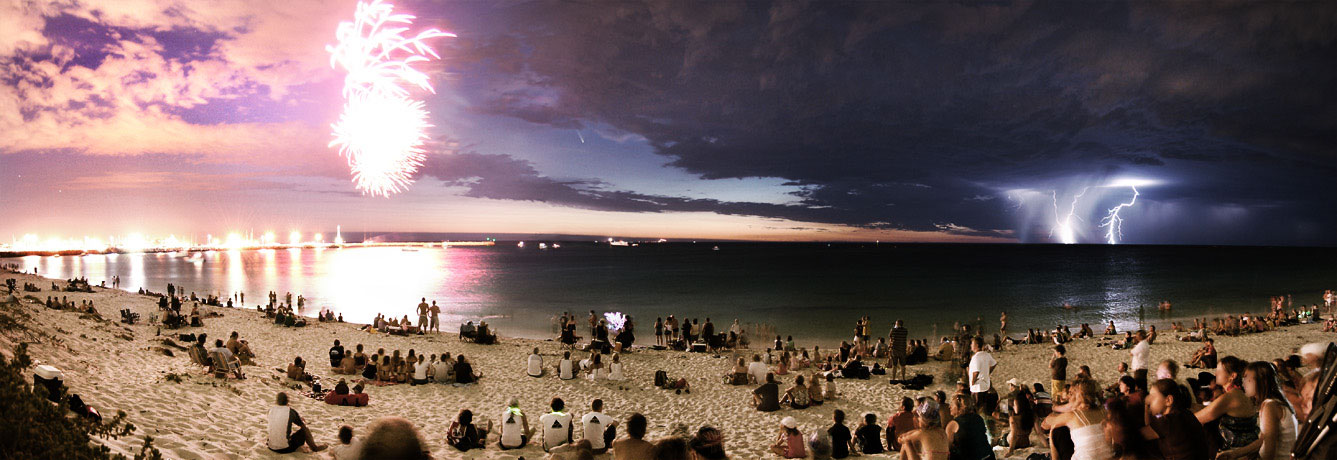
Incredible panorama of Perth beach, Australia, during the recent Australia Day celebrations. Creating the lightshow is a burst of fireworks, Comet McNaught (tiny, in the centre of the picture) and a nearby thunderstorm. Full-size version here.
From NASA’s Astronomy Picture of the Day, via Towleroad.
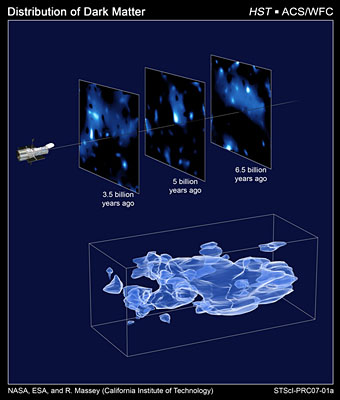
Hubble Maps the Cosmic Web of “Clumpy” Dark Matter in 3-D
This three-dimensional map offers a first look at the web-like large-scale distribution of dark matter, an invisible form of matter that accounts for most of the universe’s mass. This milestone takes astronomers from inference to direct observation of dark matter’s influence in the universe. Because of the finite speed of light, regions furthest away are also seen as they existed a long time ago. The map stretches halfway back in time to the beginning of the universe.
The map reveals a loose network of dark matter filaments, gradually collapsing under the relentless pull of gravity, and growing clumpier over time. This confirms theories of how structure formed in our evolving universe, which has transitioned from a comparatively smooth distribution of matter at the time of the big bang. The dark matter filaments began to form first and provided an underlying scaffolding for the subsequent construction of stars and galaxies from ordinary matter. Without dark matter, there would have been insufficient mass in the universe for structures to collapse and galaxies to form.
[Top] – Three slices through the evolving distribution of dark matter. The dataset is created by splitting the background source galaxy population into discrete epochs of time (like cutting through geologic strata), looking back into the past. This is calibrated by measuring the cosmological redshift of the lensing galaxies used to map the dark matter distribution, and binning them into different time/distance “slices”. Each panel represents an area of sky nine times the angular diameter of the full Moon. Note that this fixed angle means that the survey volume is a really a cone, and that the physical area of the slices increases (from 19 Mpc on a side to 31 Mpc on a side) from left to right.
[Bottom] – When the slices across the universe and back into time are combined, they make a three-dimensional map of dark matter in the universe. The three axes of the box correspond to sky position (in right ascension and declination), and distance from the Earth increasing from left to right (as measured by cosmological redshift). Note how the clumping of the dark matter becomes more pronounced, moving right to left across the volume map, from the early universe to the more recent universe.
The dark matter distribution was mapped with Hubble Space Telescope’s largest ever survey of the universe, the Cosmic Evolution Survey (“COSMOS”). To compile the COSMOS survey, Hubble photographed 575 adjacent and slightly overlapping views of the universe using the Advanced Camera for Surveys’ (ACS) Wide Field Camera onboard Hubble. It took nearly 1,000 hours of observations. The distances to the galaxies were determined from their spectral redshifts, using the Subaru telescope in Hawaii.
Forty-six percent of white evangelical Christians believe it’s at least somewhat likely that Jesus Christ will return in 2007, while 22 percent believe it’s very likely. Thirty-four percent of Protestants say it’s at least somewhat likely, compared with 17 percent of Catholics. Ten percent of those with no religion believe that Christ is at least somewhat likely to return in 2007.
Er, okay…. That paragraph should have the word “American” in it, of course.
If you’d like some prognostication from Americans (and others) with brains, the essential Edge.org has unveiled its annual question to scientists, philosophers and futurologists, the subject this time being “What are you optimistic about? Why?”. Lots of juicy speculation from people whose thoughts and opinions are a deal more informed than the usual gaggle of pundits. “The future may be a bit more like Sweden and a bit less like America,” says Brian Eno. Looking at the statistics above, let’s hope so.
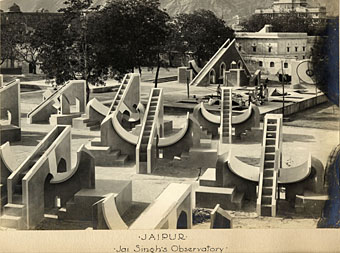
Fran Pritchett’s site has a wealth of photos of Indian architecture, including many old views of temples and a substantial section devoted to Jaipur’s fascinating Jantar Mantar.
The Jantar Mantar is a collection of architectural astronomical instruments, built by Maharaja Jai Singh II at his then new capital of Jaipur between 1727 and 1733. It is modelled after the one that he had built for him at the then Mughal capital of Delhi. He had constructed a total of five such observatories at different locations, including the ones at Delhi and Jaipur. The Jaipur observatory is the largest of these.
The name is derived from yantra, instrument, and mantra, for chanting; hence the ‘the chanting instrument’. It is sometimes said to have been originally yantra mantra, mantra being translated as formula, although there is limited justification for this since in traditional spoken Jaipur language, the locals obfuscate the written Y syllable as J.
The observatory consists of fourteen major geometric devices for measuring time, predicting eclipses, tracking stars in their orbits, ascertaining the declinations of planets, and determining the celestial altitudes and related ephemerides. Each is a fixed and ‘focused’ tool. The Samrat Jantar, the largest instrument, is 90 feet high, its shadow carefully plotted to tell the time of day. Its face is angled at 27 degrees, the latitude of Jaipur. The Hindu chhatri (small domed cupola) on top is used as a platform for announcing eclipses and the arrival of monsoons.
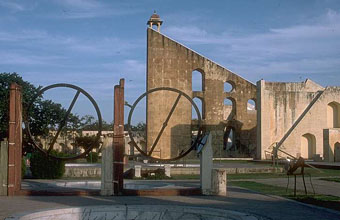
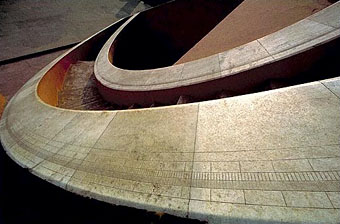
Built of local stone and marble, each instrument carries an astronomical scale, generally marked on the marble inner lining; bronze tablets, all extraordinarily accurate, were also employed. Thoroughly restored in 1901, the Jantar Mantar was declared a national monument in 1948.
An excursion through Jai Singh’s Jantar is the singular one of walking through solid geometry and encountering a collective weapons system designed to probe the heavens.
The instruments are in most cases huge structures. They are built on a large scale so that accuracy of readings can be obtained. The samrat yantra, for instance, which is a sundial, can be used to tell the time to an accuracy of about a minute. Today the main purpose of the observatory is to function as a tourist attraction.
Previously on { feuilleton }
• The Garden of Instruments