Earthrise

earthrise.jpg

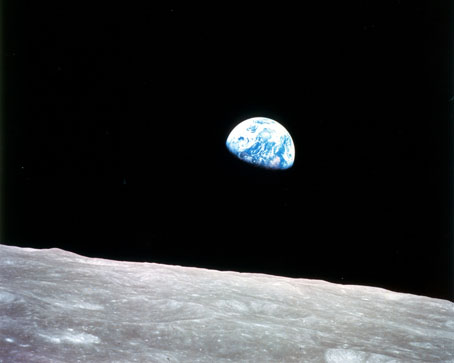
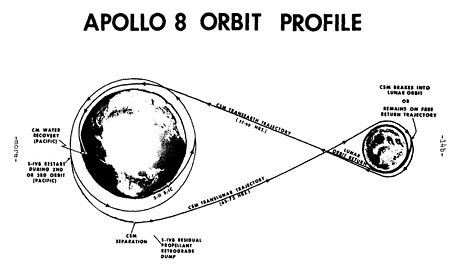
It was forty years ago this week that Apollo 8 astronaut William A Anders took this famous photograph of the Earth appearing over the Moon’s horizon. I was six years old at the time but remember the considerable interest caused by the mission, the first to leave the Earth and orbit the Moon, and I was old enough to appreciate that the flight path of the capsule formed a figure eight. This was the beginning of a four-year obsession with the Apollo missions, taking in model kits, jacket patches of spacecraft insignia and an eager viewing of every TV transmission. (Although I missed the first Moon landing a year later as it was after my bedtime.) I was convinced that by 2008 many of us would be living in space; a part of me remains disappointed that we’re not.

apollo8.jpg

The above graphic comes from the quaintly primitive Apollo 8 press kit which can be downloaded from one of NASA’s pages. On another page there’s the crew’s Christmas message to the world which controversially included readings from the Bible. And as usual with NASA you can see William Anders’ photo in a variety of sizes including luscious high-res. The impact of his picture may have diminished over the the past four decades but its import as an ecological symbol remains as pertinent as it was in 1968.

Things will be quiet here over the next few days while I visit family but I’ll be leaving the archive plug-in running for anyone who wants a random dip into the past. If you need some more retro space thrills there’s always this.

Have a good one.

afk.jpg

Previously on { feuilleton }
East of Paracelsus

Ernst Haeckel, Christmas card artist

haeckel.jpg

Okay, not really, but we can dream. From A Very Haeckel Christmas at Flickr. Haeckel’s original plates are now at Flickr also. Via DO.

Previously on { feuilleton }
The art of Ying-Yueh Chuang
The art of Jennifer Maestre
Kirsten Hassenfeld’s paper sculptures
Darwin Day
The glass menagerie

Jewel beetle

beetle.jpg

A 40X close-up of Chrysochroa fulgens, the iridescent Jewel Beetle, showing part of the insect’s eye. A stereomicroscopy photo by Charles Krebs, and one of the winners in the 2008 Olympus Bioscapes Digital Imaging Competition. Scientific American has larger images.

Previously on { feuilleton }
How many leaf beetles can dance on the head of a pin?
The art of Jo Whaley
Endangered insects postage stamps

Welcome to Mars

welcometomars.jpg

Arriving today—and barely surviving the postman’s attempts to cram it through the letterbox—is the latest volume from Strange Attractor, Welcome to Mars by Ken Hollings. I’m really looking forward to reading this since it touches on areas of interest which span the development of Cold War technologies to pulp science fiction, examining the interconnections between these disparate zones; most histories of the period prefer to stay in one area or the other. A glance at the chapter titles immediately pushes my buttons: “1947 Rebuilding Lemuria”, “1951 Absolute Elsewhere”. If all that wasn’t enough there’s an intro by Erik Davis and the first 250 copies come with a CD of “classy analogue Outer Space exotica” by Simon James. Order from the SA Shoppe and get a free postcard!

Welcome to Mars is a map of the post-war Zone, a non-fiction Gravity’s Rainbow that follows the arc of Germany’s V2 rocket to the end of the rainbow – to America.’ Erik Davis

Welcome to Mars is an iconoclastic, penetrating and darkly humorous history of America from 1947-1959, the decade in which the nation defined its image and created the blueprint for the world we live in today.

Welcome To Mars draws upon newspaper accounts, advertising campaigns, declassified government archives, old movies and newsreels from this unique period when the future first took on a tangible presence. Ken Hollings depicts an unsettled time in which the layout of Suburbia reflected atomic bombing strategies, bankers and movie stars experimented with hallucinogens, brainwashing was just another form of interior decoration and strange lights in the sky were taken very seriously indeed.

Seamlessly interweaving developments in technology, popular culture, politics, changes in home life, the development of the self, collective fantasy and overwhelming paranoia, Hollings has produced an alarming and often hysterically funny vision of the past that would ultimately govern all of our futures.

“Ken Hollings shows brilliantly how the extraordinary web of technologies that drove the Cold War have shaped not just our culture but the very way we think of ourselves as human beings. Welcome to Mars offers a rare and fascinating glimpse of the roots of the strange humanoid culture we live in today.” Adam Curtis

‘Ken Hollings has placed his critical focus at the precise point where the high technologies of information control and social manipulation intersect the passionate search for scientific ways to probe the human mind. Welcome to Mars is a searingly accurate and deeply disturbing exposé of the fantasies of American modernism that have inspired the many nightmares and the few hopeful visions of our new Millennium.’ Dr Jacques Vallée

Previously on { feuilleton }
SAJ again
Strange Attractor Journal Three
How to make crop circles