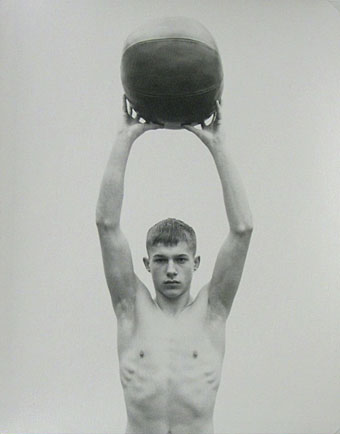
Medicine Ball (2000).
One of Luke Smalley’s faux-vintage photographs from his Gymnasium series. A new series with a more contemporary perspective, Exercise at Home, was in exhibition recently at Wessel + O’Connor Fine Art, NYC.
A journal by artist and designer John Coulthart.

Photography
Medicine Ball (2000).
One of Luke Smalley’s faux-vintage photographs from his Gymnasium series. A new series with a more contemporary perspective, Exercise at Home, was in exhibition recently at Wessel + O’Connor Fine Art, NYC.
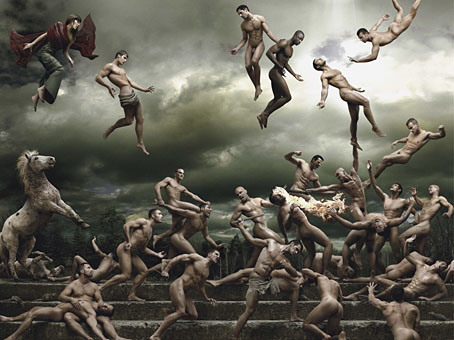
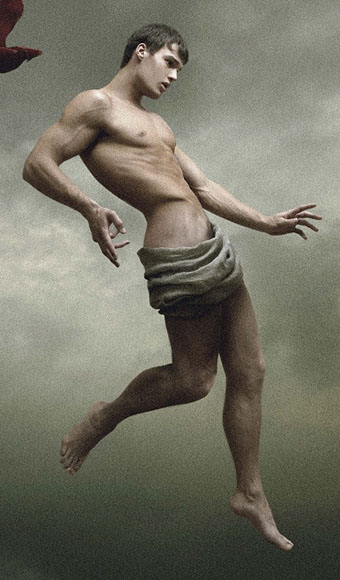
The Prophecy is a Michelangelo-esque collaboration between BeautifulMag and digital artist Aymeric Giraudel which you can download at high resolution here and here. (If you want a single picture you’ll have to stitch them together yourself.) Among the models for this are Les Farfadais whose work was mentioned here last June.
Elsewhere on { feuilleton }
• The gay artists archive
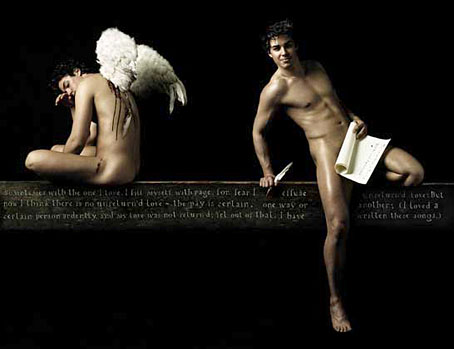
Whitman 2 (2005).
One of Anthony Gayton‘s Caravaggio-styled photographs from his exhibition, The Fall, at the Galería Mito, Barcelona, until January 26, 2008.
Elsewhere on { feuilleton }
• The gay artists archive
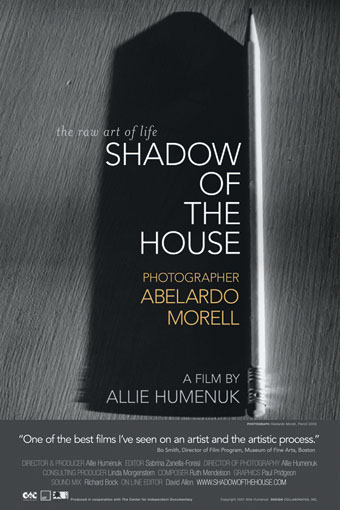
After writing about Abelardo Morell’s remarkable camera obscura photographs last month, filmmaker Allie Humenuk left a comment about her documentary which explores Morell’s work and working methods.
Shadow of the House is about looking closely. Filmed over seven years, it is an intimate portrait of photographer Abelardo Morell, revealing the mystery and method of his artistic process. The narrative skips across time and space from his early childhood escape from Castro’s regime to his status as a world-renowned photographer. The film explores his daily working life as an artist and his eventual return to Cuba after 40 years of living in exile. Shadow of the House uncovers the deep layers of a man who is pushed to confront his past and his familial allegiances as it explores his unique artistic vision.
The film website has a lot more information, including details of North American screenings, and a trailer.
Previously on { feuilleton }
• Abelardo Morell’s camera obscura
• Abelardo Morell
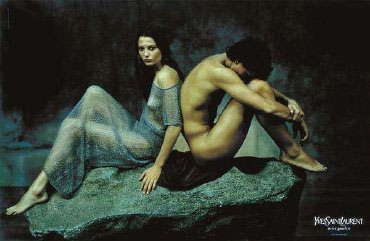
It wouldn’t surprise me if there are more examples of the fashion world borrowing the Flandrin pose but this is the only one I’ve seen so far, part of a 1998 art-inspired photo series by Mario Sorrenti for Yves Saint-Laurent. There don’t seem to be any larger copies available, unfortunately.
Elsewhere on { feuilleton }
• The recurrent pose archive
Previously on { feuilleton }
• Last Suppers and last straws
• The last circle of the Inferno