Today is the 30th anniversary of the first appearance of the rainbow flag at a gay pride event. Gilbert Baker designed the flag which was used for the 1978 Gay Freedom Parade in—where else?—San Francisco and he talked to The Independent last week about its legacy.

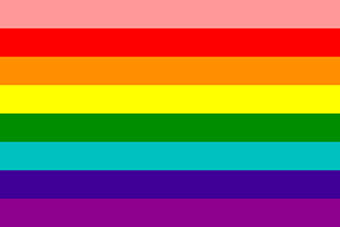
Baker’s original design can be seen below, with the stripes signifying (from top to bottom) sexuality, life, healing, sunlight, nature, magic, serenity and spirit. Subsequent changes dropped sexuality and magic to give us the more familiar arrangement seen in the photo above but it seems Baker would prefer everyone to revert to his original design. I tend to be ambivalent about rainbows, not only are they ubiquitous in other contexts—the spinning “Marble of Doom” on the left is a familiar sight to Mac users—but any spectrum arrangement presents problems for graphic designers. That aside, I wouldn’t mind seeing the original design returned to in order to distinguish it from the many other rainbow flags. But it may well be too late for that now, the six stripe flag is firmly embedded in gay culture. Garish it may be but it has the advantage of being highly visible, which is partly the point, of course. Flickr photos show how effective it is at standing out in a variety of surroundings.
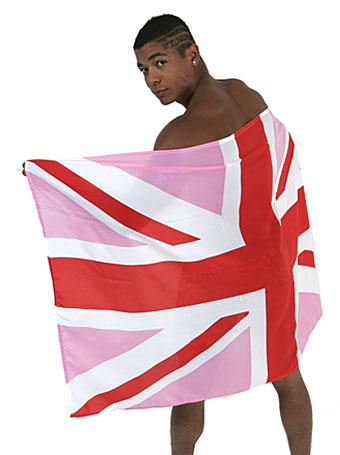
I was hoping to find a credit for the gay pastiche of Joe Rosenthal’s Iwo Jima photo but details about its creator seem elusive. If anyone knows who the photographer was, please leave a comment. I’ve noticed recently that this photo in particular, one of many pastiches of that famous image, annoys a certain type of knuckle-dragging American who sees it as an insult to the soldiers of the Second World War. In which case one has to hope they haven’t seen this Terry Pratchett book jacket. Here in Britain we regard it as bad taste to take flags too seriously, hence the increasingly common appearance at UK gay events of pink Union flags like the one below. Flags are signs, not religious icons, and as such they’re always open to change and reinterpretation; the evolution and appropriation of Gilbert Baker’s flag is the perfect example of that.
Update: The Joe Rosenthal pastiche is by Ed Freeman.
Previously on { feuilleton }
• The recurrent pose #2
• Michael Petry’s flag