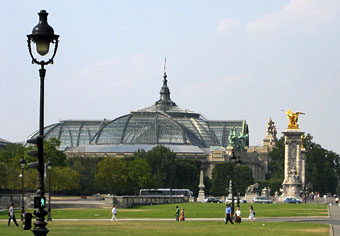
The Grand Palais from Ave du M Gallieni.
The Grand Palais, opposite the Petit-Palais, was built in 1897–1900 by Louvet, Deglane, and Thomas. Its dimensions, covering all area of about 38,000 sq. yds, are imposing. It consists of a large front building, united with a smaller one in the rear by a transverse gallery. The style is composite, but mainly reminiscent of the 17th century. The façade is adorned with a double colonnade, rising to a height of two stories; and there are three monumental entrances in the central pavilion. The sculptures of the central portico, representing the Beauty of Nature, and Minerva and Peace, are by Gasq, Boucher, Verlet, and Lombard. Those to the right represent Sculpture, Painting, Architecture, and Music, and are by Cordonnier, Lefebvre, Carlès, and Labatut. To the left are the Arts of Cambodia, Egypt, Greece, and Rome, by Bareau, Suchet, Béguine, and Clausade. On and under the colonnades are friezes of Amoretti, holding the attributes of the arts. At the top are a balustrade, allegorical groups on the abutments, by Sepsses and Greber, and bronze quadrigae, by Récipon. In the middle of the principal building rises a depressed dome. The rear-façade, in the Ave d’Antin, is embellished with colonnades, sculpture, and friezes in polychrome stoneware, made at Sèvres (Ancient and Modern Art).
In 1900 this building is to be used for contemporary and centennial exhibitions. Afterwards it is to be the scene of the annual exhibitions of paintings and sculptures, horse shows, agricultural fairs, and the like. Its destination explains the peculiarities of its internal construction. The roof is glazed, consisting of curved sheets of glass 10 ft. long and 3 ft. wide.
Baedeker’s Paris (1900).
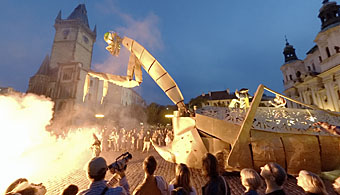
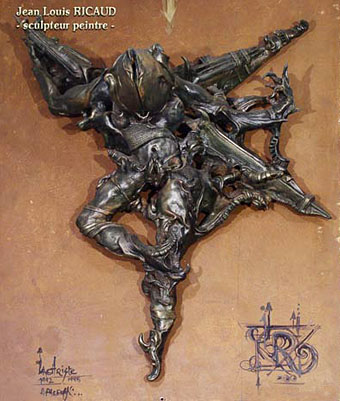
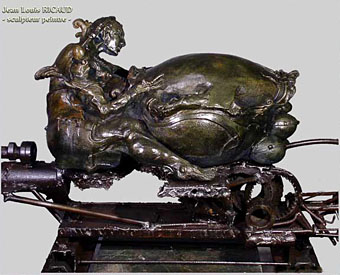
One of the highlights of this trip was a visit to the wonderful Grand Palais to see an exhibition of invented machines that wouldn’t have been out of place in La Cité des Enfants Perdus or a Terry Gilliam film. The slightly run-down but still splendid venue was the perfect setting for rusted contraptions devoted to making loud noises or smashing things to pieces. The exhibition is still running should you have the good fortune to be in Paris up to the 13th of this month.
Continue reading “Paris III: Le Grande Répertoire–Machines de Spectacle”