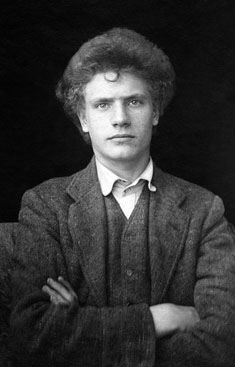
Austin Osman Spare

spare.jpg

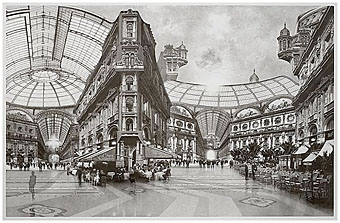
Today is the 50th anniversary of the death of one of my favourite artists, Austin Osman Spare.

Like many people in the 1970s, I was introduced to the work of Austin Spare by Man, Myth and Magic, a seven volume “illustrated encyclopedia of the supernatural” published weekly in 120 112 parts by Purnell. My mother was a Dennis Wheatley reader so we had a couple of occult paperbacks in the house, among them one of William Seabrook‘s accounts of voodoo in Haiti and a copy of Richard Cavendish’s wonderful magical primer, The Black Arts, (later retitled The Magical Arts). Cavendish had been chosen as editor of Man, Myth and Magic and included occultist and writer Kenneth Grant on his editorial staff, a decision that gave the book’s producers access to Grant’s collection of Spare pictures. In a rather bold move, they launched Man, Myth and Magic in 1970 with a detail of a Spare drawing on the cover, a work often referred to as The Elemental although the authoritative Spare collection, Zos Speaks has it titled as The Vampires are Coming. It’s a shame that AOS didn’t live for a few more years to see this; after labouring in poverty and obscurity for most of his life he would have found his work flooding Britain, with this first issue on sale all over the country and the cover picture being pasted on billboards and sold as posters. It’s possible there were even television adverts for the book (although I don’t recall any), since there usually were for expensive part works like this.
Continue reading “Austin Osman Spare”

Saint-Aubin’s Butterfly People

a0000f80.jpg

Titre.

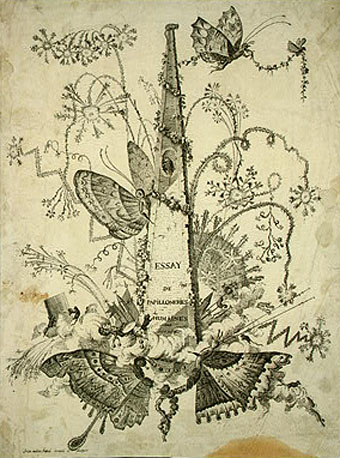
Charles-Germain de Saint-Aubin (Paris 1721–86) was one of three famous artist brothers. He worked as a designer for fabrics and textiles, and held the position of dessinateur du Roi to Louis XV. He made twenty-seven etchings, of which the best-known are two sets of six plates from around 1750 entitled Essay de Papilloneries humaines, one horizontal and one vertical in format, in which butterflies act as humans. Earlier designs show animals such as monkeys masquerading as humans, but this seems to be the only time that butterflies appear.

Continue reading “Saint-Aubin’s Butterfly People”

Filippo Morghen’s Voyage to the Moon

prm135x.jpg

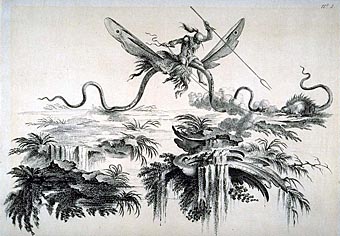
It’s a shame there isn’t more of this imaginative work from Filippo Morghen (1730–1777). In a series of etchings from around 1766 he presents the moon as a tropical world inhabited by the 18th century conception of New World savages. I especially like the hunter on his winged serpent (above) and the elaborate trap set to behead a wary beast (below). The explanatory text is from this print collection which also has large copies of the pictures.

Filippo Morghen was a member of a large family of artists. His brother Giovanni was a painter and printmaker and his son, Rafaello, was a printmaker who specialized in reproductive prints after Raphael and Leonardo. Filippo himself was a designer and printmaker. In addition to the present series on the theme of a voyage to the moon, Morghen is known for a series of plates detailing antiquities from Herculaneum and for views of the environs of Naples.

Continue reading “Filippo Morghen’s Voyage to the Moon”

Charles Méryon’s Paris

meryon.jpg

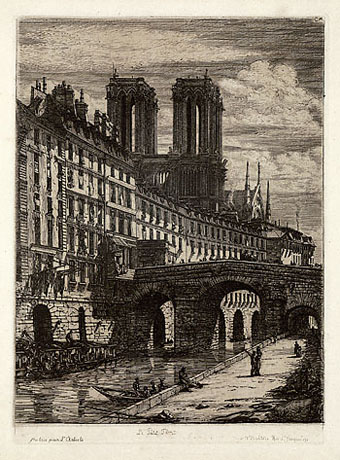
Charles Méryon (1821–1868) made his name producing etchings of the city of Paris, and became as accomplished at rendering the solidity of architecture as Piranesi. Méryon manages to do for the City of Light what Piranesi did for the Eternal City with his famous Vedute di Roma, celebrating the buildings whilst paying careful attention to the glamour of deterioration. I looked at the work of Méryon and Piranesi a great deal when embarking on my Lovecraft adaptations and still regret not buying an expensive (for the time) book of Méryon’s work in the late 1980s. Happily there are plenty of museum websites with his etchings in their collections.

Elsewhere on { feuilleton }
The etching and engraving archive