Hadrian: Empire and Conflict

antinous.jpg

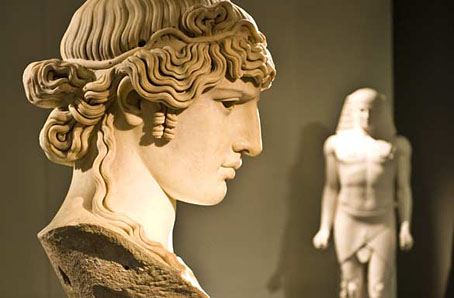
The sculpture known as Antinous Mondragone (c.130 AD).

The planned British Museum exhibition I mentioned in January, a major examination of the Emperor Hadrian’s life and influence, opens today and runs to 26 October, 2008. Hadrian means more to Britons than most Roman Emperors on account of the still-extant wall which bears his name, built to divide England from the untameable wilds of Scotland, or Caledonia as it was then known. On a personal level he fascinates for his obsession with his dead lover Antinous and the mausoleum (later the Castel Sant’Angelo) and villa he left in Rome.

Hadrian was a man of great contradiction in both his personality and reign: a military man and homosexual, he combined ruthless suppression of dissent with cultural tolerance. He reacted with great ferocity against the Jewish Revolt in 132 AD (examples of poignant objects belonging to Jewish rebels hiding in caves near Jerusalem will be included in the exhibition), but he was also a dedicated philhellene, passionate about Greek culture. He took a young Greek male lover, Antinous, who accompanied him on his travels around the empire. In AD 130, Antinous drowned in mysterious circumstances in Egypt. Consumed by grief, Hadrian founded a new city, Antinoupolis, close to the spot where he died and had Antinous declared a god, linked to the Egyptian deity Osiris. A cult of Antinous-Osiris sprang up resulting in statues, busts and silverware featuring the image of the newly deified youth.

And proving that this is a subject whose time has come, John Boorman has a film in production based on Marguerite Yourcenar’s Memoirs of Hadrian. Given Boorman’s uneven output that could be either a good or bad thing; we’ll no doubt find out soon enough.

A very modern emperor | Mary Beard on Hadrian
Hadrian’s Wall World Heritage site
Virtual Museum: Antinous Portraits

Previously on { feuilleton }
Hadrian and Greek love
Vedute di Roma
The Cult of Antinous

Berenice Abbott

abbott.jpg

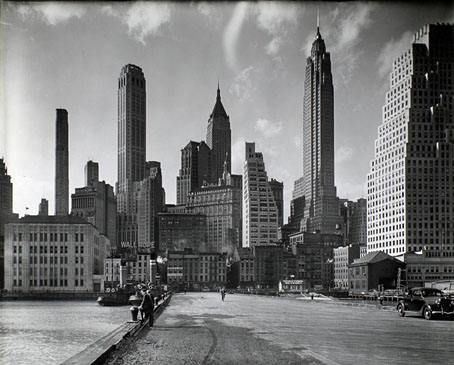
Manhattan Skyline: I. South Street and Jones Lane, Manhattan. March 26, 1936.

I love Berenice Abbott’s photographs of New York in the 1930s which capture the city in transition from a world of 19th century brownstones to the more familiar high-rise skyline. Dover Publications produced their own collection of her photos which I used as one of my key references when drawing Reverbstorm. The NYPL Digital Gallery has a huge selection online, including many which didn’t make the Dover book.

Previously on { feuilleton }
Eugene de Salignac
Luther Gerlach’s Los Angeles
The Bradbury Building: Looking Backward from the Future
Edward Steichen
Karel Plicka’s views of Prague
Atget’s Paris
Downtown LA by Ansel Adams

Albert Kahn’s Autochromes

khan1.jpg

“Lying on a raised dais, this woman may have been the concubine of an affluent opium smoker.” (1915)

In 1909 the millionaire French banker and philanthropist Albert Kahn embarked on an ambitious project to create a colour photographic record of, and for, the peoples of the world. As an idealist and an internationalist, Kahn believed that he could use the new Autochrome process, the world’s first user-friendly, true-colour photographic system, to promote cross-cultural peace and understanding. More.

More Albert Kahn Autochromes and similar early views in colour at this Flickr pool.

Update: And there’s The Wonderful World of Albert Kahn, site and book.

khan2.jpg

The Palais du Trocadéro from the Eiffel Tower (1912).

Previously on { feuilleton }
The Palais du Trocadéro
The Dawn of the Autochrome
German opium smokers, 1900

Old lighthouses

fleetwood1.jpg

From a collection of old postcards depicting British lighthouses. My own fascination with these structures can be traced directly to these two particular examples. The Lower Light or Beach Lighthouse is positioned a couple of streets away from the nursing home where I was born. Although we never lived in Fleetwood, I grew up a few miles down the coast and we often made trips to this unusual port which 19th century entrepreneurs built from nothing in the 1830s.

The lighthouses were built in the 1840s, intended to function together as a guide to ships approaching the docks through sandbanks. To me they helped augment the town’s curious edge-of-the-world quality. Fleetwood is positioned at the end of a peninsular, surrounded by the Irish Sea on two sides with the estuary of the River Wyre on the third. The trams which travel the length of the coast have to make a loop around a block of buildings when they reach the Pharos lighthouse and head south again. A lighthouse built in the middle of a residential street seemed completely bizarre when I was a child; it still looks strange now, as though it was dropped there then forgotten. Once you’ve reached it there’s nowhere left to go. (Well, unless you take the ferry over the river….) Its modest companion is more naturally situated on the promenade nearby. This Flickr photo shows how it looks today.

fleetwood2.jpg

Previously on { feuilleton }
Hungarian water towers