Anamorphosis

quays1.jpg

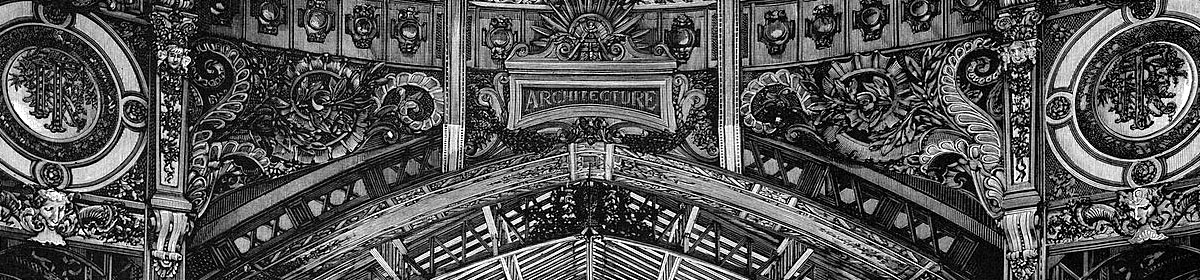
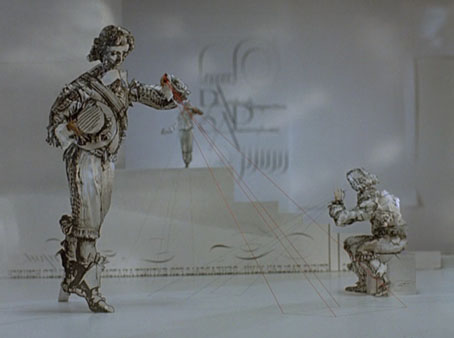
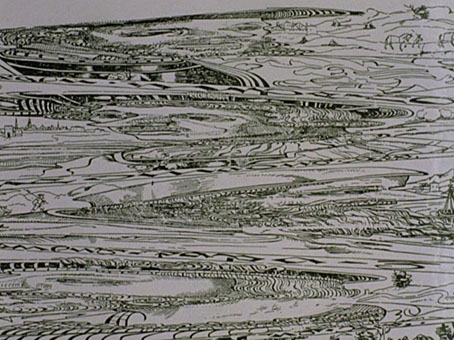
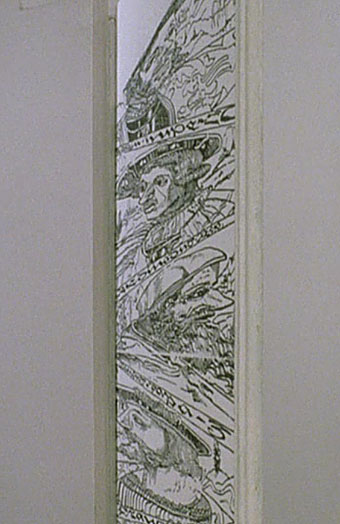
Some anamorphosis for All Fool’s Day. De Artificiali Perspectiva, or Anamorphosis (1991) is a short film by the Brothers Quay which can be seen in two parts at YouTube. (And I’d urge anyone interested to avail themselves of the essential double-disc collection of the Quays’ early work which includes this film.) There are plenty of sites devoted to anamorphosis such as this one but films tend to explain the effect better than still pictures by showing the stages of transformation to or from pictorial coherence. The stills below, for example, work better in motion than they do here. The Quay’s first feature, Institute Benjamenta (1995), also features some anamorphosis with a mural on the walls of a passage in the film’s strange school for servants.
quays2.jpg

Also at YouTube there’s a short video demonstration of mirror anamorphosis, a variation where the distorted picture corrects itself when viewed with a mirrored tube. Musician Rick Wakeman used this effect for an album he released in 1976, No Earthly Connection, a work whose cover art is more impressive than the music it embellishes. The album came with a thin sheet of mirrored plastic which could be folded to create a viewing device.
quays3.jpg

Previously on { feuilleton }
The Ambassadors in detail
False perspective
Trompe l’oeil

Laurie Lipton’s Splendor Solis

lipton.jpg

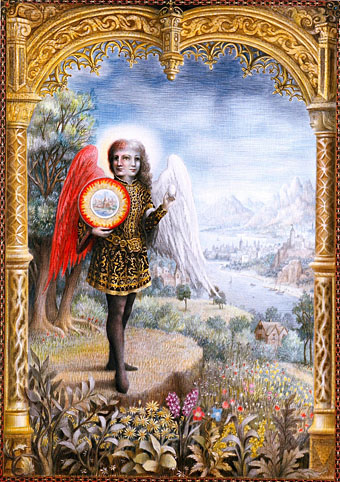
Splendor Solis: Winged (1989).

Following from the post earlier this month about the Splendor Solis series of alchemical plates, Thom draws my attention to a contemporary reworking by American artist Laurie Lipton. I seem to recall seeing one of these at Phantasmaphile but didn’t think at the time to see whether Ms Lipton had any similar work. She does indeed have similar work, her own versions of the entire series of plates, all of them detailed drawings produced with coloured pencils. See the full set here. Thanks Thom!

Previously on { feuilleton }
The Arms of the Art
Splendor Solis

L’Hôtel, Paris

lhotel1.jpg

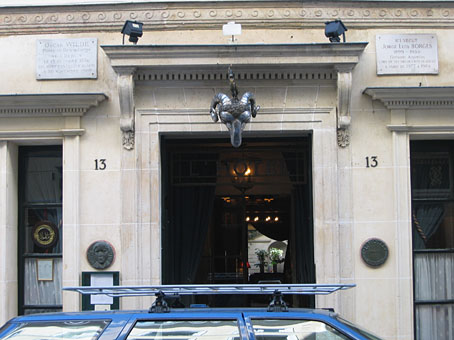
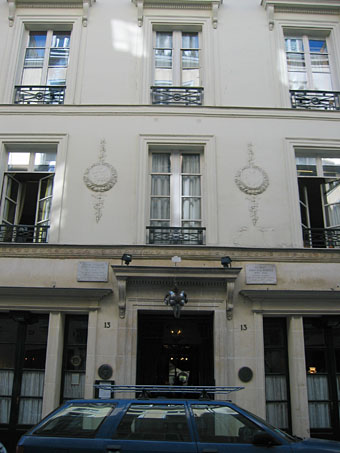
The London broadsheets have been in a ferment for the past few days over a forthcoming exhibition at the V&A, The Cult of Beauty: The Aesthetic Movement 1860–1900 which opens on April 2nd. The Guardian‘s Jonathan Jones wrote a piece pointing out the French associations of the British Aesthetes in which he mentions the Hôtel d’Alsace at 13 Rue des Beaux-Arts, Paris, the place where Oscar Wilde spent his last few months in 1900 prior to expiring in room no. 16. By coincidence I’d been looking at my own photos of the hotel only the day before so here they are, little more than snapshots but they give an idea of the building at least.

lhotel2.jpg

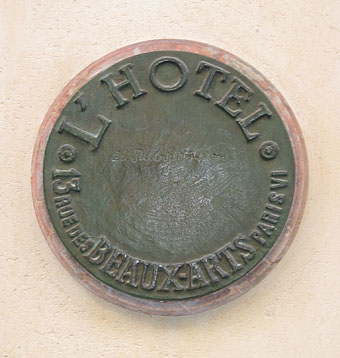
The hotel is now merely L’Hôtel, and I had a couple of surprises when I went to find the place the last time I was in Paris. The first is that the Rue des Beaux-Arts is some distance away from any main thoroughfares, although this perhaps isn’t so surprising given Wilde’s straitened circumstances. The second was seeing a plaque to Jorge Luis Borges (see below) on the wall opposite the one for Oscar Wilde with its incorrect year of birth. Borges had a lifelong fascination with Wilde, the first piece he had published was a translation into Spanish of The Happy Prince (and The Modern Word has a short essay by Borges about Wilde). I knew that Borges had stayed in the hotel (there’s a famous photo of him standing in the atrium) but didn’t expect his patronage to be commemorated in this way; once again, Paris has a respect for writers that puts many other cities to shame. Wilde is celebrated with two plaques—there’s another beside the door which can be seen here—but what these pictures don’t show is the atrium itself, a small space in the centre of the building which gives the hotel a distinction Wilde might have appreciated even if he would have preferred to spend his final hours in one of the more luxurious establishments.

There are more views of the narrow Rue des Beaux-Arts at Google Maps while the hotel has a website here.

lhotel3.jpg

Continue reading “L’Hôtel, Paris”

The Cliff House revisited

cliffhouse1.jpg

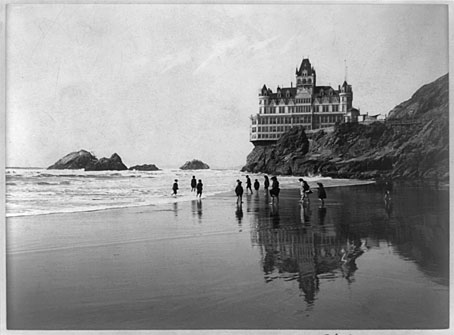
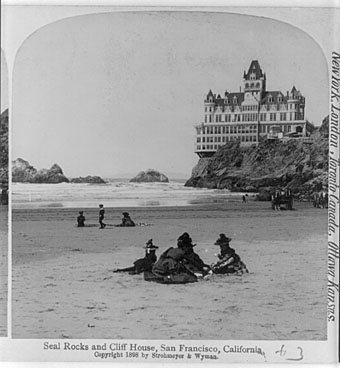
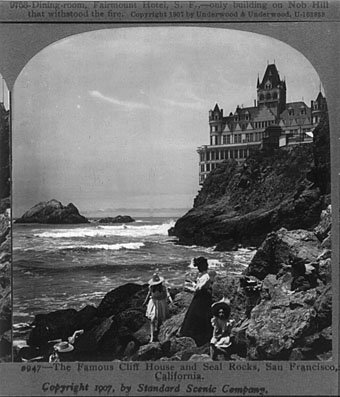
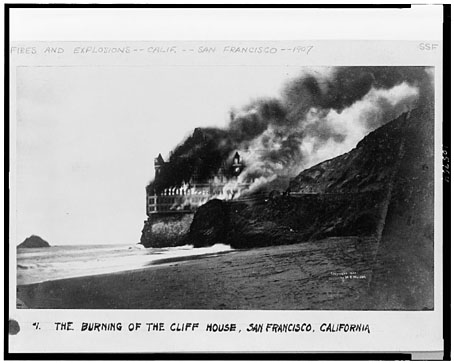
Adolph Sutro’s Cliff House restaurant, San Francisco, has appeared here before but these are some additional photos of the improbable structure from the Library of Congress archives, including a picture of the fire that destroyed the building in 1907. As noted in the earlier post, Blue Öyster Cult aficionados may recognise the house from the cover of the group’s 1988 album, Imaginos.

cliffhouse2.jpg

cliffhouse3.jpg

cliffhouse4.jpg

Previously on { feuilleton }
Adolph Sutro’s Gingerbread Palace

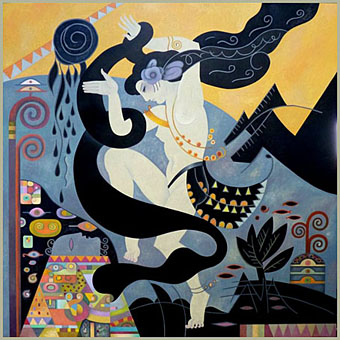
The Salomé paintings of Caroline Smith

smith_seduction.jpg

Seduction.

One of a series of paintings by a British artist, and what a great series it is with echoes of ancient art as well as Gustav Klimt. Also further evidence that this theme isn’t a wholly masculine preoccupation.

Elsewhere on { feuilleton }
The Salomé archive