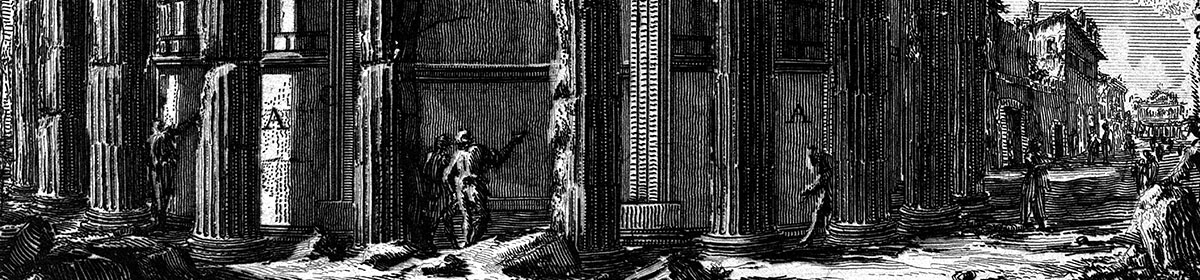
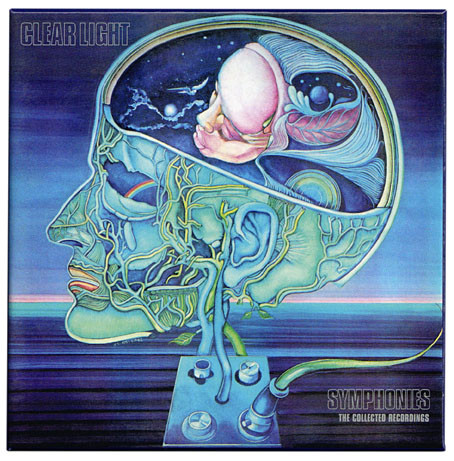
The Clearlight that concerns us here is a French musical ensemble with a shifting line-up, formed by and oriented around the activities of its keyboard-playing composer Cyrille Verdeaux. Clearlight, in other words, shouldn’t be confused with the short-lived American psychedelic band known as Clear Light. Cherry Red have just released five Clearlight albums in one of their well-produced CD boxes: Clear Light Symphony (1975), Forever Blowing Bubbles (1975), Les Contes Du Singe Fou (1977), Visions (1978), and Impressionist Symphony (2014). The box bears the subtitle “The Collected Recordings” but these albums comprise only one half of the Clearlight discography. I doubt there’s much demand for anything more substantial than this, at least in Britain where the group have been chiefly known for their first album, Clear Light Symphony. Cyrille Verdeaux’s booklet notes describe how he secured a deal with Virgin Records thanks to the success of Mike Oldfield’s early albums. Verdeaux’s demo tape was aiming for a similar blend of rock music with classical structures, with one long “symphony” divided into two parts. When the album was being recorded Virgin persuaded him to flesh out his composition with three musicians who were signed to the label via Gong—Steve Hillage, Tim Blake and Didier Malherbe—all of whom play on the second part. Or what should have been the second part… Virgin switched the two playing sides of the recording around in order to give the Gong artists greater prominence. The switch has been reversed for this latest release.
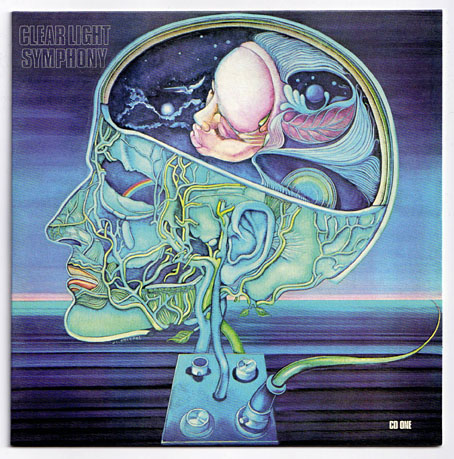
Cover art by Jean-Claude Michel.
I’ve not heard everything in Cyrille Verdeaux’s discography but the Clearlight albums that follow the debut are further excursions into quasi-classical prog-rock composition. There was a lot of this around in the 1970s, especially from keyboard players like Rick Wakeman, Vangelis, Bo Hansson and others. Verdeaux isn’t as much of a Liberace show-off as Wakeman, and he’s not as original as Vangelis, but in Clearlight his piano and keyboard flourishes benefit from the other musicians assembled on each release. Tim Blake had settled in France in the late 1970s, and turns up on several of the albums that follow Clear Light Symphony. The presence of Blake’s burbling synthesizers and Christian Boulé’s Hillage-like guitar lead the music out of the concert hall and into the cosmos. I have to admit to being pleasantly surprised by this collection of albums. I bought the set mainly to restore Clear Light Symphony to my record collection, an album I used to own on vinyl then sold following a shelf purge in the early 2000s. (One thing you’ll never get on a CD reissue is the locked groove that ends side two of the vinyl release.) My worries about the other albums being severely unpalatable haven’t been realised.
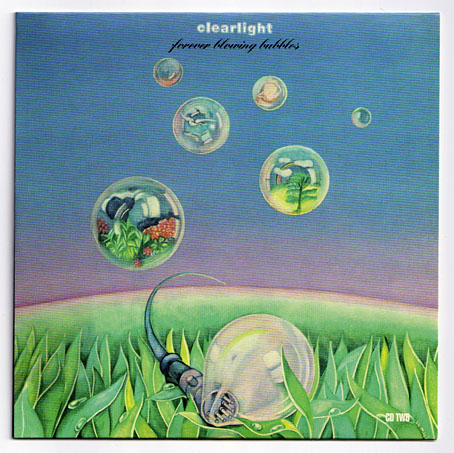
Cover art by Jean-Claude Michel.
Forever Blowing Bubbles was another Virgin release, this time with shorter pieces separated by electronic bubbling noises that posit each composition as one of a number of musical “bubbles” that we’re visiting in turn. A couple of these are songs which I was less keen on but the music is just as good as on the debut album. This is also the first album in the box featuring bonus tracks, a common feature of album reissues which often prove to be superfluous. Not so here, where the additions sound like a continuation of the album as a whole. King Crimson enthusiasts may like to know that David Cross plays violin on this album.
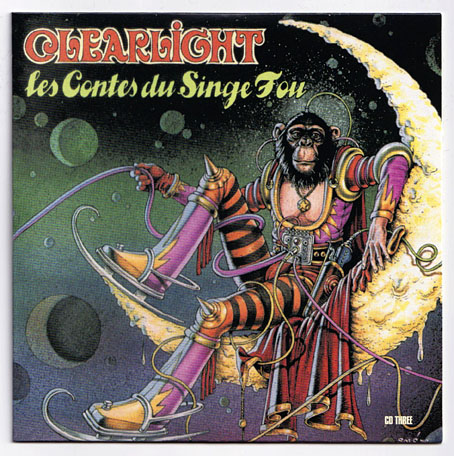
Cover art by Jean Solé.
Les Contes Du Singe Fou continues the formula, with more short compositions and a couple more songs, one of which is so close to the beginning of Supper’s Ready by Genesis as to be almost plagiaristic. In place of David Cross on violin there’s a recent exile from Magma, Didier Lockwood, whose fiery contributions are especially welcome. I didn’t expect there to be a tangible link with the Zeuhl artists when Verdeaux’s compositions are generally more palatable than Magma and co. Christian Boulé was touring in Steve Hillage’s band in 1977 so Yves Chouard takes over on the guitar. I ought to note that this album and the one that follow have been mastered from vinyl sources.
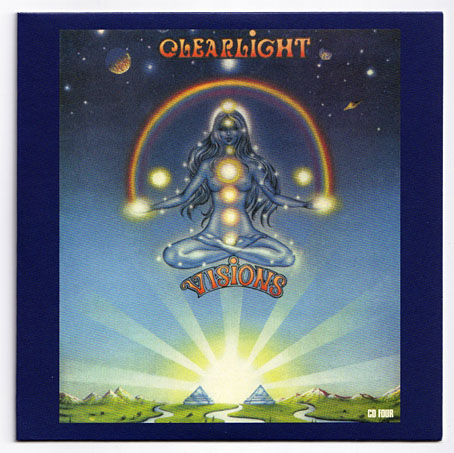
Cover art by Sergio Macedo.
Visions maintains the Clearlight recipe while adding a new ingredient in the form of a lengthy raga piece, Full Moon Raga. This is an album that no-one would have dared release in the post-punk Britain of 1978, but the combination of meditational Indian music with Sergio Macedo’s hippy-mystical cover art looks forwards as well as backwards, to all the New Age albums of the 1980s with their crystalline temples and airbrushed landscapes by Gilbert Williams and his imitators. Didier Lockwood and Christian Boulé are present once more, as is Didier Malherbe on another moonlighting trip away from Gong.
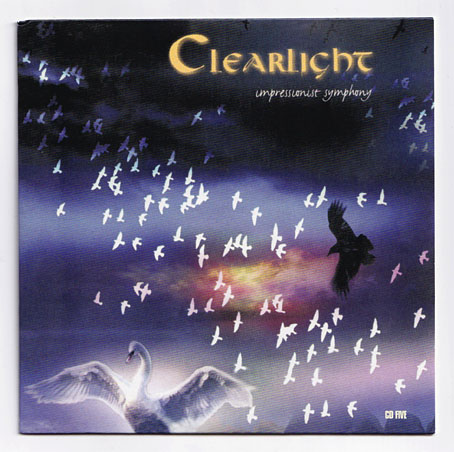
No cover artist credited.
Impressionist Symphony is the album I was most concerned would be a disappointment, being a much later recording that was attempting to capture the atmosphere of Clear Light Symphony. Each track is dedicated to one of Verdeaux’s favourite Impressionist painters but the only real link with Impressionism is the horribly punning titles: “Time Is Monet”, “Lautrec Too Loose”, etc. The music is very much of a piece with the earlier recordings, with substantial contributions from Steve Hillage on guitar and Tim Blake on Theremin. Hillage is the biggest surprise on this album, his playing being a return to the style he became popular for in the late 1970s, and which was largely abandoned by the time he and Miquette Giraudy formed System 7 in 1990.
Cyrille Verdeaux recorded much more than this under the Clearlight name but I’m doubtful we’ll be seeing another boxed collection unless this one proves popular, an unlikely probability. In the meantime there’s another Verdeaux project that’s worthy of note but I’ll save that for another post.
Previously on { feuilleton }
• Zeuhl Ẁortz!
• Inventions for echo guitars
• The Werewolf of Anarchy
• Dune: some French connections