

The Book of Hyperborea (1996). Cover art by Robert H. Knox.
“My Hyperborean tales, it seems to me, with their primordial, prehuman and sometimes premundane background and figures, are the closest to the Cthulhu Mythos, but most of them are written in a vein of grotesque humor that differentiates them vastly.” — Clark Ashton Smith
Since re-reading Clark Ashton Smith’s The Tale of Satampra Zeiros I’ve been revisiting more of Smith’s stories set in the lost world of Hyperborea. And having put together a post some years ago that gathered all the original illustrations for Smith’s Zothique cycle, I thought I’d try and do the same for another of his story series. As I noted in the earlier post, we’re fortunate today that it’s so easy to see illustrations that in the past would have been impossible to find unless you owned (or had access to) a huge collection of pulp magazines. Pulp illustrations aren’t always very good—in the case of the early issues of Weird Tales, they’re frequently amateurish—but those that illustrate new fiction for the first time are historically important if nothing else.
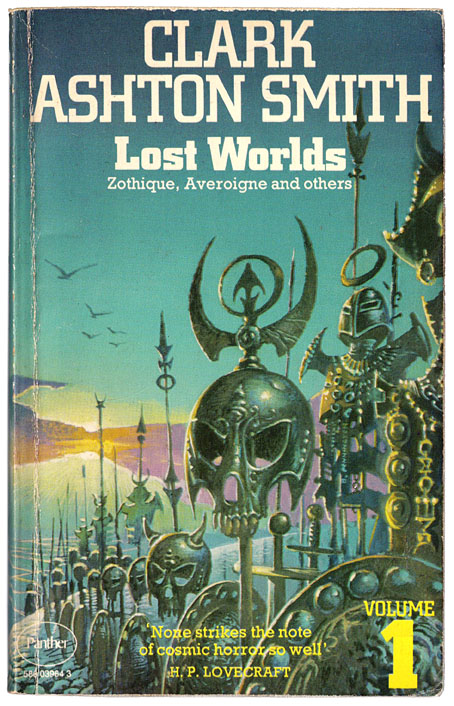
Lost Worlds: Volume 1 (1974). Cover art by Bruce Pennington. Lost Worlds was a single-volume collection published by Arkham House (USA) and Neville Spearman (UK). The Panther paperback covers by Bruce Pennington could easily be used on other books but these were the first Smith volumes I owned.
The first Hyperborea stories were among Smith’s earliest prose fantasies, owing something to Lord Dunsany on the one hand (HP Lovecraft detected a Dunsanian quality), and the writers of antiquity on the other, the name “Hyperborea” (“Behind the North Wind”) being borrowed from the Greeks. The northern location is about the only feature of the continent that the Greek writers would recognise, Smith’s world being a temperate pre-Ice Age realm of mountains and verdant jungles. Dinosaurs and megafauna share the lands with human inhabitants for whom sorcery is a common practice. As with Zothique, the cycle was an influential one. Lin Carter in the introduction to his Ballantine collection, Hyperborea (1971), suggests that the name of the continent might have prompted Robert E. Howard to set his Conan stories in “the Hyborean Age”. This could be the case: Howard and Smith were writing for the same publications, and the first Conan story was published in Weird Tales shortly after The Tale of Satampra Zeiros; but Howard was also reading the Greeks as well. A more substantial influence may be found in Fritz Leiber’s Nehwon, a world in which aspects of Hyperborea and Zothique are combined. Sword and sorcery begins “behind the North Wind”, in other words, although there’s very little sword-play in Smith’s fiction, that was Leiber and Howard’s department.
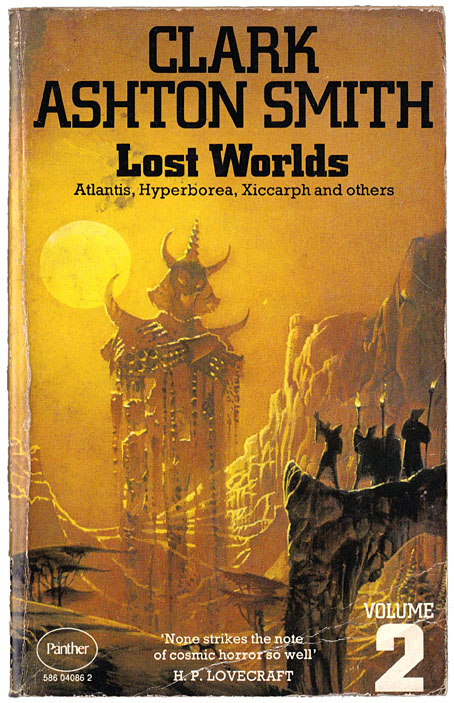
Lost Worlds: Volume 2 (1974). Cover art by Bruce Pennington.
The original Hyperborea illustrations are fewer than those for Zothique. As with the later cycle, several of the stories are unillustrated, while others were given lacklustre artwork. In the earlier post I followed the story order chosen by Lin Carter which attempted to contrive an internal chronology for the cycle. Carter did the same with his Hyperborea collection so I’ve followed his example once again. Later collections, like Will Murray’s Book of Hyperborea, tend to order the stories by publication date.
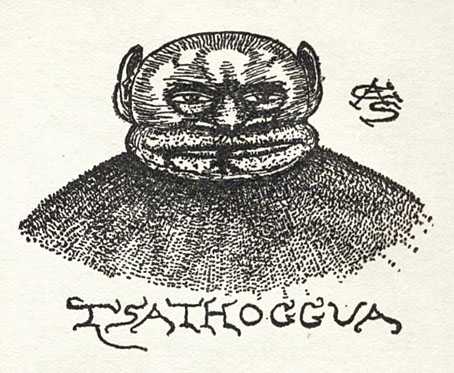
The Seven Geases, Weird Tales, October 1934.
An illustration of Tsathoggua by Smith himself. The toad-god turns up in person in this story.
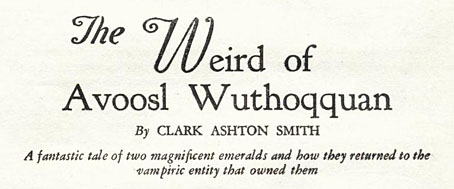
The Weird of Avoosl Wuthoqquan, Weird Tales, June 1932.
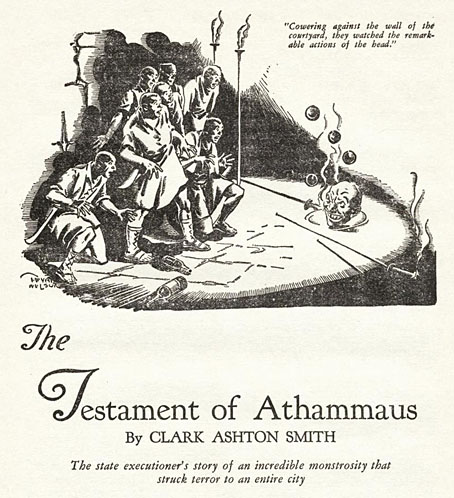
The Testament of Athammaus, Weird Tales, October 1932. Art by T. Wyatt Nelson.
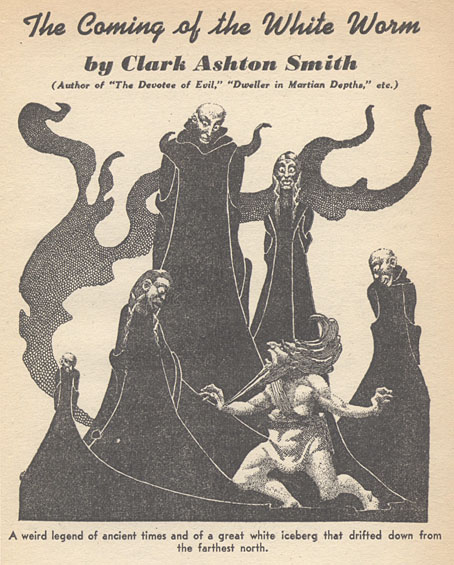
The Coming of the White Worm, Stirring Science Stories, April 1941. Art by Hannes Bok.
Ubbo-Sathla, Weird Tales, July 1933.
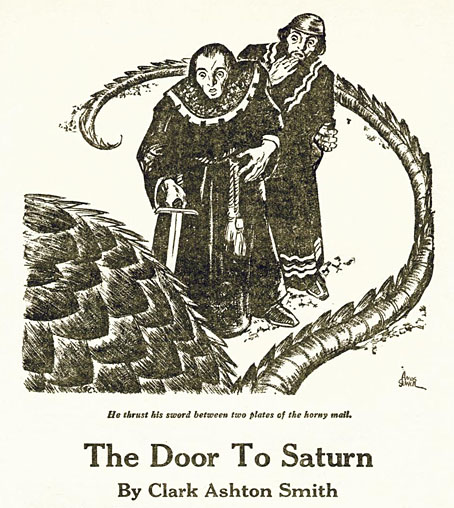
The Door to Saturn, Strange Tales Of Mystery And Terror, January, 1932. Art by Amos Sewell.
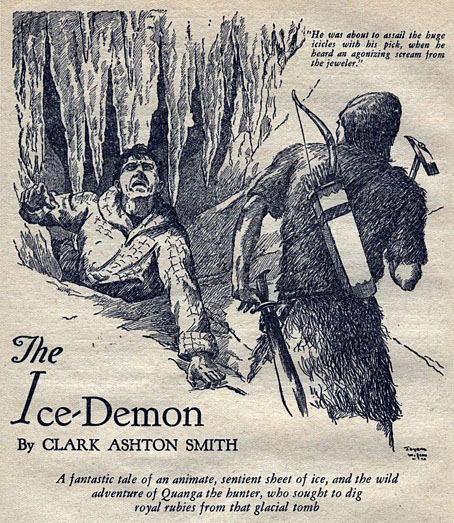
The Ice-Demon, Weird Tales, April 1934. Art by Jayem Wilcox.
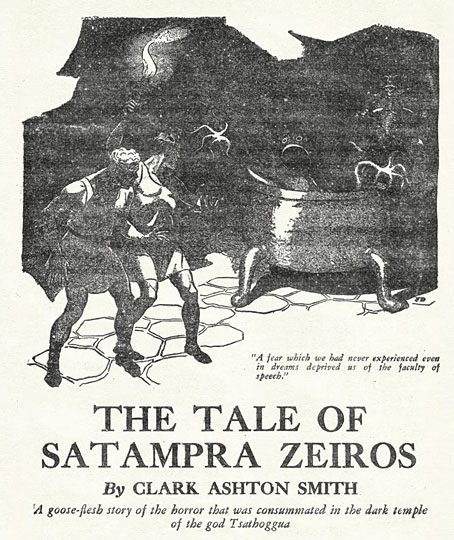
The Tale of Satampra Zeiros, Weird Tales, November 1931. Art by Joseph Doolin.
A decent illustration spoiled by poor printing.
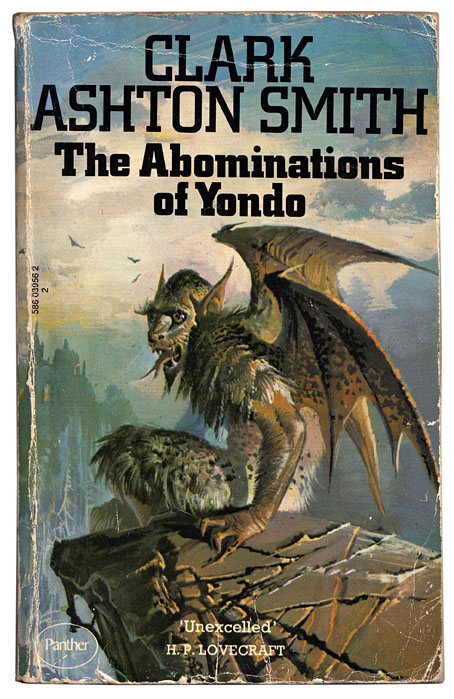
The Abominations of Yondo (1974). Cover art by Bruce Pennington.
One of the earliest stories in the cycle, originally published without illustrations in a 1926 edition of Overland Monthly. Since Bruce Pennington’s work appears above I’ve let him finish the post.
Elsewhere on { feuilleton }
• The illustrators archive
Previously on { feuilleton }
• The Return of the Sorcerer
• Ray Harryhausen’s swords and sorceries
• Beksiński at Mnémos
• The Cthulhu Mythos in the pulps
• Illustrating Zothique
• The Plutonian Drug
• More trip texts
• Yuggoth details
• The Garden of Adompha
• The City of the Singing Flame
• Haschisch Hallucinations by HE Gowers
• Odes and Sonnets by Clark Ashton Smith
• Clark Ashton Smith book covers
I truly enjoy the impassioned lens of your surveys and have done so for years. I’m not sure if it’s of value to thank someone for their passions, but I am grateful to learn from yours.
SORRY JOHN — THIRD ATTEMPT — I WAS TALKING ABOUT SMITH’S INFLUENCE ON JACK VANCE’S THE DYING EARTH, IN TURN AN INFLUENCE ON EARLY HARRISON AND HIS FANTASY STORIES. SOME OF MINE, TOO. LARRY SHAW & DON WOLLHEIM DID SO MUCH TO FIND SMITH and Co AN AUDIENCE AND DESERVE ACKNOWLEDGEMENT FOR THEIR WORK IN THE FANTASY REVIVAL IN LANCER BOOKS AND ACE BOOKS IN THE EARLY 60s. I think Wollheim in particular should be acknowledged in some way for introducing a wider audience to the likes of Smith but it seems he’s been forgotten or written out of the histories because of his publishing of Tolkein which brought his and Shaw’s favourite writers to a mass audience.
Those book covers from the 70’s were my art museum growing up as a kid. I used to go to Sears and go to their paperback section, and be there for hours just looking at the covers for sci-fi, Agatha Christie mysteries, etc. Always great artwork. I bought a few just for the covers. I’m grateful for and cherish that childhood experience.
Michael: Thanks. This one wasn’t so impassioned with the contents being less fruitful than usual. Since I work as an illustrator I also have a professional curiosity, I like to see how other artists have interpreted a story or illustrated a cover.
Mike: Sorry about that (if it was the fault of WordPress). I could expand the commenting options here but I try to avoid things appearing too complicated. Re: Smith’s fiction, I mentioned the Jack Vance connection in my Zothique post. I have a special fondness for Dying Earth scenarios, when treated right they offer decadence on a cosmic scale. As you did yourself in Dancers at the End of Time, of course… I can’t really comment on Wollheim, the mid-century US publishing scene isn’t an area I’ve explored in any detail.
Federico: I’ve said the same on many occasions. A good book cover can help make an already attractive book into an essential purchase. I would have bought the Smith paperbacks even if they had terrible covers–the recommendation from Lovecraft was enough–but the Pennington artwork was an extra incentive. All the covers he did for Smith are vague enough that you could swap them from one book to another; but they all communicated the right kind of atmosphere.
Great illustrations, but Hans Bok is the best.
It’s often the case with Bok. It’s a shame he didn’t illustrate more of Smith’s fiction.