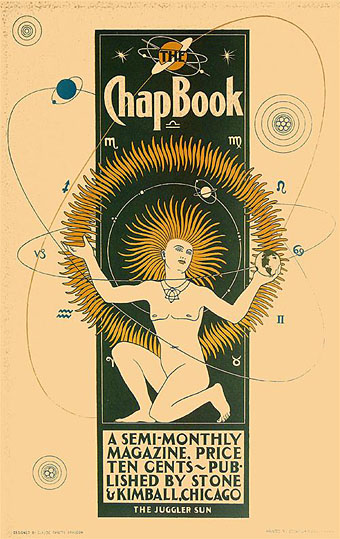
The Juggler Sun (1895).
On the shortest day of the year it seems fitting to post a picture of the sun and hope that in 2009 the clouds clear long enough for us Brits to see more than a month of it. Claude Fayette Bragdon’s poster is a remarkably stylised work for 1895 and might easily have been produced twenty or more years later. The Chap-Book was a periodical which included Bragdon among its illustrators although none of the cover designs to be found online are this striking. Bragdon wasn’t only an illustrator, however.
A man of many talents, Claude Fayette Bragdon (1866–1946) was an architect, artist, writer, philosopher, and stage designer. Bragdon’s work in these varied fields interrelated and overlapped, tied together by his theosophical belief in creating and communicating beauty. After a successful career as an architect in Rochester, NY, Bragdon entered the world of stage design in 1919, at the age of 53, by consenting to design a traveling production of Hamlet for actor-producer and personal friend Walter Hampden. Bragdon’s arrival in the world of theater came at a time when significant changes in staging techniques were on the horizon. (More.)
I usually celebrate polymathy but in Bragdon’s case his varied interests seem to have deprived us of more work by a unique illustrative talent. The indispensable VTS has further examples of his clean style from a 1915 treatise on architecture and design, Projective Ornament. It was increasingly common during this period to regard ornamentation in architecture as a 19th century evil to be purged from all future buildings, a concept expressed most notoriously by Adolf Loos in his 1908 essay, Ornament and Crime. Bragdon engaged with the argument by proposing that architects put aside historical and natural pastiche and look to geometry for a new style of decoration. His illustrations in Projective Ornament are beautifully done and some (like the one below) might almost be the work of an Art Deco illustrator such as George Barbier.

Elsewhere on { feuilleton }
• The illustrators archive
Previously on { feuilleton }
• The Decorative Age
• Images of Nijinsky
John, I do not know if you are familiar with the site Golden Age Comicbook Stories (http://goldenagecomicbookstories.blogspot.com), but if you aren’t I think you might find it interesting, in particular this post about an illlustrator by the name of Dugald Stewart-Walker:
http://goldenagecomicbookstories.blogspot.com/2008/12/dugald-stewart-walker-1883-1937-girl.html
Thanks Nathalie. Yes, I’ve been following that site for a while and linked to it in my earlier post about Walker’s work. GACBS has an amazing collection of books and magazines. Great that he posts so many large scans of the artwork.
Discovered this site while searching Claude Fayette Bragdon / and a few others …. and suddenly the name
Dugald Stewart-Walker pops up !!!! I have had difficulty finding information related to D. Stewart-Walker … since I purchased an original water color nearly 30 years ago … seems like a very long time for the INTERESTED sectors to begin talking about him ?
efc
Do you know if anyone sells Claude’s posters? I’d be interested in buying some. Cluade was my great grandfather. All my best, Katherine
Hi Katherine. The poster above can be found here but that’s the only one I’ve seen:
http://www.internationalposter.com/poster-details.aspx?id=USL17899