Steam and smoke

walden1.jpg

Cardiff Docks (1894) by Lionel Walden.

There’s a tendency to consider the art of the 19th century as being preoccupied with the rural, the mystical and the historic: all true in the case of the Pre-Raphaelites. But the effects of the Industrial Revolution attracted enough artists to create a sub-genre of painting that takes the miasmas of factories and the hellish glow of furnaces as its subject; Philip de Loutherbourg’s Coalbrookdale by Night (1801) is one of the more well-known examples, not least for being a painting that shows the future emerging from a rural landscape in a truly infernal manner.

Lionel Walden (1861–1933) was an American artist who was in Wales long enough to paint several scenes of the Cardiff docks and the steelworks. I’d not seen this gorgeously atmospheric painting of the docks before but it captures the light and the ambience of a British autumn/winter with the same fidelity as John Atkinson Grimshaw, an artist who made chilly mornings and smoky twilights his speciality. Walden’s other paintings are a lot lighter, with more traditional views of docks, boats and fishermen. (Via Beautiful Century.)
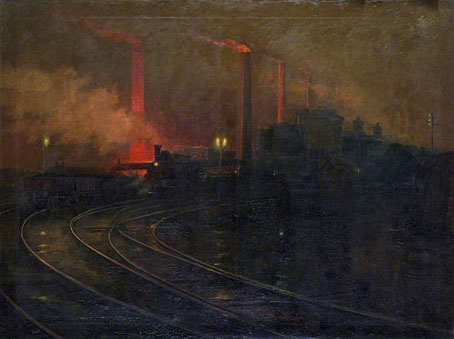
walden2.jpg

The Steelworks, Cardiff at Night (1893–97) by Lionel Walden.

Previously on { feuilleton }
How It Works
The art of John Atkinson Grimshaw, 1836–1893
Winter light

friedrich1.jpg

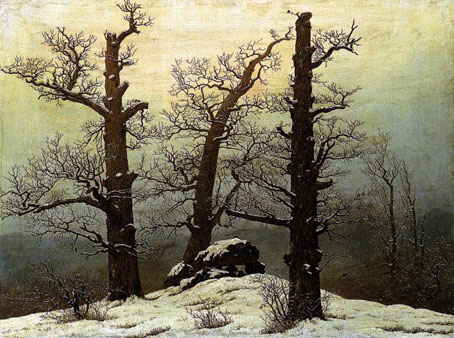
Dolmen in the Snow (1807).

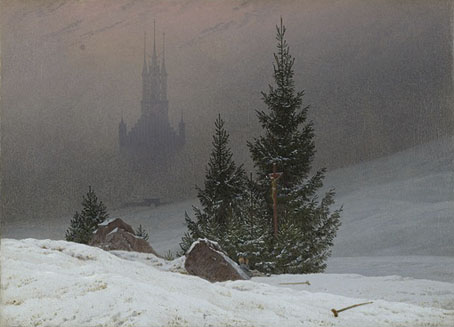
Some paintings for the Winter Solstice by one of my favourite Romantic artists, Caspar David Friedrich (1774–1840). Snow scenes tend to inspire picturesque cliché but in Friedrich’s paintings winter is merely another season in which to evoke his Christian mysticism through the depiction of landscape. The pagan dolmen above is an unusual subject, far more common are churchyard ruins and mountainside crosses although he was also happy enough painting luminous landscapes, especially of mountains and the sea. His treatment of natural light is quite extraordinary and his photo-realist style makes an interesting contrast with the similar effects captured by JMW Turner‘s palette of blurs and smears.

friedrich2.jpg

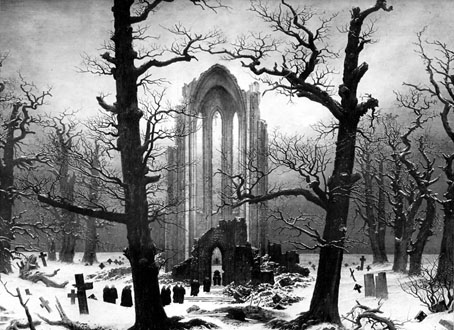
Monastery Graveyard in the Snow (1819).

I hadn’t noticed before until I looked through some online galleries that Friedrich was painting the same trees over and over. The gnarled trunks in the dolmen painting are almost identical (but reversed) to the foreground trees in the graveyard picture and similarly-shaped trees occur in other paintings. If you’re wondering why the graveyard picture is in black and white, the original was destroyed during the Second World War. Colour copies can be found but I think these may have been tinted from a monochrome photo print.

friedrich3.jpg

Winter Landscape (1811).

Previously on { feuilleton }
Winter Solstice
The art of John Atkinson Grimshaw, 1836–1893
The art of Karl Friedrich Schinkel, 1781–1841

The art of John Atkinson Grimshaw, 1836–1893
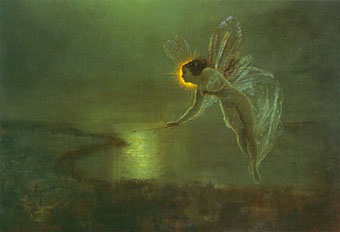
grimshaw1.jpg

Spirit of the Night (1879).

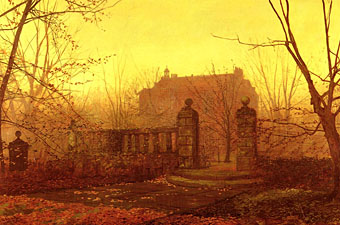
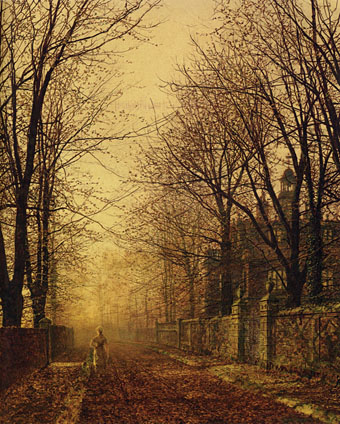
Few people recognise the name of John Atkinson Grimshaw today but anyone who’s bought a birthday or greeting card in Britain will have seen his Spirit of the Night fairy painting, one of a generic series he produced in the 1870s that remains very popular despite the painter’s obscurity. Grimshaw would probably be surprised by this, the fairies were a brief diversion (I like the camp Classicism of Endymion on Mount Latmus), his real enthusiasm was for depicting the gold and amber tints of an English autumn. When he wasn’t painting fallen leaves in quiet streets he was capturing the moonrise or a smoky Victorian twilight in pictures of such spectral delicacy they could easily be used as illustrations for stories by Arthur Machen. This site devoted to the artist has many more, including the fairy paintings; perfect viewing for damp and gloomy evenings.

grimshaw2.jpg

Autumn Morning.

grimshaw3.jpg

A Golden Beam.

Previously on { feuilleton }
The art of Karl Friedrich Schinkel, 1781–1841