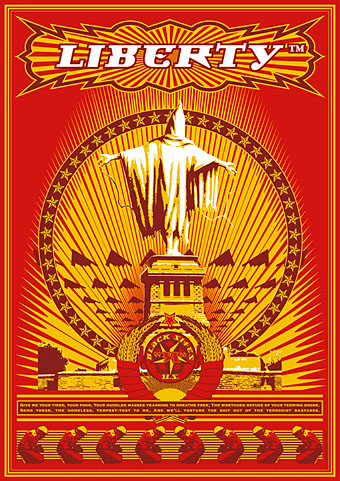
Liberty 2006

liberty.jpg

“For a while there I was criticized as being the vice president for torture. We don’t torture. That’s not what we’re involved in.” Vice President Dick Cheney, October 24th, 2006.

“In the “war on terror”, the US administration has resorted to secret detention, enforced disappearance, prolonged incommunicado detention, indefinite detention without charge, arbitrary detention, and torture or other cruel, inhuman or degrading treatment.” Amnesty International.

Today is the 120th anniversary of the dedication of the Statue of Liberty, that famous gift of the French to “the home of freedom”. One can only wonder what President Grover Cleveland would have made of the current White House incumbent when George Bush signed the Military Commissions Act into law recently, giving himself and future presidents the power to “indefinitely hold people without charge, take away protections against horrific abuse, put people on trial based on hearsay evidence, authorize trials that can sentence people to death based on testimony literally beaten out of witnesses, and slam shut the courthouse door for habeas petitions.” (Anthony D. Romero, American Civil Liberties Union Executive Director).

Now that the United States has taken yet another step towards becoming the kind of country it used to profess to despise, I thought it was time that the Statue of Liberty received a makeover, something more suited to the Neo-Stalinist nation that Bush and co have been busy creating. The challenge for America in the near future, if the Democrats manage to take back the White House in 2008, will be to reverse the course the country has been set upon since 2001. At the moment I’m too cynical to believe that there’ll be any immediate reversal of these policies. Parties in opposition always complain loudly about the ravaging of constitutions then find the new laws they were complaining about have all sorts of conveniences for them once they gain power. Have the Democrats the courage to face down more “terrorist sympathiser” bullshit? Time will tell.

In the same series: Blood Money 1, Blood Money 2, War®.

Update: seems like I missed George’s latest wheeze, signing a new law relaxing the restrictions on the President declaring martial law. We’re constantly told these days it’s hysterical to mention creeping fascism (and I usually agree with George Orwell that the “f” word trips off the lips too easily). Any bets on when the time will be right?
A literary event: new Thomas Pynchon

MutedPosthorn.jpgNew Thomas Pynchon novel to be released
Mysterious author’s first novel in almost a decade comes out in December

NEW YORK—Thomas Pynchon fans, the long wait is apparently over: His first novel in nearly a decade is coming out in December.

But details, as with so much else about the mysterious author of such postmodern classics as “V.” and “Gravity’s Rainbow,” have proved a puzzle.

Since the 1997 release of “Mason & Dixon,” a characteristically broad novel about the 18th-century British explorers, new writings by Pynchon have been limited to the occasional review or essay, such as his introduction for a reissue of George Orwell’s “1984.” He has, of course, made no media appearances or allowed himself to be photographed, not counting a pair of cameos in “The Simpsons,” for which he is sketched in one episode with a bag over his head.

This much is known about the new book: It’s called “Against the Day” and will be published by Penguin Press. It will run at least 900 pages and the author will not be going on a promotional tour.

“That will not be happening, no,” Penguin publicist Tracy Locke told The Associated Press on Thursday.

Like J.D. Salinger (who at one point Pynchon was rumored to be), the 69-year-old Pynchon is the rare author who inspires fascination by not talking to the press. Alleged Pynchon sightings, like so many UFOs, have been common over the years, and his new book has inspired another round of Pynchon-ology on Slate and other Internet sites.

Late last week, the book’s description—allegedly written by Pynchon—was posted on Amazon.com. It reads in part:

“Spanning the period between the Chicago World’s Fair of 1893 and the years just after World War I, this novel moves from the labor troubles in Colorado to turn-of-the-century New York, to London and Gottingen, Venice and Vienna, the Balkans, Central Asia, Siberia at the time of the mysterious Tunguska Event, Mexico during the Revolution, postwar Paris, silent-era Hollywood, and one or two places not strictly speaking on the map at all.

“With a worldwide disaster looming just a few years ahead, it is a time of unrestrained corporate greed, false religiosity, moronic fecklessness, and evil intent in high places. No reference to the present day is intended or should be inferred.”

The description was soon pulled from the site, with Penguin denying any knowledge of its appearance. According to Amazon.com spokesman Sean Sundwall, Penguin requested the posting’s removal “due to a late change in scheduling on their part. We expect the description to be reposted to the book’s detail page in the next day or two.”

Locke declined comment on why the description was taken down, but did reluctantly confirm two details provided by Sundwall, that the book is called “Against the Day” (no title is listed on Amazon.com) and that Pynchon indeed wrote the blurb, which warns of more confusion to come.

“Contrary-to-the-fact occurrences occur,” Pynchon writes. “If it is not the world, it is what the world might be with a minor adjustment or two. According to some, this is one of the main purposes of fiction. Let the reader decide, let the reader beware. Good luck.”

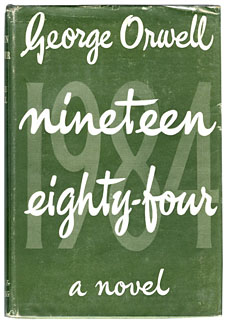
Nineteen Eighty-Four

1984.jpg

WAR IS PEACE
Nineteen Eighty-Four, 1949

“I just want you to know that, when we talk about war, we’re really talking about peace.” George W. Bush, June 18, 2002

George Orwell’s classic novel was published fifty-seven years ago today. There’s little reason to remind anyone of its prescience or the ubiquity of the neologisms Orwell invented; examples like the one above are all too easy to find in the current political landscape. That prescience can also be seen in his essay ‘Politics and the English Language‘ written in 1946, which shows how much his mind was engaged with the use of language and its relationship to politics shortly before he began writing the novel. The extract below is especially pertinent and worth bearing in mind whenever you hear a politician talking.

In certain kinds of writing, particularly in art criticism and literary criticism, it is normal to come across long passages which are almost completely lacking in meaning. Words like romantic, plastic, values, human, dead, sentimental, natural, vitality, as used in art criticism, are strictly meaningless in the sense that they not only do not point to any discoverable object, but are hardly ever expected to do so by the reader. When one critic writes, “The outstanding feature of Mr. Xs work is its living quality,” while another writes, “The immediately striking thing about Mr. X’s work is its peculiar deadness,” the reader accepts this as a simple difference of opinion. If words like black and white were involved, instead of the jargon words dead and living, he would see at once that language was being used in an improper way.

Many political words are similarly abused. The word Fascism has now no meaning except insofar as it signifies “something not desirable.” The words democracy, socialism, freedom, patriotic, realistic, justice, have each of them several different meanings which cannot be reconciled with one another. In the case of a word like democracy, not only is there no agreed definition, but the attempt to make one is resisted from all sides. It is almost universally felt that when we call a country democratic we are praising it: consequently the defenders of every kind of regime claim that it is a democracy, and fear that they might have to stop using the word if it were tied down to any one meaning.

Words of this kind are often used in a consciously dishonest way. That is, the person who uses them has his own private definition, but allows his hearer to think he means something quite different. Statements like Marshal Petain was a true patriot, The Soviet Press is the freest in the world, The Catholic Church is opposed to persecution, are almost always made with intent to deceive. Other words used in variable meanings, in most cases more or less dishonestly, are class, totalitarian, science, progressive, reactionary, bourgeois, equality.