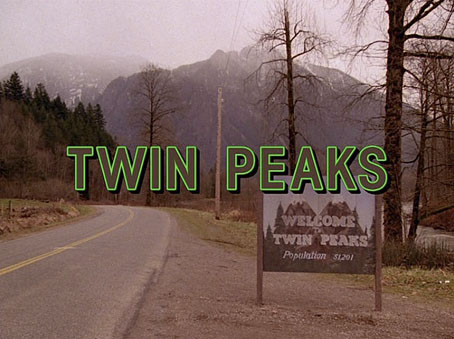
Having spent the past two weeks re-watching the whole run of Twin Peaks, and following that with David Lynch’s 1992 prequel, Fire Walk With Me, I feel I owe the producers of these works a note of apology. Being a long-time Lynchophile I eagerly watched every episode of Twin Peaks when it was first screened by the BBC in 1991, and while I thoroughly enjoyed the first fifteen episodes I grew increasingly dismayed with the series as the principal writer and director wandered off halfway through and the whole thing lost focus. There was a return to form with the very last episode, and Fire Walk With Me is great despite some flaws, a film I much prefer to the later Lost Highway, but that disappointment meant I’d never tried watching the whole series again until now, courtesy of a very reasonably-priced Gold Box Edition (thanks, Fopp).
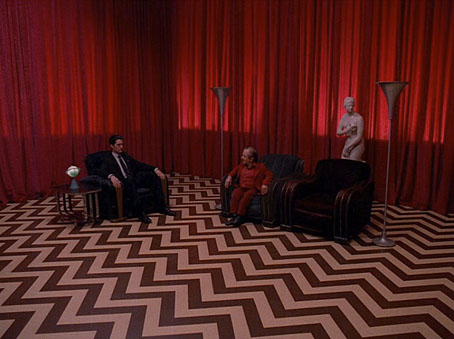
Kyle MacLachlan and Michael J. Anderson.
There were a number of surprises: first of all the main story hangs together better than I remembered, starting with the investigation into Laura Palmer’s death, grading to the cat-and-mouse game with rogue FBI agent Windom Earle, then looping back via the Black Lodge business in the final episode and Fire Walk With Me to Laura Palmer again. The sub-plots in season two are still a mix of the annoying (all the Dick Tremayne stuff) or the pointless (the unconvincing attempt to put James Hurley into a Black Widow ménage)—and the episode directed by Diane Keaton is positively amateurish—but if you stick with Agent Cooper all is well. Aside from the content lapses the quality of the whole thing was a delight, having watched the series originally with mono sound on a TV with a fuzzy picture. There are many great performances which benefit from the DVD mastering, among which I’d choose Kyle MacLachlan, Sherilyn Fenn, and especially Ray Wise as Leland Palmer whose role is by turns comic, terrifying, and ultimately tragic when he comes to terms with the horror of his predicament.
The best episodes are all Lynch-directed, of course, and I hadn’t realised before that the climax of the first story arc, the murder of Maddy Ferguson, is episode 15, right in the middle of the run. And I had the opportunity this time to do something I’m sure many Lynch-heads have done already, namely watch Fire Walk With Me after the final episode as though it’s episode 31. Seeing the film this way deepens the whole experience despite obvious disjunctions such as the slightly older cast and Donna Hayward being played by a different actor altogether. (In a David Lynch film this perhaps doesn’t matter too much.) What’s most thrilling is the realisation that Lynch has done something here which seems almost unique by joining the end of his otherwise unfinished story to its beginning; Laura Palmer’s life and death becomes a Möbius strip in which questions of ends or beginnings are negated. And why not when the Red Room is an apparently timeless space?
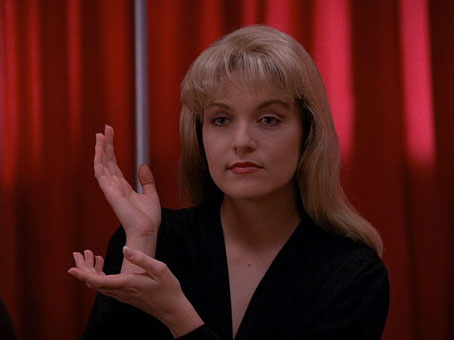
Sheryl Lee.
I could enthuse at length about the musical moments which are always a high spot in Lynchland—Julee Cruise’s appearances, Audrey’s dance, Little Jimmy Scott (!) in The Black Lodge—but if you’ve seen these you’ll know to what I refer. If you haven’t, well…your life is a hollow sham. Now that we’re in the month of the Gift Apocalypse I’d thoroughly recommend the Twin Peaks box as a purchase for anyone who likes the weird stuff. A feast of garmonbozia awaits.
Previously on { feuilleton }
• David Lynch window displays
• Patrick McGoohan and The Prisoner
• David Lynch in Paris
• Inland Empire

_MET_DP816992.jpg)