
Category: {photography}
Photography
20 Sites n Years by Tom Phillips
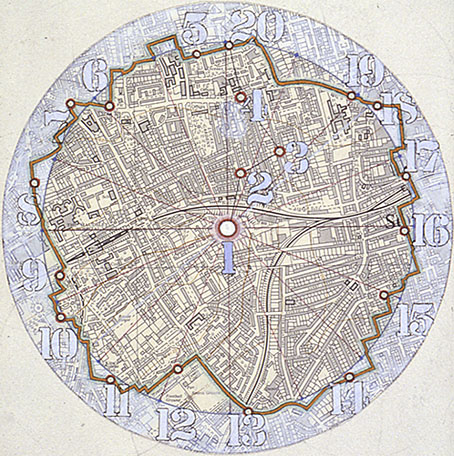
Tom Phillips has long been one of my favourite contemporary artists and he’d certainly be my candidate for one of the world’s greatest living artists even though the world at large stubbornly refuses to agree with this opinion. Phillips’ problem (if we have to look for problems) would seem to be an excess of talent in an art world that doesn’t actually like people to be too talented at all (unless they’re dead geniuses like Picasso) and a lack of the vaunting ego that propels others into the spotlight.
Phillips is predominantly a painter but a restlessly experimental one. On my journey through the London galleries in May I visited the National Portrait Gallery, a rather dull place mostly filled with pictures of the rich and famous by the rich and famous. There were two Tom Phillips works on display in different rooms, inadvertently showing his artistic range: one, a fairly standard (if very finely detailed) portrait of Iris Murdoch, the other a computer screen showing a portrait of Susan Adele Greenfield which manifested as an endlessly-changing series of 169 processed drawings and video stills. One work was static and traditional, the other fluid, contemporary and unlike anything else in the building.
Turkish wrestlers
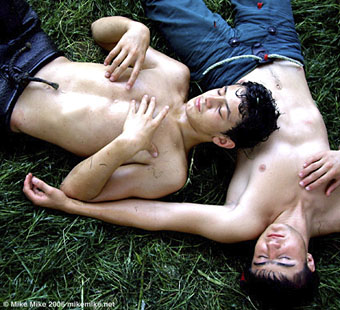
Wonderful Flickr photo set by istanbul mike
depicting off-duty Kirkpinar wrestlers.
Paris V: Details
Final Paris posting here, gathering up more of the better photos.
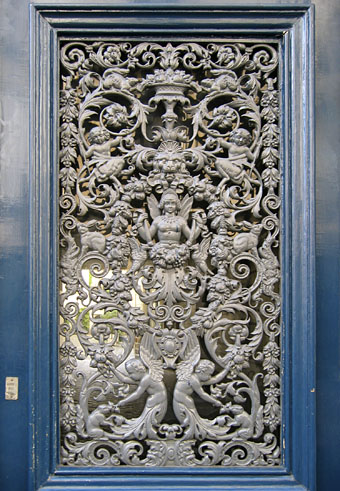
Walk down any residential street and you’ll see amazing doors like this that lead to the courtyards of apartment blocks. All the decorations are different, as are the brass door-handles emblazoned with human or animal heads. You could spend months photographing them.
Paris IV: Notre-Dame
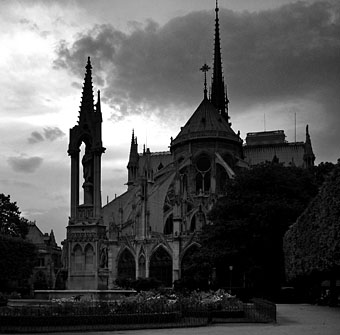
Baedeker insists that the façade of Notre-Dame is the cathedral’s finest feature but I disagree; I much preferred seeing the windows on the southern transept and the buttresses supporting the nave. There were also fewer people in the small square at the back. The mass of tourists at the front seemed like a contemporary equivalent of the hordes that have frequently laid siege to the building.
The Cathedral of Notre-Dame, founded in 1163 on the site of a church of the 4th cent. was consecrated in 1182, but the nave was not completed till the 13th century. The building has since been frequently altered, and has been judiciously restored since 1845 ; but the general effect is hardly commensurate with the renown of the edifice. This is owing partly to structural defects, partly to the lowness of its situation, and partly to the absence of spires. It is, moreover, now surrounded by lofty buildings which farther dwarf its dimensions; and, lastly, the adjacent soil has gradually been raised to the level of the pavement of the interior, whereas in 1748 the church was approached by a flight of thirteen steps.
During the Revolution the cathedral was sadly desecrated. A decree was passed in August, 1793, devoting the venerable pile to destruction, but this was afterwards rescinded, and the sculptures only were mutilated. On 10th Nov. in the same year, the church was converted into a ‘Temple of Reason’, and the statue of the Virgin replaced by one of Liberty, while the patriotic hymns of the National Guard were heard instead of the usual sacred music. On a mound thrown up in the choir burned the ‘torch of truth’, over which rose a Greek ‘temple of philosophy’, adorned with busts of Voltaire, Rousseau, and others. The temple contained the enthroned figure of Reason (represented by Maillard, the ballet dancer), who received in state the worship of her votaries. White-robed damsels, holding torches, surrounded the temple, while the side-chapels were devoted to orgies of various kinds. After 12th May, 1794, the church was closed, but in 1802 it was at length re-opened by Napoleon as a place of divine worship.
In 1871 Notre-Dame was again desecrated by the Communards. The treasury was rifled, and the building used as a military depot. When the insurgents were at last compelled to retreat before the victorious troops, they set fire to the church, but fortunately little damage was done.
At the back of the Cathedral is another ‘place’, occupying the site of the old archiepiscopal palace, in the centre of which rises the tasteful Gothic Fontaine Notre-Dame, designed by Vigoureux, and erected in 1845.
At the S.E. end of the Isle de la Cité, not far from the fountain just described, stands the Morgue (open daily), a small building re-erected in 1861, where the bodies of unknown persons who have perished in the river or otherwise are exposed to view. They are placed on marble slabs, kept cool by a constant flow of water, and are exhibited in the clothes in which they were found. The process of refrigeration to which the bodies are subjected makes it possible to keep them here, if necessary, for three months. The bodies brought here number 700-800 annually. The painful scene attracts many spectators, chiefly of the lower orders.
Baedeker’s Paris (1900).