The skull beneath the skin

skull1.jpg

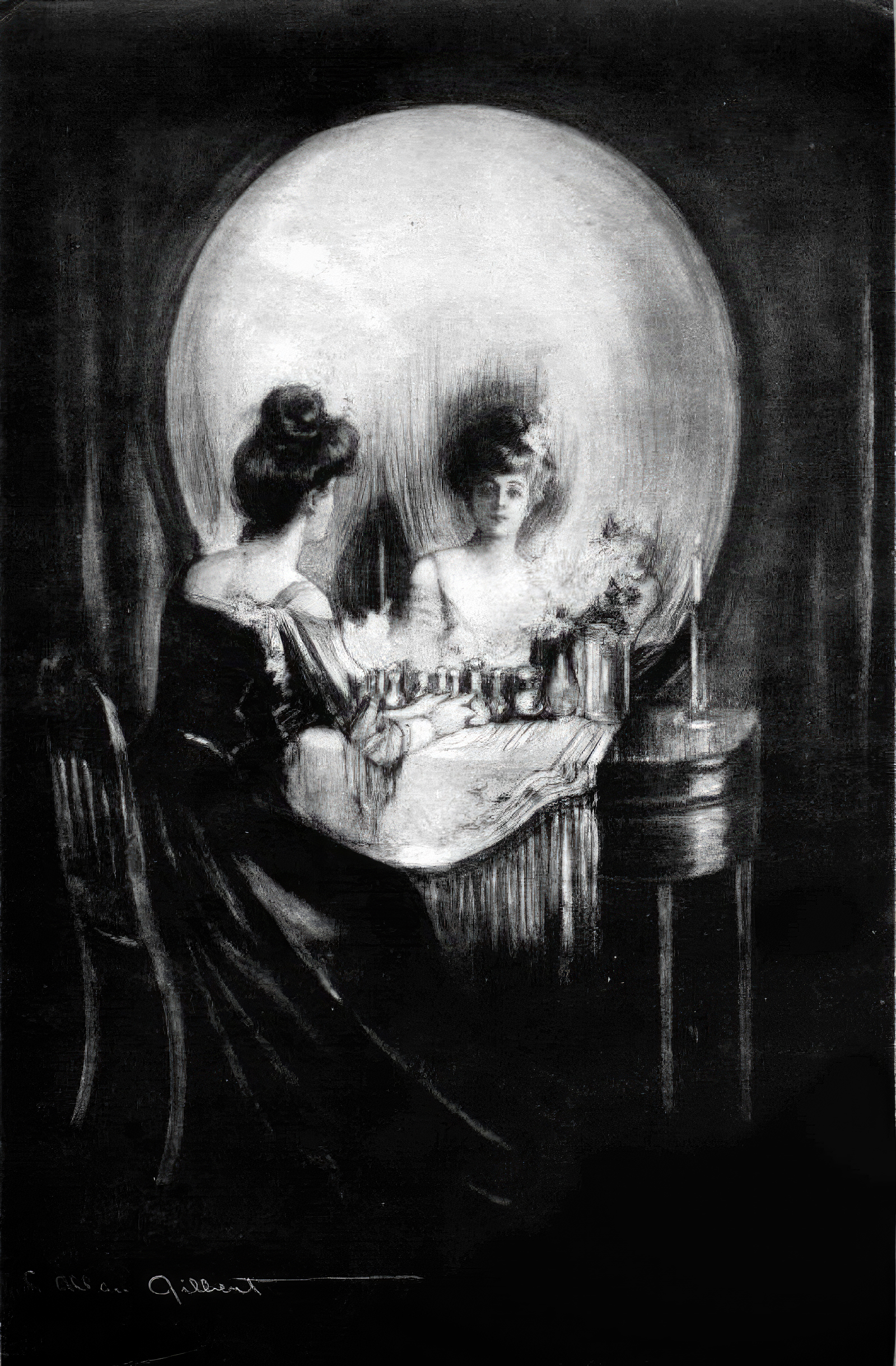
All Is Vanity by Charles Allan Gilbert (1892).

The subliminal skull is another of those perennial motifs that recur in art from time to time, and one which has become especially prevalent since the late 19th century. There seem to be a number of reasons for this, the most obvious being that if you’re going to show how clever you are by hiding one image inside another you may as well make the hidden thing something that everyone recognises. A secondary reason would seem to be the waning power of the vanitas theme. As painting became more pictorially sophisticated it wasn’t enough to simply show a skull and expect people to accept this with a stern moral as the principal content. Hence the development of death as a non-skeletal character in Symbolism and the reduction of skulls in pictures to a kind of playful game.

Holbein’s anamorphic skull in The Ambassadors is probably the grandfather of all the later versions but the more recent popularity of the hidden motif can be traced back to Charles Allan Gilbert whose 1892 picture, All is Vanity, drawn when he was just 18, was sold to Life Publishing in 1902, and subsequently spread all over the world in postcard form. Despite giving birth to a host of imitators, Gilbert’s picture is the one that still inspires artists and photographers up to the present day.
Continue reading “The skull beneath the skin”

The art of Heidi Taillefer

taillefer.jpg

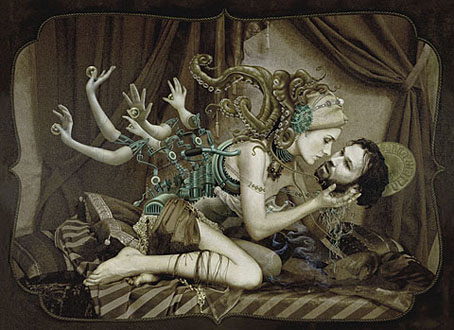
Frustration Attraction (2006).

A Canadian artist works a marvellous variation on Salomé using oils and photo-printed canvas. Lots of other fine, inventive work at her site, all of it shown far too small to see the considerable detail. A tip to artists with websites: let us see the pictures properly; people appreciate it and will spread the word if they like your work. Via Fabulon.

Update: Her site has been relaunched and you can now see a lot more of the detail in her incredible paintings.

Elsewhere on { feuilleton }
The fantastic art archive

Previously on { feuilleton }
Beardsley’s Salomé
Peter Reed and Salomé After Dark
Alla Nazimova’s Salomé

The Palais Lumineux

lumineux.jpg

A final visit to the Exposition Universelle of 1900 with this photograph of the Palais Lumineux, a piece of period Chinoiserie built in the Champ de Mars close to the Eiffel Tower. I forget where I found this tinted view but Wikipedia has what appears to be the same photograph coloured so as to resemble a night scene.

Previously on { feuilleton }
Louis Bonnier’s exposition dreams
Exposition Universelle, 1900
The Palais du Trocadéro
The Evanescent City
Winsor McCay’s Hippodrome souvenirs

Exposition Universelle, 1900

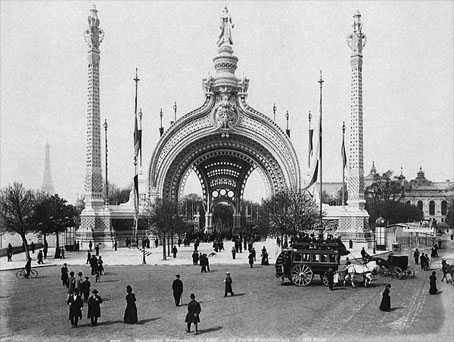
exposition1.jpg

La porte monumentale.

Was the Paris Exposition of 1900 the most gloriously excessive of them all? Judging by these photos it certainly looks it. I should have linked to these earlier when I had a post about the Palais du Trocadéro which was one of the buildings raised for the occasion. The Eiffel Tower was built for the 1889 exposition (and was famously intended to be a temporary structure) but became the centrepiece of the 1900 fair. Wikipedia has a large plan of the entire layout and two of the halls, the Grand and Petit Palais, are still in existence and used as exhibition spaces.

Continue reading “Exposition Universelle, 1900”