So Much Fire to Roast Human Flesh

bast008.jpgJUST IN TIME FOR THE SCHOOL YEAR — ARTHUR MAGAZINE LAUNCHES NEW ALBUM TO BENEFIT COUNTER-MILITARY RECRUITING CAMPAIGNS

“Let’s help give youth a balanced view of what military service REALLY means,” says Arthur editor Jay Babcock.

With wars raging across the Middle East and prospects for peace dimming, the youth of America have wised up and are starting to stay away from military recruiters in droves. Said recruiters have retaliated with aggressive—and often criminal—tactics.

An eye-opening study issued this August by the Government Accountability Office reported that “allegations and service-identified incidents of recruiter wrongdoing” increased almost 50 percent between 2004 and 2005. Criminal violations more than doubled over the same period of time. Increasingly common tactics used by the nation’s 20,000 military recruiters range from lying about the financial benefits of service to threatening high school students with arrest if they back out of an enlistment process already underway. Military recruiters have also been assisting recruits in the falsification of documents to cover up conditions like autism, mental illness and serious drug problems that would bar them from service if reported. [See below for more information.]

Musician Josephine Foster is joining forces with Bastet, the publishing imprint of Arthur magazine, to help give America’s kids and parents the tools they need to protect them from the depredations of the nation’s many unscrupulous military recruiters.

On Tuesday, August 29, Arthur magazine will release So Much Fire to Roast Human Flesh, an 18-track, multi-artist compilation CD curated by Foster featuring exclusive contributions from some of the more outspoken members of the nation’s burgeoning psychedelic folk scene, including Devendra Banhart, Feathers, David Pajo and members of Espers and Spires That in the Sunset Rise. Musicians from earlier generations of the underground, such as Michael Hurley, Kath Bloom and Angels of Light, are also present.

All profits from sales of So Much Fire… will be distributed to specific counter-military recruitment and pacifist organizations and programs who effectively advise high school students and other Americans at risk of being taken advantage of by the military’s recruiters and omnipresent big-budget marketing campaigns.

“All of the musicians represented on So Much Fire… are American citizens,” said Josephine Foster. “Our voices join with many others across this land that freely question and openly oppose war. Hopefully we will raise a good sum of money to help fund the educational pacifist tasks these organizations do. They are dedicated to creating a positive counter to the rising tides of the war being waged. We hope to assist them in their efforts promoting peace and non-militarism in the United States.”

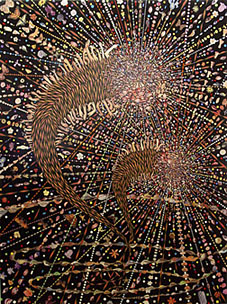
“I am deeply grateful to everyone involved in this gesture; from every musician, to Fred Tomaselli for use of his incredible painting as the cover art, to Jay Babcock and Laris Kreslins at Arthur magazine who so enthusiastically took up this idea and worked to realize it. In the end, all of the labor was donated, including the manufacturing.”

Said Arthur magazine editor Jay Babcock, “We are putting what little money we have where our mouth is. We hope that other people of conscience will do the same.”

The album’s title is taken from a line by the poet Apollinaire, who died from wounds he sustained while serving in World War I.

So Much Fire… is now available for order from Arthurmag.com and, starting August 29, from record stores across North America.

Track listing:

THE CHERRY BLOSSOMS – ‘Dragonfly’ (live)
FEATHERS – ‘Dust’
MICHAEL HURLEY – ‘A Little Bit of Love for You’
MEG BAIRD – ‘Western Red Lily (Nunavut Diamond Dream)’
ANDREW BAR – ‘Don’t Trust That Man’
GOATGIRL – ‘President Combed His Hair’
DEVENDRA BANHART – ‘I Know Some Souls’ (demo)
KATH BLOOM – ‘Baby Let It Come Down On Me’
CHARLIE NOTHING – ‘Fuck You and Your Stupid Wars’
DIANE CLUCK – ‘A Phoenix and Doves’
JOHN ALLINGHAM & ANN TILEY – ‘Big War’
JOSEPHINE FOSTER – ‘Would You Pave the Road?’
ANGELS OF LIGHT – ‘Destroyer’
RACHEL MASON – ‘The War Clerk’s Lament’
PAJO – ‘War Is Dead’
MVEE – ‘Powderfinger’
KATHLEEN BAIRD – ‘Prayer for Silence’
LAY ALL OVER IT – ‘A Place’

Read the GAO report, “Military Recruiting: DOD and Services Need Better
Data to Enhance Visibility over Recruiter Irregularities” here.

High school students, their parents and friends can learn more about
their rights when confronted by recruiters here.
Keith Olbermann channels Ed Murrow

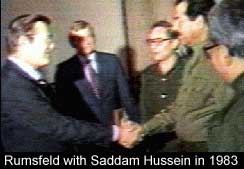
rumsfeldhussein.jpgOn Tuesday, Secretary of Defense Donald Rumsfeld said administration critics suffered from “moral or intellectual confusion.” American TV commentator Keith Olbermann responds. My earlier opinion of Mr Rumsfeld can be seen here.
The man who sees absolutes, where all other men see nuances and shades of meaning, is either a prophet, or a quack.

Donald H. Rumsfeld is not a prophet.

Mr. Rumsfeld’s remarkable speech to the American Legion yesterday demands the deep analysis—and the sober contemplation—of every American.

For it did not merely serve to impugn the morality or intelligence—indeed, the loyalty—of the majority of Americans who oppose the transient occupants of the highest offices in the land. Worse, still, it credits those same transient occupants—our employees—with a total omniscience; a total omniscience which neither common sense, nor this administration’s track record at home or abroad, suggests they deserve.

Dissent and disagreement with government is the life’s blood of human freedom; and not merely because it is the first roadblock against the kind of tyranny the men Mr. Rumsfeld likes to think of as “his” troops still fight, this very evening, in Iraq.

It is also essential. Because just every once in awhile it is right and the power to which it speaks, is wrong.

In a small irony, however, Mr. Rumsfeld’s speechwriter was adroit in invoking the memory of the appeasement of the Nazis. For in their time, there was another government faced with true peril—with a growing evil—powerful and remorseless.

That government, like Mr. Rumsfeld’s, had a monopoly on all the facts. It, too, had the “secret information.” It alone had the true picture of the threat. It too dismissed and insulted its critics in terms like Mr. Rumsfeld’s—questioning their intellect and their morality.

That government was England’s, in the 1930s.

It knew Hitler posed no true threat to Europe, let alone England.

It knew Germany was not re-arming, in violation of all treaties and accords.

It knew that the hard evidence it received, which contradicted its own policies, its own conclusions—its own omniscience—needed to be dismissed.

The English government of Neville Chamberlain already knew the truth.

Most relevant of all—it “knew” that its staunchest critics needed to be marginalized and isolated. In fact, it portrayed the foremost of them as a blood-thirsty war-monger who was, if not truly senile, at best morally or intellectually confused.

That critic’s name was Winston Churchill.

Sadly, we have no Winston Churchills evident among us this evening. We have only Donald Rumsfelds, demonizing disagreement, the way Neville Chamberlain demonized Winston Churchill.

History—and 163 million pounds of Luftwaffe bombs over England—have taught us that all Mr. Chamberlain had was his certainty—and his own confusion. A confusion that suggested that the office can not only make the man, but that the office can also make the facts.

Thus, did Mr. Rumsfeld make an apt historical analogy.

Excepting the fact, that he has the battery plugged in backwards.

His government, absolute—and exclusive—in its knowledge, is not the modern version of the one which stood up to the Nazis.

It is the modern version of the government of Neville Chamberlain.

But back to today’s Omniscient ones.

That, about which Mr. Rumsfeld is confused is simply this: This is a Democracy. Still. Sometimes just barely.

And, as such, all voices count—not just his.

Had he or his president perhaps proven any of their prior claims of omniscience—about Osama Bin Laden’s plans five years ago, about Saddam Hussein’s weapons four years ago, about Hurricane Katrina’s impact one year ago—we all might be able to swallow hard, and accept their “omniscience” as a bearable, even useful recipe, of fact, plus ego.

But, to date, this government has proved little besides its own arrogance, and its own hubris.

Mr. Rumsfeld is also personally confused, morally or intellectually, about his own standing in this matter. From Iraq to Katrina, to the entire “Fog of Fear” which continues to envelop this nation, he, Mr. Bush, Mr. Cheney, and their cronies have—inadvertently or intentionally—profited and benefited, both personally, and politically.

And yet he can stand up, in public, and question the morality and the intellect of those of us who dare ask just for the receipt for the Emporer’s New Clothes?

In what country was Mr. Rumsfeld raised? As a child, of whose heroism did he read? On what side of the battle for freedom did he dream one day to fight? With what country has he confused the United States of America?

The confusion we—as its citizens—must now address, is stark and forbidding.

But variations of it have faced our forefathers, when men like Nixon and McCarthy and Curtis LeMay have darkened our skies and obscured our flag. Note—with hope in your heart—that those earlier Americans always found their way to the light, and we can, too.

The confusion is about whether this Secretary of Defense, and this administration, are in fact now accomplishing what they claim the terrorists seek: The destruction of our freedoms, the very ones for which the same veterans Mr. Rumsfeld addressed yesterday in Salt Lake City, so valiantly fought.

And about Mr. Rumsfeld’s other main assertion, that this country faces a “new type of fascism.”

As he was correct to remind us how a government that knew everything could get everything wrong, so too was he right when he said that—though probably not in the way he thought he meant it.

This country faces a new type of fascism—indeed.

Although I presumptuously use his sign-off each night, in feeble tribute, I have utterly no claim to the words of the exemplary journalist Edward R. Murrow.

But never in the trial of a thousand years of writing could I come close to matching how he phrased a warning to an earlier generation of us, at a time when other politicians thought they (and they alone) knew everything, and branded those who disagreed: “confused” or “immoral.”

Thus, forgive me, for reading Murrow, in full:

“We must not confuse dissent with disloyalty,” he said, in 1954. “We must remember always that accusation is not proof, and that conviction depends upon evidence and due process of law.

“We will not walk in fear, one of another. We will not be driven by fear into an age of unreason, if we dig deep in our history and our doctrine, and remember that we are not descended from fearful men, not from men who feared to write, to speak, to associate, and to defend causes that were for the moment unpopular.”

And so good night, and good luck.

Previously on { feuilleton }
Good Night and Good Luck

Why doesn’t America believe in evolution?

evolution.jpgCould it be something to do with invisible men in the sky? And apes in the White House?
New Scientist reports.

19 August 2006
New Scientist
Jeff Hecht

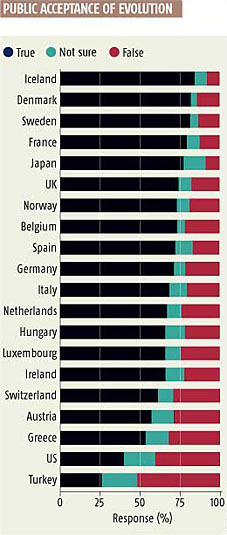
HUMAN BEINGS, AS WE KNOW THEM, developed from earlier species of animals: true or false? This simple question is splitting America apart, with a growing proportion thinking that we did not descend from an ancestral ape. A survey of 32 European countries, the US and Japan has revealed that only Turkey is less willing than the US to accept evolution as fact.

Religious fundamentalism, bitter partisan politics and poor science education have all contributed to this denial of evolution in the US, says Jon Miller of Michigan State University in East Lansing, who conducted the survey with his colleagues. “The US is the only country in which [the teaching of evolution] has been politicised,” he says. “Republicans have clearly adopted this as one of their wedge issues. In most of the world, this is a non-issue.”

Miller’s report makes for grim reading for adherents of evolutionary theory. Even though the average American has more years of education than when Miller began his surveys 20 years ago, the percentage of people in the country who accept the idea of evolution has declined from 45 in 1985 to 40 in 2005 (Science, vol 313, p 765). That’s despite a series of widely publicised advances in genetics, including genetic sequencing, which shows strong overlap of the human genome with those of chimpanzees and mice. “We don’t seem to be going in the right direction,” Miller says.

There is some cause for hope. Team member Eugenie Scott of the National Center for Science Education in Oakland, California, finds solace in the finding that the percentage of adults overtly rejecting evolution has dropped from 48 to 39 in the same time. Meanwhile the fraction of Americans unsure about evolution has soared, from 7 per cent in 1985 to 21 per cent last year. “That is a group of people that can be reached,” says Scott.

The main opposition to evolution comes from fundamentalist Christians, who are much more abundant in the US than in Europe. While Catholics, European Protestants and so-called mainstream US Protestants consider the biblical account of creation as a metaphor, fundamentalists take the Bible literally, leading them to believe that the Earth and humans were created only 6000 years ago.

Ironically, the separation of church and state laid down in the US constitution contributes to the tension. In Catholic schools, both evolution and the strict biblical version of human beginnings can be taught. A court ban on teaching creationism in public schools, however, means pupils can only be taught evolution, which angers fundamentalists, and triggers local battles over evolution.

These battles can take place because the US lacks a national curriculum of the sort common in European countries. However, the Bush administration’s No Child Left Behind act is instituting standards for science teaching, and the battles of what they should be has now spread to the state level.

Miller thinks more genetics should be on the syllabus to reinforce the idea of evolution. American adults may be harder to reach: nearly two-thirds don’t agree that more than half of human genes are common to chimpanzees. How would these people respond when told that humans and chimps share 99 per cent of their genes?

New Scientist magazine, issue 2565.

The Smirking Chimp

bell_bush.jpg

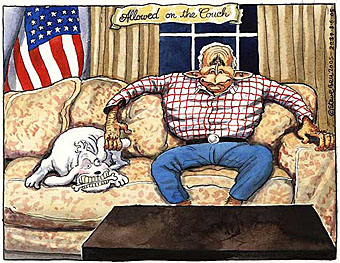
Cartoon by the wonderful Steve Bell.

I keep resolving to stop posting so much political stuff, there’s enough of that elsewhere and generally I’d prefer not to have the names, faces and actions of these miserable wretches polluting my web space. This was too good to miss, however. And this piece of polemic makes a good companion piece.

Jonathan Chait: Is Bush Still Too Dumb to Be President?
You can’t run a country on horse sense.
The Los Angeles Times
July 16, 2006

WAY BACK when he first appeared on the national scene, the rap against George W. Bush was that he might be too dumb to be president. As time passed, questions about Bush’s mental capabilities faded away.

After 9/11, his instinctive rather than analytical view of the world seemed to be just what we needed, and Americans of all stripes were desperate to see heroic qualities in him. (As Dan Rather announced at the time: “George Bush is the president; he makes the decisions; and, you know, as just one American, wherever he wants me to line up, just tell me where.”)

On top of that, Democrats decided it was politically counterproductive to attack Bush’s intelligence. Bruce Reed of the Democratic Leadership Council said in 2002, for instance, that calling Bush dumb “plays directly into Bush’s strength, which is that he comes across as a regular guy.” And so, for most of the last six years, the question of Bush’s intelligence has remained off the table.

Oh, sure, a few of us have brought it up from time to time, but we have generally been dismissed out of hand as wacky Bush-haters. By 2004, the question had been turned around completely. Democrats had almost nothing to say about Bush’s lack of intellect, while Republicans joyfully and repeatedly attacked John Kerry as an egghead. Anti-intellectualism was triumphant.

Yet it is now increasingly clear that Bush’s status as non-rocket scientist is a serious problem. The problem is not his habit – savored by late-night comedians – of stumbling over multisyllabic words. It is his shocking lack of intellectual curiosity.

Ron Suskind’s new book, “The One Percent Doctrine,” paints a harrowing picture of Bush’s intellectual limits. Bush, writes Suskind, “is not much of a reader.” He prefers verbal briefings and often makes a horse-sense judgment based on how confident his briefer seems in what he’s saying. In August 2001, the CIA was in a panic about an upcoming terrorist attack and drafted a report with the title, “Bin Laden Determined to Strike in U.S.” When a CIA staffer summed up the memo’s contents in a face-to-face meeting with Bush, the president found the briefer insufficiently confident and dismissed him by saying, “All right, you’ve covered your ass, now,” according to Suskind. That turned out to be a fairly disastrous judgment.

Bush loyalists like to dismiss Suskind’s reporting, but it jibes with the picture that has emerged from other sources. L. Paul Bremer III’s account of his tenure as head of Iraq’s Coalition Provisional Authority depicts Bush as uninterested in the central questions of rebuilding and occupying the country.

Video of a presidential meeting that came to light this year showed Bush being briefed on the incipient Hurricane Katrina. His subordinates come off as deeply concerned about a potential catastrophe, but Bush appears blase, declining to ask a single question. And of course there was the famous 2001 incident in which Russian President Vladimir Putin conveyed to Bush a story of being given a cross by his mother. Bush invested deep significance in the story. “I found him to be very straightforward and trustworthy,” he told reporters. “I was able to get a sense of his soul.”

Bush’s supporters have insisted for the last six years that liberal derision of the president’s intelligence amounts to nothing more than cultural snobbery. We don’t like his pickup truck and his accent, the accusation goes, so we hide our blue-state prejudices behind a mask of intellectual condescension.

But the more we learn about how Bush operates, the more we can see we were right from the beginning. It matters that the president values his gut reaction and disdains book learnin’. It’s not just a question of cultural style. The president’s narrow intellectual horizons have real consequences, sometimes cataclysmic ones.

It’s true that presidents can succeed without being intellectuals themselves. The trouble is that Bush isn’t just a nonintellectual, he viscerally disdains intellectuals. “What angered me was the way such people at Yale felt so intellectually superior and so righteous,” he told a Texas Monthly reporter in 1994.

When I went to college at Michigan, I occasionally played pickup basketball with varsity football players. They obviously felt athletically superior to me. I didn’t resent them for it – because they were.