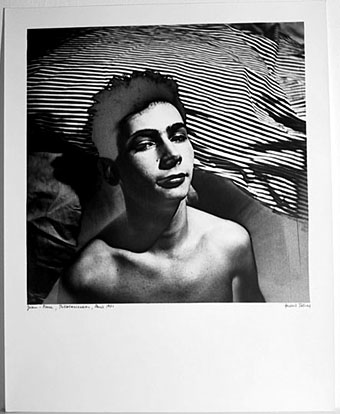
Ruben photographed by Jose Manchado.
A journal by artist and designer John Coulthart.

Photography
Ruben photographed by Jose Manchado.
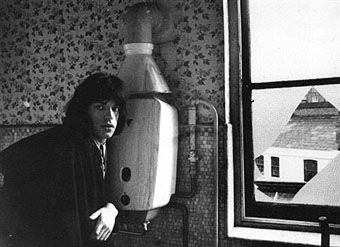
Mick Jagger by Cecil Beaton (1968).
Donald Cammell thought Mick Jagger to be a more provocative rock star than Elvis Presley because Jagger was willing to experiment with his masculinity. Elvis, although extraordinarily erotic to a generation of young women, never did. What this difference suggests, among other things, is that Mick Jagger’s appeal is not Elvis’s—and never was. Critic Greil Marcus has argued that what Elvis did was to purge the Sunday morning sobriety from folk and country music and to purge the dread from blues; in doing so, he transformed a regional music into a national music, and invented party music. Elvis popularized an amalgam of musical forms and styles into “rock’n’roll,” a black American euphemism for sexual intercourse. What the Rolling Stones did to rock music, some years after Elvis made sex an integral part of its appeal, was to infuse rock with a bohemian theatricality, at first through Brian Jones, who was the first British pop star to cultivate actively a flamboyant, androgynous image. For a time, Brian even found his female double in Anita Pallenberg. Brian Jones and the Stones thus re-introduced into rock music its erotic allure, and hence made it threatening (again).
From an excellent piece by Sam Umland for PERFORMANCE: A Photographic Exhibition featuring the work of Donald Cammell and Nicolas Roeg at the Drkrm. Gallery, Los Angeles, opening on January 20th. Umland wrote the recent biography of Donald Cammell with Rebecca Umland (published by Fab Press) for which I designed the cover. Featured in the exhibition are prints from the Del Valle Archive, including eleven photographs of Mick Jagger taken by Cecil Beaton when Performance was being filmed.
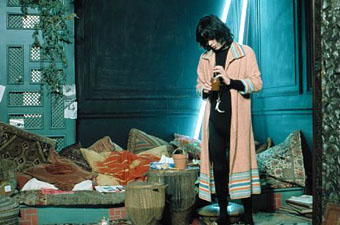
“When are Warner Brothers going to do the right thing and release Performance on DVD?” I asked in April last year. Well now they are, although it remains to be seen which version of the film has been used; several exist, some of them shorter than others. Release is scheduled for February 13th in the US and March 12th in the UK.
PERFORMANCE: A Photographic Exhibition
featuring the work of Donald Cammell and Nicolas Roeg
January 20-February 24, 2007
Drkrm. Gallery
2121 San Fernando Road
Suite 3
Los Angeles
CA 90065
Previously on { feuilleton }
• Quite a performance
• Borges in Performance
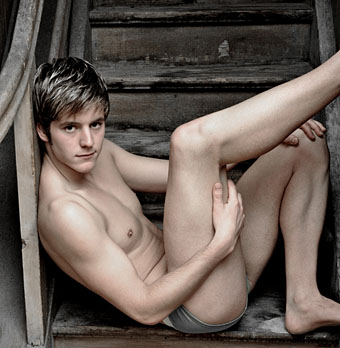
Samuel photographed by Sandro Bross.
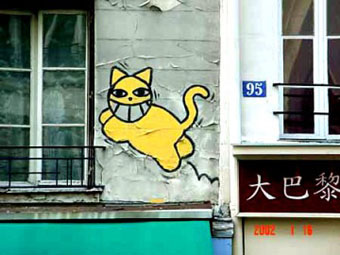
Who or what is the mysterious, grinning yellow cat? Wikipedia explains:
M. Chat (also known as Monsieur Chat and Mr Chat) is the name of a graffiti cat that appeared in Paris and other European cities in the months and years following the 9/11 terrorist attacks. The graffiti appeared most frequently on chimneys, but has been sighted in other places such as train platforms as well. It has also made appearances at political rallies. The originator of the street art remains anonymous.
The yellow cartoon cat is characterized by its large Cheshire Cat grin. The cat is most often portrayed in a running pose, but has also been variously depicted waving signal flags, bouncing on a ball, sporting angel wings, and waving in greeting at the entrance to a train station. It is sometimes accompanied by the tagline M. CHAT in small letters.
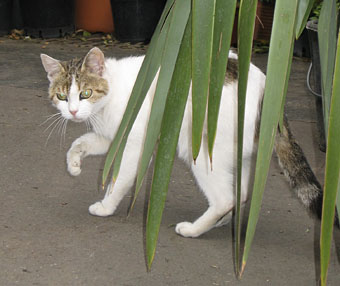
A shame I didn’t discover this phenomenon before I went to Paris last year, the city is cluttered with reproductions of Théophile Steinlen’s Chat Noir poster so it would have been fun to look for a more subversive animal. I found the wary creature below near the gardening market on the Ile de la Cité.
French filmmaker Chris Marker is famously a feline aficionado so it’s no surprise that he’s made a documentary entitled The Case of the Grinning Cat (Chats perchés) examining the appearance of M Chat through the twin lenses of his video camera and his political concerns. A French site, Monsieur Chat (et autres…), similarly documents occurrences of the mysterious animal and this is their page about Marker’s film. Finally, there’s a Flickr pool although with fewer photographs than one might hope.
Via City of Sound.
Update: Monsieur Chat’s creator revealed (in French).
Previously on { feuilleton }
• Sans Soleil