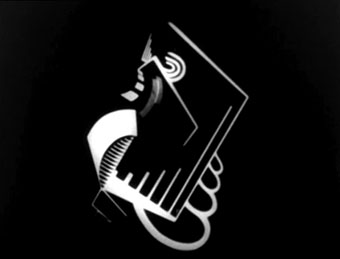
Symphonie Diagonale by Viking Eggeling

eggeling.jpg

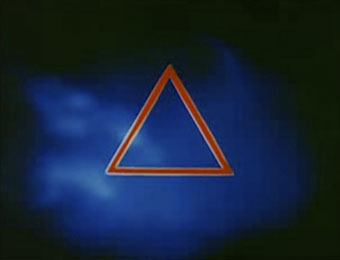
This early piece of abstract cinema from 1924 is available for viewing in several locations—YouTube and Ubuweb have copies—but the best version can be seen at Europa Film Treasures. The film was originally silent so don’t feel too bad about watching with the sound off or with your own score to replace those which were added later.

Born in Sweden to a family of German origin, Viking Eggeling emigrated to Germany at the age of 17, where he became a bookkeeper, and studied art history as well as painting. From 1911 to 1915 he lived in Paris, then moved to Switzerland at the outbreak of World War I. In Zurich he became a associated with the Dada movement, became a friend of Hans Richter, Jean Arp, Tristan Tzara, and Marcel Janco. With the end of the Great War he moved to Germany with Richter where both explored the depiction of movement, first in scroll drawings and then on film. In 1922 Eggeling bought a motion picture camera, and working without Richter, sought to create a new kind of cinema. Axel Olson, a young Swedish painter, wrote to his parents in 1922 that Eggeling was working to “evolve a musical-cubistic style of film—completely divorced from the naturalistic style.” In 1923 he showed a now lost, 10 minute film based on an earlier scroll titled Horizontal-vertical Orchestra. In the summer of 1923 he began work on Symphonie Diagonale. Paper cut-outs and then tin foil figures were photographed a frame at a time. Completed in 1924, the film was shown for the first time (privately) on November 5. On May 3, 1925 it was presented to the public in Germany; sixteen days later Eggeling died in Berlin. For more on Eggeling see the book Viking Eggeling 1880–1925 by Louise O’Konor.

Elsewhere on { feuilleton }
The abstract cinema archive

Mary Ellen Bute: Films 1934–1957

bute.jpg

Mary Ellen Bute.

Last week I noted the appearance at Ubuweb of Mary Ellen Bute’s little-seen Passages from James Joyce’s Finnegans Wake. News comes this week of an exhibition of her abstract films at sketch, London.

sketch presents the first gallery survey exhibition of abstract film by Mary Ellen Bute (b. Houston, Texas 1906, d. 1983).

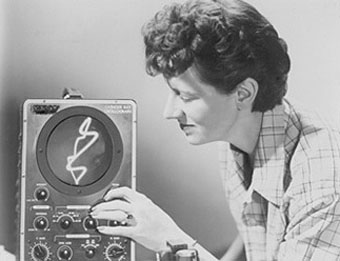
From 1934–1957 Mary Ellen Bute made fourteen short films pioneering techniques with light, sound and the moving image. Her work involved collaborating with artists, musicians, inventors and others who adopted a scientific experimental approach to creating sound and optical effects. In addition to sampling hand processes such as drawing and painting directly on film the work features imagery created automatically by a custom-built, cathode-ray oscilloscope. She can one of the first woman artists to experiment with the medium but unlike contemporaries Hans Richter (b. 1888), Len Lye (b. 1901) and Oskar Fischinger (b. 1900) her work remains largely unknown. This exhibition brings together a complete chronology of her abstract films, most of which have never been shown in Britain and for the first time will present her work as a multi-screen installation using sketch’s twelve projectors. This exhibition has been curated by Michelle Cotton who has included Bute’s work in survey of artist film distributed by the Independent Cinema Office. Essentials: Modernity will be released nationwide later this year.

A publication featuring essays and previously unpublished material will be published by ALMANAC to be launched in September 2008. ALMANAC is curatorial studio and independent imprint run by Andres Bonacina, Victoria Brooks, James Lambert & Anne Low.

The exhibition runs from 26 July to 13 September, 2008.

bute2.jpg

Synchromy No. 4: Escape.

For those of us not in London, there’s always YouTube which has a small selection of Ms Bute’s work and in decent quality for once. The two later colour films are especially worth watching; Tarantella was a collaboration with Norman McLaren while Synchromy No. 4 used Bach’s Toccata and Fugue in D Minor two years before Disney’s similar sequence in Fantasia.

Mary Ellen Bute on YouTube:
Rhythm in Light (1934)
Dada (1936)
Synchromy No. 4: Escape (1938)
Tarantella (1940)

Elsewhere on { feuilleton }
The abstract cinema archive

Norman McLaren

mclaren1.jpg

Pas de Deux (1968).

News of a theatre piece celebrating the creativity of Norman McLaren, the pioneering Scots (and gay) animator and film-maker, had me searching YouTube again for his work. His short film Neighbours (1952) is very well-known, oft-cited and imitated for its pixillated character movement. No surprise to see it there, then, along with other works such as Boogie Doodle (1941), Fiddle Dee Dee (1947), A Phantasy (1952), Blinkety Blank (1955) and several others.

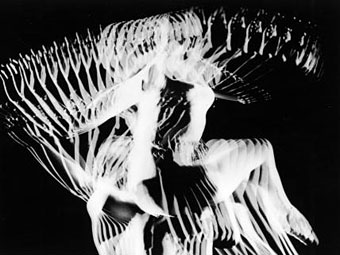
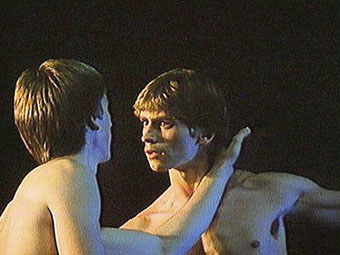
Less well-known is a favourite film of mine which hadn’t been YouTubed last time I looked but which is now there in two parts, Pas de Deux (1968). This is a black and white film of a simple ballet performance transformed by its presentation to yield something that could only exist on film. Careful lighting, an atmospheric score, judicious use of slow motion and the stunning application of optical printing to multiply and mirror the figures makes one of the best ballet films I’ve ever seen; it was also one of McLaren’s personal favourites among his many films. He used slow motion again for two more dance works, Ballet Adagio (1972) and Narcissus (1983), one of his final films which impresses for its overt homoerotics but is less striking than its predecessor. The only version of the latter on YouTube is this scratch version with the visuals set to more recent music.

mclaren2.jpg

Narcissus (1983).

The best way to see McLaren’s incredible films is at a decent resolution, of course, and the National Film Board of Canada have made them available on a seven-DVD box set.

mclaren3.jpg

The theatre work mentioned above is Norman by Michel Lemieux and Victor Pilon which is at Macrobert, Stirling, from 17–19 April, 2008 then the Theatre Royal, Brighton from 6–10 May, 2008.

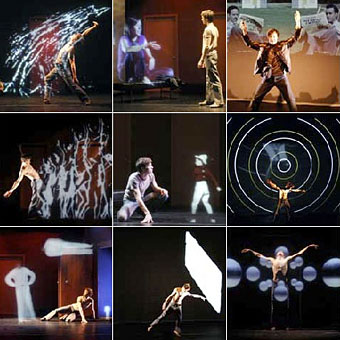
In an improbable act of theatrical alchemy, dancer/choreographer Peter Trosztmer literally inhabits McLaren’s cinematic universe. He dances, weaves, converses and interacts with the animator’s pulsing images and leaping figures, set loose in a riotous ballet of line, light and movement.

Previously on { feuilleton }
Reflections of Narcissus

John Whitney’s Catalog

whitney.jpg

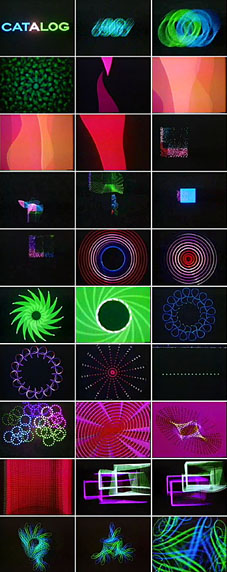
YouTube keeps turning up the abstract cinema goods with this great seven-minute John Whitney showreel from 1961. And recent additions include a better copy of Whitney’s Arabesque as well as Permutations from 1966.

Update: Two masterpieces by John Whitney’s brother, James, Yantra and Lapis, are now on YouTube at last!

Elsewhere on { feuilleton }
The abstract cinema archive

The Demon Regent Asmodeus

demon_regent.jpg

The Demon Regent Asmodeus (2006).

Alan Moore readers have finally discovered my little easter egg on the Mindscape of Alan Moore DVD so I can now talk about the creation of this miniature work. Director Dez Vylenz and I thought it would be nice to have a hidden extra somewhere on the main disc and this was the result.

am.jpg

Glykon and Asmodeus by Alan Moore (1994).

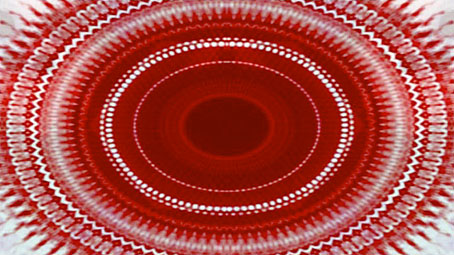
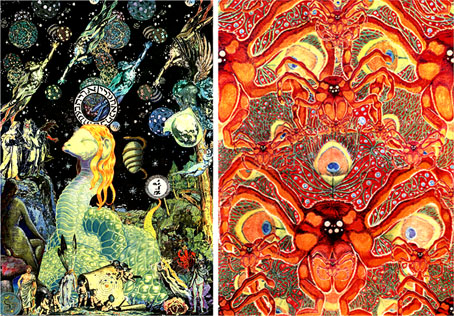
I’d always liked the Asmodeus section that Alan reads on the first Moon & Serpent CD and had the idea for some kind of animation based around the reading using his 1994 portrait of Asmodeus for the visuals. I used Apple’s Motion application for the animation of the DVD menus and it was this application that also animated the three-minute film. Alan’s picture was the sole source for all the visuals even though for most of the running time these are a kaleidoscopic mesh of circles and hexagons. The reading (with sound effects by Tim Perkins) works symmetrically, building to a central point then reversing itself so that the words from the first half are read in reverse order. I followed this scheme with the animation; the film begins in abstraction, evolves into the Asmodeus portrait then devolves back into abstraction. There’s also a symmetrical split to the visuals which are matched along a vertical axis in the centre of the screen. I had James Whitney’s Lapis in mind when creating these circular patterns although Whitney’s forty-year-old film remains abstract throughout. Whitney’s film was also done the hard way, one frame at a time, without the luxury of computer filters.

The Mindscape of Alan Moore is available via mail order from Shadowsnake Films.

Previously on { feuilleton }
Alan Moore in Arthur magazine
Of Moons and Serpents
Lapis by James Whitney