Bridges-Go-Round, a film by Shirley Clarke

clarke

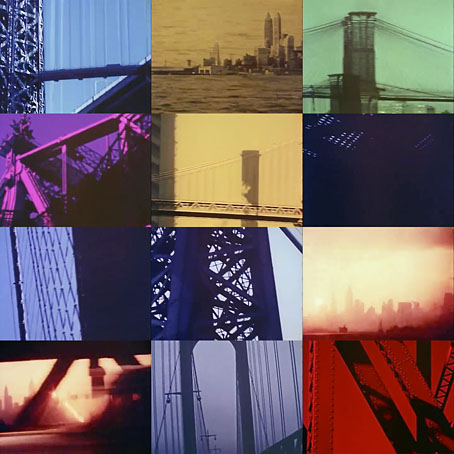
Bridges-Go-Round (1958) is a short but beguiling film that makes New York’s bridges seem like huge pieces of kinetic sculpture. The version linked here is also unusual for being two films in one: the film repeats itself with identical visuals but a different soundtrack. The first version is scored by a jazz piece from composer and producer Teo Macero, the second has electronic music by Louis and Bebe Barron that sounds very similar to their all-electronic score for Forbidden Planet (1956). When the music changes the film seems to change with it.

Previously on { feuilleton }
NY, NY, a film by Francis Thompson

Somnambulists, a film by Mieczyslaw Waskowski

waskowski.jpg

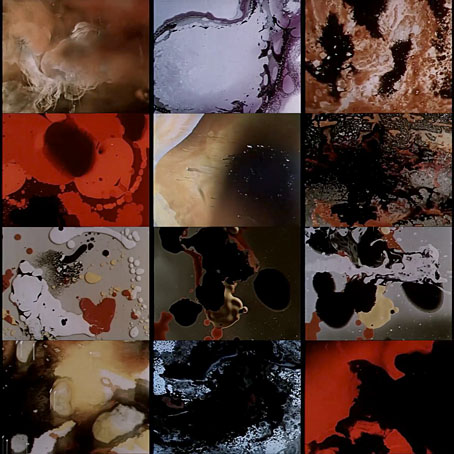
This 9-minute film by Polish actor and director Mieczyslaw Waskowski was made in 1958. At that time Waskowski’s swirling blobs of paint in oil or water would have seemed merely abstract; a decade on and they would have unavoidable psychedelic or even cosmic connotations. Stanley Kubrick used similar effects for some of the shots in the Star Gate sequence of 2001: A Space Odyssey only at much higher resolution and camera speed.

Elsewhere on { feuilleton }
The abstract cinema archive

NY, NY, a film by Francis Thompson

nyny1.jpg

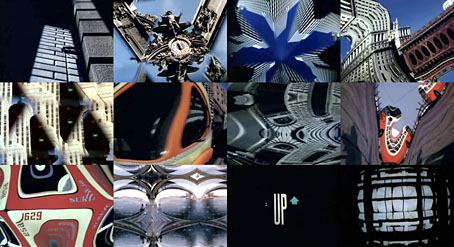
In Heaven and Hell (1956) Aldous Huxley considers various forms of art that might be said to imitate or resemble the intense visuals generated by psychedelic agents. In past centuries this would include firework displays and the vivid hues of stained glass windows; when discussing the present, mention is made of NY, NY, a short film by Francis Thompson that Huxley had recently seen.

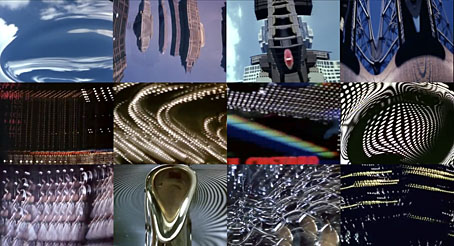
Thompson’s film presents a day in the life of New York City with every shot being subject to some form of distortion or fragmentation via prismatic lenses or reflected surfaces. Nearly sixty years later this seems less psychedelic than it would have done to Huxley, although some of the reflections give the same effects as Ira Cohen’s later Mylar Chamber photographs. Watch NY, NY here, and if you do I’d recommend muting the Mickey Mouse score.

nyny2.jpg

Previously on { feuilleton }
Fog Line, a film by Larry Gottheim
Wavelength
La Région Centrale

Walter Ruttmann’s abstract cinema

ruttmann1.jpg

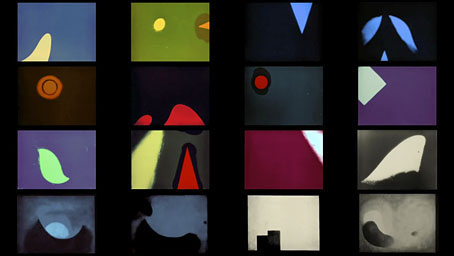
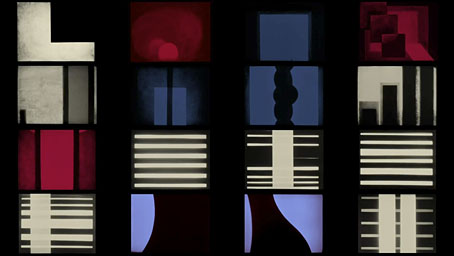
Histories of abstract cinema often begin with Oskar Fischinger, a filmmaker and animator who was certainly a pioneer of the form. But these four silent shorts by Walter Ruttmann (1887–1941), Lichtspiel: Opus I, II, III & IV (1921–25) predate Fischinger’s work, and also prefigure Fischinger’s own animations of swooping shapes, blooming circles and stabbing triangles. Ruttmann’s abstractions are very sophisticated considering they’re such early examples of this type of experimental cinema. Some of the sequences in Opus IV resemble the kinds of graphics seen during title sequences in TV programmes of the 1960s.

ruttmann2.jpg

Elsewhere on { feuilleton }
The abstract cinema archive

Continu-discontinu 2010, a film by Piotr Kamler

continu.jpg

A recent film by Piotr Kamler that’s not on the DVD collection from aaa, Continu-discontinu 2010 is a short animation that’s a lot more abstract than Kamler’s earlier works although you might detect the director’s hand in the motion of some of its wandering particles. In place of the electronic scores that soundtrack many of his films there’s a recording of a viol piece composed by Marin Marais.

Previously on { feuilleton }
L’Araignéléphant
Le labyrinthe and Coeur de secours
Chronopolis by Piotr Kamler