Ave Atque Vale!

ave.jpg

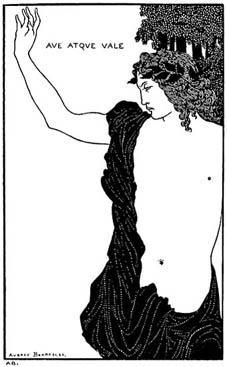
Aubrey Beardsley illustrates Catullus for The Savoy, no. 7 (1896).

Farewell then, Mister Aitch, now he’s decided to call it a day at the wonderful and unique Giornale Nuovo. He’d been blogging (must we call it that? It seems we must…) for five years which probably makes him first generation in the concentrated timescale of web-existence. Five years is a long time to be doing anything never mind regularly throwing hard-won morsels of research to the browsing hordes.

His posts will be missed here since it was his journal, along with a handful of others (Bldg Blog, The Nonist, BibliOdyssey among them), which confirmed for me that this discipline could have a purpose beyond mere diaristic vanity, something I enjoy reading but had no desire to engage in myself. One of the specialist concerns at Giornale Nuovo was the etching or engraving and Mister Aitich managed to cover this area so comprehensively I frequently found that artists I’d considered writing about were already discussed there in far greater detail than I could summon the energy (or the book resources) for myself. Those book resources are a thing of wonder and I remain eternally jealous of Mister Aitch’s library.

Happily Giornale Nuovo will remain online as an archive, which is good to hear. This raises again the spectre of what’s to happen to all this energy and activity when we let it go. Books regularly outlive their creators but all these fragile electronic media are dependent on the whims of webhosts and developing technology. Do we want this work to survive for the benefit of future historians or not? Or should we celebrate it as ephemeral and transient? What happens when the web advances beyond Unix networks, PHP and HTML? The British Library has already expanded its deposit scheme to encompass electronic works but online publications differ from their paper equivalent in that the publisher—legally obliged in the UK to send one copy of every printed volume to the British Library—is invariably also the author. What happens if the author dies before they have a chance to submit their work which then sinks into the swamp of a billion other weblogs? When do you decide to submit a work which is forever unfinished?

I’ll leave those questions to librarians and the scholars at the Long Now Foundation who consider some of the issues presented by the prospective obsolescence of present technology. In the meantime we’ll raise a farewell toast to Mister Aitch and wish him all the very best. Don’t be hesitant in browsing his archives, there’s a wealth of eclectic, eccentric and neglected culture there deserving of your attention.

“Weirdsley Daubery”: Beardsley and Punch

punch1.jpg

Britannia à la Beardsley by ET Reed (1895).

Pickings grow slim for the dedicated Beardsleyphile after you’ve bought a few books. Despite his prolific career, Aubrey B was dead at 25 and the better collections of his work, especially Brian Reade’s essential monograph, Beardsley (1967), tend to contain almost his entire corpus, juvenilia and all. So you find yourself seeking out the work of his imitators, his successors, and even the weak but not altogether unsuccessful “Nichols” fakes from the 1920s.

Continue reading ““Weirdsley Daubery”: Beardsley and Punch”

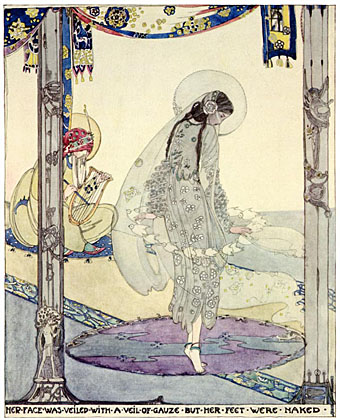
The art of Jessie M King, 1875–1949

pomegranates.jpg

The Fisherman and His Soul : Her Feet were Naked
from A House of Pomegranates by Oscar Wilde, 1915.

A delicate piece of Orientalism illustrating Wilde’s book of fairy tales. Jessie Marion King’s work is a fascinating amalgam of the decorative post-Beardsley style exemplified by Harry Clarke and the Glasgow Style of Charles Rennie Mackintosh’s Arts and Crafts movement. It’s unfortunate that her associations with Mackintosh sometimes overshadow her career as an illustrator despite her being as talented and productive as many of her male contemporaries.

The rest of the Wilde illustrations can be seen at Art Passions along with a number of other works.

Jessie M King biography page

Elsewhere on { feuilleton }
The illustrators archive

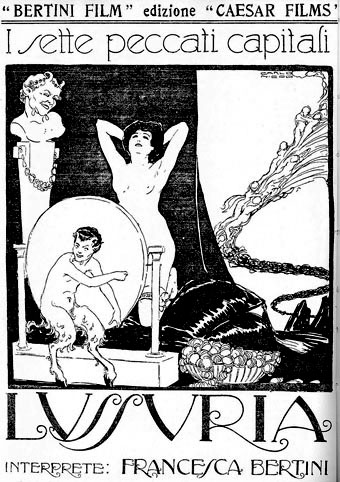
Lussuria, Invidia, Superbia

lussuria.jpg

Or Lust (1919), Envy (1919) and Pride (1918). Very Beardsley-esque posters by Carlo Nicco for a series of Italian films from the silent era starring Francesca Bertini. Doubtless the prolific Ms. Bertini’s demonstrations of the Seven Deadly Sins inspired similar promotional artwork for the other films in the series but these are the only ones visible from this Flickr collection of Italian cinema memorabilia. As with Alla Nazimova’s Salomé (and Gabriel D’Annunzio’s excessive Salammbô-esque epic, Cabiria), this confirms again that fin de siècle Decadence lived on in the early days of cinema, having been banished (for a time) from the worlds of art and literature.

Via Fabulon. (Thanks Thom!)

Continue reading “Lussuria, Invidia, Superbia”

The art of Takato Yamamoto

yamamoto1.jpg

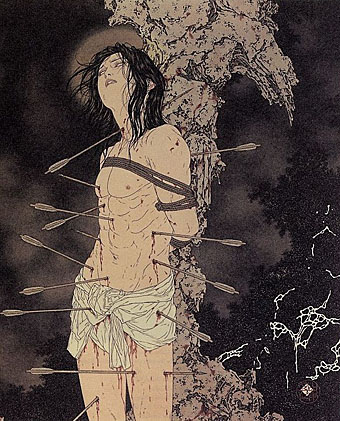
Takato Yamamoto was born in Akita prefecture (Japan) in 1960. After graduating from the painting department of the Tokyo Zokei University, he experimented with the Ukiyo-e Pop style. He further refined and developed that style to create his “Heisei Esthiticism” style. His first exhibition was held in Tokyo, in 1998.

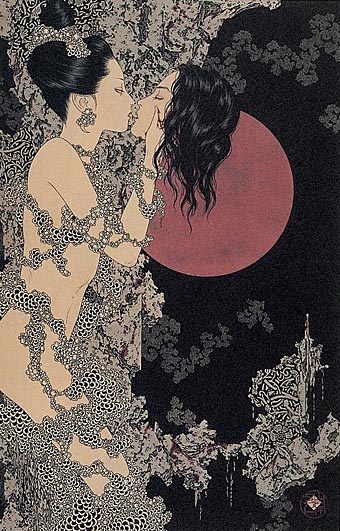
There’s much that’s superficially familiar in Takato Yamamoto’s art—“Boy’s Love” tableaux with fey young men in various states of undress mooning over each other, then the perennial Japanese obsession with naked women bound by ropes. But closer examination reveals a degree of finesse and imagination that elevates his work away from the porn ghetto into the rarified realm of Decadence (as if those favourite Symbolist themes of Saint Sebastian [above] and Salomé [below] weren’t enough of a clue). For a start the drawing style is a great amalgam of influences from Beardsley through to Harry Clarke by way of the finest Edwardian pornographer, Franz von Bayros. Then there’s the curious details of severed heads, claws, sundry bones and eyeballs which decorate the otherwise florid arrangements supporting the figures. So far there don’t appear to have been any books of Takato Yamamoto’s work produced in the west and it’s possible that the sexual content and grotesquery limits that possibility. But you can some galleries here, here and here. His official site is mostly Japanese and has to be navigated from an interior page since there seems to be a file missing from the index.

yamamoto2.jpg

Continue reading “The art of Takato Yamamoto”